

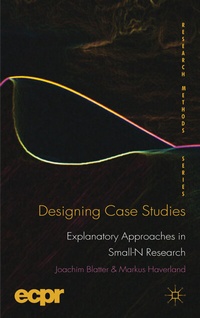
Designing Case Studies
Description

Reviews / Votes
"Hardly any subfield of political science methods has witnessed such dynamic development in recent years as the literature on case study designs. Case studies have always been at the core of central advances in political sciences research, but only in recent
years have the methodological underpinnings been elaborated on in corresponding depth. The book by Joachim Blatter and Markus Haverland contributes significantly to this field of study in two ways: firstly, it suggests a new, convincing typology of case studies; and secondly, it takes the 'designing' aspect of its title seriously by including many case studies from political science research to provide practical illustrations of their three suggested modes of designing case studies." - Julian Junk, West European Politics, 36:4, 893-894
More details
Other editions
Additional editions
Persons
Markus Haverland is Professor of Political Science, Department of Public Administration, Erasmus University Rotterdam, The Netherlands, and lectures on methodology at the Dutch Graduate School for Public Administration and Political Science (NIG) there. Amongst his previous positions was a Jean Monnet Fellowship at the European University Institute, Florence. His research interests include methodology, European Union policy-making, and the effect of the European Union on its member states.
