

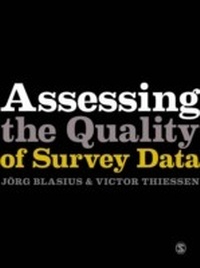
Assessing the Quality of Survey Data
1st Edition
Published on 21. February 2012
192 pages
978-1-4462-9232-7 (ISBN)
Description

This is a book for any researcher using any kind of survey data. It introduces the latest methods of assessing the quality and validity of such data by providing new ways of interpreting variation and measuring error. By practically and accessibly demonstrating these techniques, especially those derived from Multiple Correspondence Analysis, the authors develop screening procedures to search for variation in observed responses that do not correspond with actual differences between respondents. Using well-known international data sets, the authors exemplify how to detect all manner of non-substantive variation having sources such as a variety of response styles including acquiescence, respondents' failure to understand questions, inadequate field work standards, interview fatigue, and even the manufacture of (partly) faked interviews.
Reviews / Votes
This is an innovative book. Blasius and Thiessen show how careful data-analysis can uncover defects in survey data, without having recourse to meta-data or other extra information. This is good news for researchers who work with existing data sets and wish to assess their qualityJoop Hox
Professor of social science methodology, Utrecht University
'This illuminating and innovative book on the quality of survey data focuses on screening procedures that should be conducted prior to assessing substantive relations. Numerous tables and visual displays based on appropriate analyses show convincing examples of procedural deficiencies, data duplicates, and faked interview, and unusual patterns in well known international datasets. Blasius and Thiessen discuss openly what is mostly covered in survey reporting, and they show ways to improve the reliability of conclusions based on survey data. A must for survey practitioners and users
Jaak Billiet
Emeritus professor in social methodology, University of Leuven
'I hope that many social science researchers will read Joerg Blasius and Victor Thiessen's book and realize the importance of the lesson it provides, which is that many of our data sets contain serious errors which may lead to wrong conclusions if not wrong theories. Applying the suggested tests can prevent this.
Willem Saris
Director of RECSM, Universitat Pompeu Fabra, Barcelona
This is an important, groundbreaking analysis of survey data quality that serves as an indispensable vade mecum for anyone engaged in gathering, analysing or utilising survey data. Clearly quality is not always what is appears to be... Assessing the Quality of Survey Data... addresses this issue in far more detail than any other work known to this reviewer.
Maryam Nazari and G. E. Gorman
Online Information Review
Assessing the Quality of Survey Data has been written for all researchers who want to be good data detectives... This book has some considerable strengths. It really got me to reflect on the assumptions I had made about data sets I had handled. It highlighted how relatively easy it is to spot data issues early on in analysis. It also made me think of response style challenges to be more than a survey design/sampling issues and to include much more data screening. Although I won't be setting up my own detective agency, I have certainly picked up some sleuthing tips.
Catherine Owens
SR: Reviews
All prices
More details
Series
Edition
1. Auflage
Language
English
Place of publication
London
United Kingdom
Target group
College/higher education
Professional and scholarly
Product notice
Reflowable
ISBN-13
978-1-4462-9232-7 (9781446292327)
Copyright in bibliographic data and cover images is held by Nielsen Book Services Limited or by the publishers or by their respective licensors: all rights reserved.
Schweitzer Classification
Other editions
Additional editions
Joerg Blasius | Victor Thiessen
Assessing the Quality of Survey Data
Book
02/2012
1st Edition
SAGE Publications Ltd
€230.27
Shipment within 15-20 days
Joerg Blasius | Victor Thiessen
Assessing the Quality of Survey Data
Book
02/2012
1st Edition
SAGE Publications Ltd
€111.10
Shipment within 15-20 days
Persons
Joerg Blasius is a professor of Sociology at the Institute for Political Science and Sociology, University of Bonn, Germany. His research interests are mainly focused on explorative data analysis, especially correspondence analysis and related methods, data collection methods, sociology of lifestyles, and urban sociology. He is a coeditor of the SAGE Series "Survey Research Methods in the Social Sciences." Together with Michael Greenacre (University Pompeu Fabra, Barcelona), he founded Carme (Correspondence Analysis and Related Methods Network, see www.carme-n.org). From 1998 to 2016, he belonged to the Board of RC33 (Research Committee on Logic and Methodology in Sociology) of the ISA (International Sociological Association), from 2006 to 2010 he served as president. Website: https://www.politik-soziologie.uni-bonn.de/de/personal/Prof.-Dr.-Joerg-Blasius
Content
Conceptualizing Data Quality: Respondent Attributes, Study Architecture, and Institutional Practices
Conceptualizing Response Quality
Study Architecture
Institutional Quality Control Practices
Data Screening Methodology
Chapter Outline
Empirical Findings on Quality and Comparability of Survey Data
Response Quality
Approaches to Detecting Systematic Response Errors
Questionnaire Architecture
Cognitive Maps in Cross-Cultural Perspective
Conclusion
Statistical Techniques for Data Screening
Principal Component Analysis
Categorical Principal Component Analysis
Multiple Correspondence Analysis
Conclusion
Institutional Quality Control Practices
Detecting Procedural Deficiencies
Data Duplication
Detecting Faked and Partly Faked Interviews
Data Entry Errors
Conclusion
Substantive or Methodology-Induced Factors? A Comparison of PCA, CatPCA and MCA Solutions
Descriptive Analysis of Personal Feelings Domain
Rotation and Structure of Data
Conclusion
Item Difficulty and Response Quality
Descriptive Analysis of Political Efficacy Domain
Detecting Patterns with Subset Multiple Correspondence Analysis
Moderator Effects
Conclusion
Questionnaire Architecture
Fatigue Effect
Question Order Effects
Measuring Data Quality: The Dirty Data Index
Conclusion
Cognitive Competencies and Response Quality
Data and Measures
Response Quality, Task Simplification and Complexity of Cognitive Maps
Conclusion
Conclusion
Conceptualizing Response Quality
Study Architecture
Institutional Quality Control Practices
Data Screening Methodology
Chapter Outline
Empirical Findings on Quality and Comparability of Survey Data
Response Quality
Approaches to Detecting Systematic Response Errors
Questionnaire Architecture
Cognitive Maps in Cross-Cultural Perspective
Conclusion
Statistical Techniques for Data Screening
Principal Component Analysis
Categorical Principal Component Analysis
Multiple Correspondence Analysis
Conclusion
Institutional Quality Control Practices
Detecting Procedural Deficiencies
Data Duplication
Detecting Faked and Partly Faked Interviews
Data Entry Errors
Conclusion
Substantive or Methodology-Induced Factors? A Comparison of PCA, CatPCA and MCA Solutions
Descriptive Analysis of Personal Feelings Domain
Rotation and Structure of Data
Conclusion
Item Difficulty and Response Quality
Descriptive Analysis of Political Efficacy Domain
Detecting Patterns with Subset Multiple Correspondence Analysis
Moderator Effects
Conclusion
Questionnaire Architecture
Fatigue Effect
Question Order Effects
Measuring Data Quality: The Dirty Data Index
Conclusion
Cognitive Competencies and Response Quality
Data and Measures
Response Quality, Task Simplification and Complexity of Cognitive Maps
Conclusion
Conclusion
