

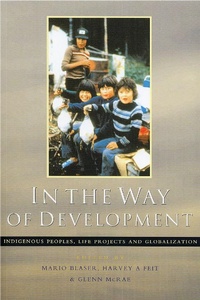
In the Way of Development
Indigenous Peoples, Life Projects and Globalization
1st Edition
Published on 29. February 2008
384 pages
978-1-84813-103-3 (ISBN)
Description

A collaboration between indigenous leaders, social activists and scholars from a wide range of disciplines, In the Way of Development explores the current situation of indigenous peoples enmeshed in the remorseless expansion of the modern economy.
The volume assembles a rich diversity of statements, case studies and wider thematic explorations all starting with indigenous peoples as actors, not victims. The accounts come primarily from North America, but include also studies from South America, and the former Soviet Union.
In the Way of Development shows how the boundaries between indigenous peoples' organizations, civil society, the state, markets, development and the environment are ambiguous and constantly changing. This fact makes local political agency possible, but also, ironically, opens the possibility of undermining it.
The volume assembles a rich diversity of statements, case studies and wider thematic explorations all starting with indigenous peoples as actors, not victims. The accounts come primarily from North America, but include also studies from South America, and the former Soviet Union.
In the Way of Development shows how the boundaries between indigenous peoples' organizations, civil society, the state, markets, development and the environment are ambiguous and constantly changing. This fact makes local political agency possible, but also, ironically, opens the possibility of undermining it.
Reviews / Votes
This superb book builds on the illuminating contrast between the "life projects" of indigenous people and the "development projects" funded by global capital. "Life projects" are about the right of any people to define the meaning of their life and their place in the cosmos. The book is filled with ambiguous but sometimes hopeful examples of indigenous peoples working with NGOs, governments, and corporations to defend their autonomy, and in the process shaping human rights and development agendas nationally and globally * John H. Bodley, Washington State University * A comprehensive account of relations between agents of globalization - corporations and states - and indigenous peoples worldwide. * Michael Asch, University of Victoria * The book's critique of Western development assumptions, its emphasis on subordinated people's own agency and its insistence on holistic, context-driven understandings are all highly relevant to the human endeavour of acquring knowledge in general and improving teaching and learning, especially among those not succeeding in today's hegemonic culture and market. * Richard H. Daly, Studies in Continuing Education *More details
Edition
1. Auflage
Language
English
Place of publication
London
United Kingdom
Publishing group
Bloomsbury Publishing PLC
Target group
College/higher education
Professional and scholarly
ISBN-13
978-1-84813-103-3 (9781848131033)
Copyright in bibliographic data and cover images is held by Nielsen Book Services Limited or by the publishers or by their respective licensors: all rights reserved.
Schweitzer Classification
Other editions
Additional editions
Mario Blaser | Glenn McRae | Harvey Feit
In the Way of Development
Indigenous Peoples, Life Projects and Globalization
Book
05/2004
Zed Books Ltd
€53.10
Shipment within 3-4 weeks
Persons
Mario. E. Blaser is a Visiting Scholar in the Department of Anthropology, University of North Carolina - Chapel Hill.
Harvey Feit is Professor of Anthropology at McMaster University in Canada. He has published widely, and served as President of the Canadian Anthropology Society and founding Chair of the Indigenous Studies Program at McMaster University.
Glenn McRae is an applied anthropologist who has worked extensively throughout the United States, India, South Africa, Southeast Asia and Latin America as an environmental consultant. He has worked extensively with advocacy organizations on environmental health issues, and continues his research on the transnational connections between local social movements in United States and those around the globe.
Harvey Feit is Professor of Anthropology at McMaster University in Canada. He has published widely, and served as President of the Canadian Anthropology Society and founding Chair of the Indigenous Studies Program at McMaster University.
Glenn McRae is an applied anthropologist who has worked extensively throughout the United States, India, South Africa, Southeast Asia and Latin America as an environmental consultant. He has worked extensively with advocacy organizations on environmental health issues, and continues his research on the transnational connections between local social movements in United States and those around the globe.
Content
Introductions
1. Indigenous Peoples and Development Processes: New Terrains of Struggle - Mario Blaser, Harvey A. Feit and Glenn McRae
2. Life Projects: Indigenous Peoples' Agency and Development - Mario Blaser
Part I: Visions: Life Projects, Representations and Conflicts
3. Life Projects: Development Our Way - Bruno Barras
4. 'Way of Life' or 'Who Decides': Development, Paraguayan Indigenism and the Yshiro People's Life Projects - Mario Blaser
5. Traditional Ecological Knowledge and Sustainable Development: Toward Co-Existence - Deborah McGregor
6. James Bay Crees' Life Projects and Politics: Histories of Place, Animal Partners and Enduring Relationships - Harvey A. Feit
7. Grassroots Transnationalism and Life Projects of Vermonters in the Great Whale Campaign - Glenn McRae
8. 'The People Had Discovered Their Own Approach to Life': Politicizing Development Discourse - Wendy Russell
Part II: Strategies: States, Markets and Civil Society
9. Survival in the Context of Mega-Resource Development: Experiences of the James Bay Cree and the First Nations of Canada - Matthew Coon Come
10. The Importance of Working Together: Exclusions, Conflicts and Participation in James Bay, Quebec - Brian Craik
11. Defending a Common Home: Native/Non-Native Alliances against Mining Corporations in Wisconsin - Al Gedicks and Zoltan Grossman
12. Chilean Economic Expansion and Mega-Development Projects in Mapuche Territories - Aldisson Anguita Mariqueo
13. Hydroelectric Development on the Bio-Bio River, Chile: Anthropology and Human Rights
Advocacy - Barbara Rose Johnston and Carmen Garcia-Downing
Part III: Invitations: Connections and Co-existence
14. Revisiting Gandhi and Zapata: Motion of Global Capital, Geographies of Difference and the Formation of Ecological Ethnicities - Pramod Parajuli
15. A Dream of Democracy in the Russian Far East - Petra Rethmann
16. The 'Risk Society': Tradition, Ecological Order and Time-Space Acceleration - Peter Harries-Jones
17. Conflicting Discourses of Property, Governance and Development in the Indigenous North - Colin Scott
18. Resistance, Determination and Perseverance of the Lubicon Cree Women - Dawn Martin-Hill
19. Restoring our Relationship for the Future - Mary Arquette, Maxine Cole and the Akwesasne Task Force on the Environment
20. In Memoriam: Chief Harvey Longboat (1936-2001)
1. Indigenous Peoples and Development Processes: New Terrains of Struggle - Mario Blaser, Harvey A. Feit and Glenn McRae
2. Life Projects: Indigenous Peoples' Agency and Development - Mario Blaser
Part I: Visions: Life Projects, Representations and Conflicts
3. Life Projects: Development Our Way - Bruno Barras
4. 'Way of Life' or 'Who Decides': Development, Paraguayan Indigenism and the Yshiro People's Life Projects - Mario Blaser
5. Traditional Ecological Knowledge and Sustainable Development: Toward Co-Existence - Deborah McGregor
6. James Bay Crees' Life Projects and Politics: Histories of Place, Animal Partners and Enduring Relationships - Harvey A. Feit
7. Grassroots Transnationalism and Life Projects of Vermonters in the Great Whale Campaign - Glenn McRae
8. 'The People Had Discovered Their Own Approach to Life': Politicizing Development Discourse - Wendy Russell
Part II: Strategies: States, Markets and Civil Society
9. Survival in the Context of Mega-Resource Development: Experiences of the James Bay Cree and the First Nations of Canada - Matthew Coon Come
10. The Importance of Working Together: Exclusions, Conflicts and Participation in James Bay, Quebec - Brian Craik
11. Defending a Common Home: Native/Non-Native Alliances against Mining Corporations in Wisconsin - Al Gedicks and Zoltan Grossman
12. Chilean Economic Expansion and Mega-Development Projects in Mapuche Territories - Aldisson Anguita Mariqueo
13. Hydroelectric Development on the Bio-Bio River, Chile: Anthropology and Human Rights
Advocacy - Barbara Rose Johnston and Carmen Garcia-Downing
Part III: Invitations: Connections and Co-existence
14. Revisiting Gandhi and Zapata: Motion of Global Capital, Geographies of Difference and the Formation of Ecological Ethnicities - Pramod Parajuli
15. A Dream of Democracy in the Russian Far East - Petra Rethmann
16. The 'Risk Society': Tradition, Ecological Order and Time-Space Acceleration - Peter Harries-Jones
17. Conflicting Discourses of Property, Governance and Development in the Indigenous North - Colin Scott
18. Resistance, Determination and Perseverance of the Lubicon Cree Women - Dawn Martin-Hill
19. Restoring our Relationship for the Future - Mary Arquette, Maxine Cole and the Akwesasne Task Force on the Environment
20. In Memoriam: Chief Harvey Longboat (1936-2001)
