

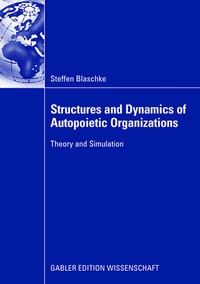
Structures and Dynamics of Autopoietic Organizations
Theory and Simulation
1st Edition
Published on 31. July 2008
XII, 216 pages
978-3-8349-9809-5 (ISBN)
Description

O body swayed to music, O brightening glance, How can we know the dancer from the dance? -William Butler Yeats, Among School Children, 1927 The closing question from Yeats' poem Among School Children incites a paradoxical answer. It is possible to observe the particular positions and movements of an individual dancer and thereby identify the performance as a speci?c dance, while it is impossible to observe the performance of the dance devoid of the positions and movements of the dancer. Still, any other dancer may well perform the same dance, and just therefore it is possible to distinguish the particular positions and movements that constitute a speci?c dance from any individual performance. "Such remarks indicate that we are aware of two ontologically distinct entities within one perceptual phenomenon," Gill (1975) highlights. Knowing the dancer from the dance is neither purpose nor objective of the following contemplation. Nonetheless, the paradox that it is both possible and impossible to know the dancer from the dance is intriguing enough to introduces this work's genuine purpose and objective. 1. 1 Purpose and Objective The primary interest of this work rests with organizational knowledge and the associated concepts of organizational learning and memory, not the least because many argue that organizational knowledge is the main source of competitive advantage (e. g. , Grant, 1996; Kogut & Zander, 1992; Nahapiet & Ghoshal, 1998; Nonaka, 1991, 1994; Prahalad & Hamel, 1990).
More details
Other editions
Additional editions
Book
06/2008
1st Edition
Springer Gabler
€53.49
Shipment within 7-9 days
Person
Dr. Steffen Blaschke promovierte bei Prof. Dr. Paul Alpar am Institut für Wirtschaftsinformatik der Philipps-Universität Marburg. Derzeit ist er als Postdoktorand an der Forschungsstelle für Neue Kommunikationsmedien der Otto-Friedrich-Universität Bamberg tätig.
Content
Organizations as Rational, Natural, and Open Systems.- Organizations as Social Systems.- Social Science Simulation.- Simulation of Organizational Structures and Dynamics.- Conclusion.
5 Simulation of Organizational Structures and Dynamics (S. 117-118)
Computational simulation allows for the study of social systems beyond the restrictions of theoretical and empirical analysis. Still, it replaces neither one of these traditional research methods but rather complements them. Several studies in management science and organization theory employ computational simulation, indeed. One of the most prominent examples from management science is the Garbage Can Model of Organizational Choice by Cohen, March, & Olsen (1972).
The simulation inquires into the decisionmaking process of organizations and yields predictions with respect to the e.ect of adversity. Other well-known computational simulations from organization theory are March's (1991) Exploration and Exploitation in Organizational Learning and Carley's (1992) Organizational Learning and Personnel Turnover, both of which revolve around issues of organizational learning, obviously. Moreover, they particularly well compare to social systems theory (Blaschke & Schoeneborn, 2006). The below model of autopoietic organization theory and the computational simulation thereof draw heavily on both March and Carley, therefore.
Computational organization theory (Lomi & Larsen, 2001, Prietula & Carley, 1994, Prietula, Carley, & Gasser, 1998) o.ers numerous other models and simulations which predict, prove, discover, explain, critique, and prescribe organizational issues such as culture (Canessa & Riolo, 2003, Carroll & Harrison, 1998, Harrison & Carroll, 1991, 2002), design (Ashworth & Carley, 2006, Carley & Lin, 1997, Ouksel & Vyhmeister, 2000, Zhu, Prietula, & Hsu, 1997), and trust (Prietula & Carley, 1999), just to name a few. These references indicate the vanguard of American research. Nevertheless, European research actively employes computational simulation, too, although its perspective is not so much with organizations in particular but more with social phenomena in general. Socionics (Malsch, 2001, Müller, Malsch, & Schulz-Schae.er, 1998) is an emerging scienti.c discipline which presents itself at the border between sociology and distributed arti.cial intelligence (or, rather, informatics, hence the name).
Its concern is with issues such as social order (Dittrich, Kron, & Banzhaf, 2003), social self-organization (Köhler, Langer, von Lüde, Moldt, Rölke, & Valk, 2007), and communication oriented modeling (Malsch & Schlieder, 2004, Malsch, Schlieder, Kiefer, Lübcke, Perschke, Schmitt, & Stein, 2007). The latter model and simulation is most noteworthy for its description of large-scale communication events in terms of the inception and reception of messages, that is, communication without agents. It is considerably close to social systems theory yet falls short of de.ning organizations. As a step towards communicationcentric organization theory, however, communication-oriented modeling is an invaluable substantiation of social systems theory and thus autopoietic organization theory.
The following model ties together social systems theory and autopoietic organization theory with respect to their understanding of social systems (organizations, networks of communication), psychic systems (individuals, organizational members), and the respective environments (Section 5.1). Both social and psychic systems are computational agents to begin with (cf. Brassel, Möhring, Schumacher, & Troitzsch, 1997) and come with the dynamics of knowledge, learning, and memory (Section 5.2). Note that these two chapters give few references to the literature except for those that add new perspectives or clarify matters.
Computational simulation allows for the study of social systems beyond the restrictions of theoretical and empirical analysis. Still, it replaces neither one of these traditional research methods but rather complements them. Several studies in management science and organization theory employ computational simulation, indeed. One of the most prominent examples from management science is the Garbage Can Model of Organizational Choice by Cohen, March, & Olsen (1972).
The simulation inquires into the decisionmaking process of organizations and yields predictions with respect to the e.ect of adversity. Other well-known computational simulations from organization theory are March's (1991) Exploration and Exploitation in Organizational Learning and Carley's (1992) Organizational Learning and Personnel Turnover, both of which revolve around issues of organizational learning, obviously. Moreover, they particularly well compare to social systems theory (Blaschke & Schoeneborn, 2006). The below model of autopoietic organization theory and the computational simulation thereof draw heavily on both March and Carley, therefore.
Computational organization theory (Lomi & Larsen, 2001, Prietula & Carley, 1994, Prietula, Carley, & Gasser, 1998) o.ers numerous other models and simulations which predict, prove, discover, explain, critique, and prescribe organizational issues such as culture (Canessa & Riolo, 2003, Carroll & Harrison, 1998, Harrison & Carroll, 1991, 2002), design (Ashworth & Carley, 2006, Carley & Lin, 1997, Ouksel & Vyhmeister, 2000, Zhu, Prietula, & Hsu, 1997), and trust (Prietula & Carley, 1999), just to name a few. These references indicate the vanguard of American research. Nevertheless, European research actively employes computational simulation, too, although its perspective is not so much with organizations in particular but more with social phenomena in general. Socionics (Malsch, 2001, Müller, Malsch, & Schulz-Schae.er, 1998) is an emerging scienti.c discipline which presents itself at the border between sociology and distributed arti.cial intelligence (or, rather, informatics, hence the name).
Its concern is with issues such as social order (Dittrich, Kron, & Banzhaf, 2003), social self-organization (Köhler, Langer, von Lüde, Moldt, Rölke, & Valk, 2007), and communication oriented modeling (Malsch & Schlieder, 2004, Malsch, Schlieder, Kiefer, Lübcke, Perschke, Schmitt, & Stein, 2007). The latter model and simulation is most noteworthy for its description of large-scale communication events in terms of the inception and reception of messages, that is, communication without agents. It is considerably close to social systems theory yet falls short of de.ning organizations. As a step towards communicationcentric organization theory, however, communication-oriented modeling is an invaluable substantiation of social systems theory and thus autopoietic organization theory.
The following model ties together social systems theory and autopoietic organization theory with respect to their understanding of social systems (organizations, networks of communication), psychic systems (individuals, organizational members), and the respective environments (Section 5.1). Both social and psychic systems are computational agents to begin with (cf. Brassel, Möhring, Schumacher, & Troitzsch, 1997) and come with the dynamics of knowledge, learning, and memory (Section 5.2). Note that these two chapters give few references to the literature except for those that add new perspectives or clarify matters.
