

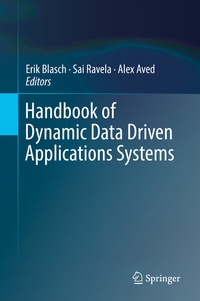
Handbook of Dynamic Data Driven Applications Systems
Description

The Handbook of Dynamic Data Driven Applications Systems establishes an authoritative reference of DDDAS, pioneered by Dr. Darema and the co-authors for researchers and practitioners developing DDDAS technologies.
Beginning with general concepts and history of the paradigm, the text provides 32 chapters by leading experts in10 application areas to enable an accurate understanding, analysis, and control of complex systems; be they natural, engineered, or societal:
-
Earth and Space Data Assimilation
-
Aircraft Systems Processing
-
Structures Health Monitoring
-
Biological Data Assessment
-
Object and Activity Tracking
-
Embedded Control and Coordination
-
Energy-Aware Optimization
-
Image and Video Computing
-
Security and Policy Coding
-
Systems Design
The authorsexplain how DDDAS unifies the computational and instrumentation aspects of an application system, extends the notion of Smart Computing to span from the high-end to the real-time data acquisition and control, and manages Big Data exploitation with high-dimensional model coordination.
More details
Other editions
New editions
Additional editions
Persons
Dr. Erik P. Blasch is a Program Officer with the Air Force Office of Scientific Research. His focus areas are in multi-domain (space, air, ground) data fusion, target tracking, pattern recognition, and robotics. He has authored 750+ scientific papers, 22 patents, 30 tutorials, and 5 books. Recognitions include the Military Sensing Society Mignogna leadership in data fusion award, IEEE Aerospace and Electronics Systems Society Mimno best magazine paper award, IEEE Russ bioengineering award, and founding member of the International Society of Information Fusion (ISIF). Previous appointments include Adjunct Associate professor at Wright State University, Exchange scientist at Defense Research and Development Canada, and officer in the Air Force Research Laboratory. Dr. Blasch is an Associate Fellow of AIAA, Fellow of SPIE, and Fellow of IEEE.
Dr. Sai Ravela directs the Earth Signals and Systems Group with research interests in Dynamic Data Driven Observing Systems at the Massachusetts Institute of Technology (MIT). He has made key contributions to Dynamic Data Driven cooperative autonomous observation of fluids, atmosphere, wildlife, retail intelligence, and micro-positioning radar. He has pioneered DDDAS concepts, and organized the first three DDDAS conferences that form the basis of this book. He has over 100 publications and patents, is the co-founder of Windrisktech LLC and E5 Aerospace LLC, and is a recipient of the MIT Infinite Kilometer award for exceptional research and outstanding mentorship.
Dr. Alex J. Aved is a Senior Researcher with the Air Force Research Laboratory, Information Directorate, Rome, NY, USA. His research interests include multimedia databases, stream processing (via CPU, GPU, or coprocessor) and dynamically executing models with feedback loops incorporating measurement and error data to improve the accuracy of the model. He has published over50 papers and given numerous invited lectures. Previously he was a programmer at the University of Central Florida and database administrator and programmer at Anderson University.
