

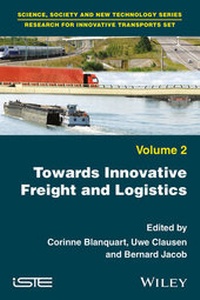
Towards Innovative Freight and Logistics
Description

More details
Other editions
Additional editions
Persons
Corinne Blanquart is a senior researcher at IFSTTAR in France. She heads the SPLOTT laboratory and conducts research on freight transport and logistics. More specifically, her areas of research are freight demand analysis and retailers' logistics in France and Germany.
Uwe Clausen is managing director of the Institute of Transport Logistics at TU Dortmund University, Germany and director of the Fraunhofer-Institute for material flow and logistics in Dortmund. His research areas include green logistics, commercial traffic modeling, intermodal transportation, mathematical optimization, network optimization and distribution systems.
Bernard Jacob, chair of the Programme Committee of TRA2014, is deputy scientific director for transport, infrastructures and safety with IFSTTAR. His research works are in bridge and road safety, traffic loads on bridges, heavy vehicles and weigh-in-motion. He is Professor at Ecole Nationale des Travaux Publics de l'Etat in France, and President of the International Society for WIM (ISWIM).
Content
Acknowledgments xix
Preface xxi
Introduction xxv
Corinne Blanquart, Uwe Clausen and Bernard Jacob
Part 1 Optimization of Freight and Logistics 1
Chapter 1 Smart Logistics Corridors and the Benefits of Intelligent Systems 3
Maarten Oonk
Chapter 2 Evaluation of the Road Transport Management System: A Self-Regulation Initiative in Heavy Vehicle Transport in South Africa 15
Paul Nordengen and Oliver Naidoo
Chapter 3 Freight Really Flexible in the Timetabling Process for a Mixed-Use Rail Network? Some Considerations Based on French Experience 29
Camille Morvant
Chapter 4 The Routing Problem of an Innovative Urban Freight Distribution Scheme 45
Elvezia Maria Cepolina and Alessandro Farina
Chapter 5 Information Sharing in Last Mile Distribution: Lessons Learned from a Pilot in Oslo 61
Olav Eidhammer and Jardar Andersen
Chapter 6 Freight Distribution Based on Delivery Area Booking 75
Bertrand David, Salima Hassas, Véronique Deslandres, René Chalon, Danièle Patier, Jean-Baptiste Thébaud and Pierre Descombes
Part 2 New Vehicle Concepts 89
Chapter 7 Swedish Roadmap for High Capacity Transport (HCT) 91
Jerker Sjögren and Helena Kyster-Hansen
Chapter 8 Targeted Selection of Overweight Vehicles in Norway 105
Erlend Aakre, Thomas Engen and Isabelle Roche Cerasi
Chapter 9 Possible Impacts of Increasing Maximum Truck Weight: Finland Case Study 121
Lasse Nykänen and Heikki Limatainen
Chapter 10 SARTRE Automated Platooning Vehicles 137
Eric Chan
Chapter 11 Maintenance-on-Demand Concepts for Commercial Vehicles: The MoDe Project 151
Thilo Bein, Matthias Raushenbach, Dominik Elberskirch, Thomas Bonnot, François Philip, Pascal Kemps, Bart Peeters, Henrik Huovila, Peitsa Turvanen, Elias Khoury, Bob Thomas and Andreas Schirling
Chapter 12 Facilitating Modal Shift by an Innovative Inland Vessel and Logistics System 169
Sandra Stein, Jan Kaffka, Daniel Diekmann, Uwe Clausen, Nenad Zrnic and Wilfried Sihn
Chapter 13 Navigator 2020 - Innovation in Inland Waterway Transport 185
Michael Fastenbauer, Andreas Bäck and Gudrun Maierbrugger
Part 3 Governance and Organizational Issues 197
Chapter 14 Development of a Holistic Approach Fostering Innovation Uptake in the Logistics Area 199
Jannicke Baalsrud Hauge, Kostas Kalaboukas, Kahina Hamadache, Paola Lupieri, Margherita Forcolin, Hans Westerheim, Nils Meyer-Larsen, Alberto Capella, Gunnar Stefansson and Violeta Roso
Chapter 15 Transformation of the Danube Ports into Logistics Centers and Their Integration in the EU Logistics Network 217
Sanja Bojic, Milosav Georgijevic and Dejan Brcanov
Chapter 16 How to Create a Management Structure for Transport Corridors 231
Maria Öberg, Kristina Nilsson and Charlotta Johansson
Chapter 17 The Role of Human Factors in Rail Freight Innovation 245
Carlo Vaghi, Philip Wheat, Ines Österle, Alberto Milottia and John Nellthorp
Chapter 18 Enhancing the Ramp-Up of a New Contract Logistics Business by Developing a Workers' Requirements Matrix 259
Katharina Winter, Christiane Geiger an Uwe Clausen
Chapter 19 Engaging City Stakeholders to Achieve Efficient and Environmentally Friendly Urban Freight Movements 275
Thomas Zunder, Paulus Aditjandra, Jarl Schoemaker, Konstantina Laparidou, Carlo Vaghi and Ines Österle
Chapter 20 Energy-Efficient Urban Freight Logistics: the Set-up and Operation of Freight Quality Partnerships in European Cities 289
Dimitrios Tsamboulas and Panayota Moraiti
Part 4 Assessment Framework and Future Steps 307
Chapter 21 How Green are the TEN-T Core Network Corridors?
George Panagakos and Harilaos Psaraftis
Chapter 22 The Role of Corridor Development in Boosting the European Industrial Future Based on Northern Scandinavian Mines 325
Jenni Echhardt and Jarkko Rantala
Chapter 23 Effect of a Full Internalization of External Costs of Global Supply Chains on Production, Trade and Transport 337
Lóránt Tavasszy, Jorrit Harmsen, Olga Ivanova and Tatyana Bulavskaya
Chapter 24 A City Distribution Impact Assessment Framework 353
Susanne Balm, Cathy Macharis, Lauriane Milan and Hans Quak
Chapter 25 Evaluation of the Urban Freight Transportation (UFT) Projects 369
Tatiana Graindorge and Dominique Breuil
Chapter 26 The Unknown Part of the Transport System: the Light Duty Vehicle 385
Michel Savy and Sabrina Tenfiche
List of Authors 397
Index 405
Introduction
Freight transport faces a dual challenge. It must satisfy the demands of globalized trade on the one hand and meet environmental requirements on the other. In this context, innovation is a crucial topic to enable the transition of the current transportation and logistics system into a sustainable one. This volume provides an overview of the latest technological innovations all over Europe with additionally some international examples, based on ICT (Information and Communication Technologies) or new vehicle concepts, for all modes and all scales (urban, regional, national or International).
Innovation is a key factor of economic and social evolution. In the European Union, innovations are on the political agenda to transform the current transport system into a sustainable transport system. Transport has the potential to become one of the most innovative industrial sectors in Europe. Research and development in freight transport have a high priority in both Europe and North America, because of its importance for the economy, employment, and European integration. The competitiveness of enterprises and countries, and business as a whole greatly depend on freight transport efficiency. In addition, innovations help in coping with the challenges of reducing greenhouse gas emissions and fossil energy consumption.
Research and innovation support any sustainable transport policy, are necessary to meet the objectives of the European white paper of 2011, and allow the emergence and deployment of technical solutions for the transition of the current transportation system into a sustainable transportation system. Nevertheless, innovation in the field of transport creates a great paradox: nearly a quarter of European private research is dedicated to the transport sector; ten of the twenty companies with the largest research budgets in Europe belong to this sector with a performance among the most innovative in Europe - and yet transport is not, as with nano-technology, micro-electronics and biotechnology, associated with an image of advanced technologies, innovation and high creativity. One of the reasons for this is that transport is only understood as an integrator of external technologies, whether specific or generic.
This volume highlights how innovative the transport sector is. Telematics, safe logistics systems and new vehicle and transport concepts, including electric mobility, are among the topics investigated and the research works presented during the Transport Research Arena (TRA) 2014, and described in this volume. It shows the specificity of innovation in the field of transport, as the ability of a concept, a composition, or the "Engineering" to control a complex system.
However, despite the achievements in the implementation of innovation policies, environmental issues remain a consequence of transportation activities. This requires more radical innovations and technological leaps. This volume shows the way to promote the diffusion of radical innovation in the goods transportation system. One conclusion is that radical innovations spread through changes in the organization of the system.
That is why technological and infrastructural innovations are necessary, but not sufficient for achieving efficient logistics and transport chains. Non-technological innovation, i.e. innovative supply chains, processes and business models are also addressed in this volume. The deployment of innovative solutions requires a change in the transport system organization and in the relationships between industrial and governmental players, regulators, operators, users and customers. These aspects are also analyzed here.
The target audience of this volume is researchers, as well as practitioners, industrialists and decision-makers. For researchers, the volume gives an up-to-date picture of the latest innovations in the field of transport. For practitioners and industrialists, the volume highlights the importance of considering innovations as part of a social system, taking account of the possibilities of adoption by the social system of transport. For decision-makers, it provides recommendations to promote innovation and its diffusion.
This volume first presents the potential of technological innovations in freight traffic management, information systems and vehicles, then moves on to address stakeholders' governance issues and innovation assessment.
I.1. Optimization of freight and logistics
Mastery of information, allowed by the latest management systems, is the basis of the development of co-modality, i.e. using each transport mode as efficiently and economically as possible throughout the whole transport system. Logistics supply chains cross from mode to mode. Advanced information and communication technologies contribute towards co-modality by improving infrastructure, traffic and fleet management and facilitating a better tracking and tracing of goods across the global transport networks.
Achieving such mastery is the aim of intelligent freight, as it involves ICTs in infrastructures and vehicles. For logistics and transportation companies, a proper integration of ICTs is the key to innovate and supply a whole new range of services. However, ICT adoption remains uneven: smaller businesses tend to focus mainly on transportation operations and only occasionally integrate information management, while larger operators tend to "neglect" physical transportation in order to focus more on coordination, organization and service management; as such, they are more likely to adopt the tools and methods of intelligent freight.
The European white paper describes freight in a "hub and spoke model" which distinguishes between the last mile and city logistics and long haul freight (above 300 km), with the short haul between both. Among the targets, cities should only use clean vehicles (no or very low emissions and non-fossil energy), and a 50% modal shift to rail/sea/waterborne transport is required for freight above 300 km. These ambitious targets require more dedicated research exploiting the potential for disruptive innovations. Improving quality and reliability of rail/sea/waterborne networks and optimized information flow for smooth transition between modes will be crucial. ITS solutions dedicated to urban freight are potentially very numerous, but so far have not been used in many cities. Among the most eagerly anticipated solutions are: real-time traffic information focused on truck drivers, online reservation of loading/unloading areas, and systems for consolidating urban deliveries.
This raises a variety of challenges to support mobility for growth, notably enhancing safety and reducing transport's dependency on fossil fuels, whilst promoting co-modal logistics services that deliver attractive solutions improving the efficiency and resilience of supply chains, and allowing more sustainable choices to shippers, operators and pro-active receivers of goods.
This part defines concepts such as smart corridors connecting smart hubs, and the implementation conditions of management systems for long distance road transport as well as for rail transport. It also highlights specificities for the use of ITS in urban freight, with route and delivery area booking issues.
I.2. New vehicle concepts
New concepts of vehicles could provide innovative solutions in order to optimize energy consumption and efficiency. Avoiding unnecessary trips may also reduce energy consumption.
The potential benefit of using higher capacity vehicles is investigated in several Northern European countries, as well as in other regions of the world, with major productivity gains expected. Higher capacity vehicles may improve fuel efficiency and reduce emissions by reducing the vehicle-kilometers travelled for the same mass or volume (payload) mileage. Introducing these higher capacity vehicles would require some regulation adaptations.
Besides vehicles themselves, other options are proposed concerning their operation. Platooning, i.e. forming trains of heavy vehicles at short or very short distances, may reduce the aerodynamic effects and drag forces and therefore increase fuel efficiency up to 5 to 7%, as well as lane capacity. Eco-driving strategies comprising fuel consumption and safety are quite efficient to reduce energy consumption up to 10%. In a limited budgetary context, solutions which do not require changing the existing infrastructure or building new infrastructure are of high interest. Another challenge consists of optimizing maintenance.
Innovation not only concerns road transport, but modal shift is also dependent on innovations of non-road vehicles. Inland navigation is an efficient, safe and environmentally-friendly mode of transport. Performing technologies usually result in higher logistics efficiency and lower operating costs. These can be achieved by targeted fleet innovations, e.g. vessel design, further automation, including ICT, which are described here.
The interdependency between vehicles' innovations, improved logistics solutions, transhipment, training and governance is highlighted.
I.3. Governance and organizational issues
The freight transport system is considered as a socio-technical system, referring to the interactions between stakeholders, technologies and infrastructure. Socio-technical systems consist of a cluster of elements, including technology, regulation, user practices and markets, cultural meaning, infrastructure, maintenance networks and supply networks.
In this framework, smart and integrated freight transport results from the joint optimization of the social and technical factors. Thus, optimization of each aspect...
