

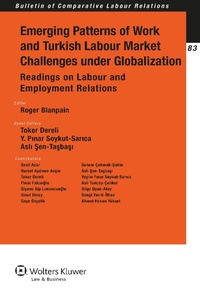
Emerging Patterns of Work and Turkish Labour Market Challenges under Globalization
Readings on Labour and Employment Relations
Published on 22. November 2012
344 pages
978-90-411-4996-1 (ISBN)
Description

In the context of globalization, Turkey plays a unique role. Poised both geographically and culturally between Europe and the Middle East, with a formidable political history in both realms and a thriving modern economy, its domestic affairs inevitably take on a significance that transcends its borders. Among these its employment relations regime, as it sets about conforming to the neoliberal standards of globalization, prove to be of compelling interest for labour law professionals everywhere.
This collection of thirteen essays by notable Turkish legal academics in the field presents practitioners and researchers with in-depth analysis and commentary on such aspects as the following:
ways to raise the floor on working conditions;
impact of multinational corporations' research and development activities on skills and labour costs;
education inequalities, skills development, and the role of technology;
environment and sustainability issues;
Turkey's proposed severance pay fund as a flexicurity measure;
the nature of subcontracted labour particularly as revealed in Turkey's shipbuilding industry;
labour unionism and collective bargaining;
female employment and gender-based discrimination; and
mobbing and workplace bullying.
The overall analysis does justice to the book's stated aim of exploring the integration of Turkey's system of labour and employment relations through transnational connections which have reached levels that can no longer be restricted to national boundaries.
This collection of thirteen essays by notable Turkish legal academics in the field presents practitioners and researchers with in-depth analysis and commentary on such aspects as the following:
ways to raise the floor on working conditions;
impact of multinational corporations' research and development activities on skills and labour costs;
education inequalities, skills development, and the role of technology;
environment and sustainability issues;
Turkey's proposed severance pay fund as a flexicurity measure;
the nature of subcontracted labour particularly as revealed in Turkey's shipbuilding industry;
labour unionism and collective bargaining;
female employment and gender-based discrimination; and
mobbing and workplace bullying.
The overall analysis does justice to the book's stated aim of exploring the integration of Turkey's system of labour and employment relations through transnational connections which have reached levels that can no longer be restricted to national boundaries.
More details
Other editions
Additional editions
Roger Blanpain
Emerging Patterns of Work and Turkish Labour Market Challenges under Globalization
Readings on Labour and Employment Relations
Book
11/2013
1st Edition
Kluwer Law International
€236.21
Shipment within 10-20 days
Persons
Content
- Cover
- Half Title Page
- Title Page
- Copyright Page
- Notes on Contributors
- Summary of Contents
- Table of Contents
- Foreword
- About This Book
- List of Tables
- List of Figures
- PART I General and Global Issues
- CHAPTER 1 Turkey and the Emerging Trends in Global Labour Mobility
- §1.01 INTRODUCTION
- §1.02 ECONOMIC CAUSES AND CONSEQUENCES OF TURKISH LABOUR MOBILITY
- §1.03 TURKEY AND THE FREE MOVEMENT OF WORKERS IN THE EU
- §1.04 CONCLUDING REMARKS
- CHAPTER 2 European Multinationals' Offshore R&D Strategies towards Turkey with Regard to: Labour Capabilities, Skills and Labour Costs
- §2.01 INTRODUCTION
- §2.02 LITERATURE REVIEW
- [A] R&D Offshore
- [B] Requirements for Offshore R&D
- [C] R&D Policy of MNEs
- [D] MNEs' Decision Regarding Location
- §2.03 RESEARCH METHODOLOGY
- [A] Case Study
- [B] Sample
- §2.04 FINDINGS
- [A] Turkey's Economy and Science, Technology & Innovation (STI)
- [B] Turkey's Employment and R&D Labour Force
- [C] R&D Labour Cost in Turkey
- [D] R&D Law of Turkey
- §2.05 CONCLUSION
- [A] Policy Implications for Turkey
- CHAPTER 3 Industrial Employment, Emissions and Sustainability in Turkey
- §3.01 INTRODUCTION
- §3.02 LITERATURE REVIEW AND BACKGROUND HYPOTHESES
- §3.03 DATA AND ANALYSIS
- [A] CO2 Emissions, Economic Development and Employment in Turkey
- [B] Estimation and Results
- §3.04 CONCLUSION AND DISCUSSION
- PART II Labour Market and Employment Issues
- CHAPTER 4 Education Inequality among Working-Age Population in Turkey: A Cohort Analysis
- §4.01 INTRODUCTION
- §4.02 EDUCATION SYSTEM AND EDUCATIONAL ATTAINMENT IN TURKEY
- §4.03 METHODOLOGY AND DATA
- §4.04 EDUCATIONAL ATTAINMENT AND EDUCATION INEQUALITIES BY BIRTH COHORTS
- §4.05 CONCLUSION
- CHAPTER 5 Skills, Technology and Working Practices in Turkey
- §5.01 INTRODUCTION
- §5.02 LITERATURE REVIEW
- §5.03 METHODOLOGY
- §5.04 EMPIRICAL FINDINGS
- §5.05 CONCLUSION
- CHAPTER 6 The Role of NGOs in the Improvement of the Turkish Labour Market
- §6.01 INTRODUCTION
- §6.02 NGOs AS EMPLOYERS IN DEVELOPED COUNTRIES
- §6.03 NGOs AS EMPLOYERS IN TURKEY
- [A] The Legal Perspective on NGOs
- [B] Human Resources in NGOs in Turkey
- [C] Participation in NGOs in Turkey
- §6.04 TOWARDS AN INSTITUTIONALIZED SECTOR IN TURKEY
- §6.05 CONCLUSION
- PART III Labour Law and Practice Issues
- CHAPTER 7 Severance Pay Fund as a Flexicurity Policy
- §7.01 INTRODUCTION
- §7.02 THE CONCEPT OF FLEXICURITY
- §7.03 THE CLASSICAL SEVERANCE PAY SYSTEM
- §7.04 THE FUNDED SEVERANCE PAY SYSTEM
- §7.05 CONCLUSION
- CHAPTER 8 Some Current Practices and Problems of the Principal Employer and Subcontractor Relationship in Turkey: The Case of the Shipbuilding Sector
- §8.01 INTRODUCTION
- §8.02 THE PRINCIPAL EMPLOYER AND THE SUBCONTRACTOR RELATIONSHIP LEGISLATION IN TURKEY
- §8.03 ACTION PLAN TAKEN BY GOVERNMENT ABOUT 'SUBCONTRACTING'
- [A] Shipbuilding Sector of Turkey
- §8.04 REASONS WHY IMPLEMENTATION OF SUBCONTRACTOR WORK IN SHIPBUILDING SECTOR IS INEVITABLE
- §8.05 PROBLEMS FACED IN SUBCONTRACTING IMPLEMENTATIONS IN THE SHIPBUILDING SECTOR OF TURKEY
- §8.06 DISCUSSION OF SOLUTION ALTERNATIVES FOR THE PROBLEMS ENCOUNTERED IN THE SHIPBUILDING SECTOR OF TURKEY
- §8.07 CONCLUSION
- PART IV Industrial Relations
- CHAPTER 9 Labour Relations in Turkey from the Perspective of International Norms on Freedom of Association and Collective Bargaining: An Evaluation of Turkey's New Act on Unions and the Collective Agreement
- §9.01 INTRODUCTION
- §9.02 HISTORICAL BACKGROUND AND KEY ISSUES IN FREEDOM OF ASSOCIATION IN TURKEY BEFORE ACT NO. 6356
- [A] 1947-1960 ERA
- [B] 1963-1980 ERA
- [C] 1980-2013 ERA
- [D] Key Issues in Turkey's Relations with ILO until the Passage of Act No. 6356
- §9.03 EVALUATION OF THE NEW ACT ON UNIONS AND THE COLLECTIVE AGREEMENT
- [A] Definitions
- [B] Unions
- [1] Structure, Establishment and Membership
- [2] Membership of Unions to Upper-Level Organizations
- [3] Protection of Freedom of Association for Workers
- [4] The Protection for Union Shop-Stewards
- [5] The Protection for Union Administrators
- [6] Activities of Organizations
- [7] Auditing the Organizations and the Principle of Transparency
- §9.04 COLLECTIVE BARGAINING, TYPES OF COLLECTIVE AGREEMENTS
- SCOPE, FORM AND EFFECTS
- [A] Types of Collective Agreements
- [B] Form and Effects
- [C] Worker Categories Who Can Have Access to the Benefits of Collective Agreements
- [D] Extension of the Collective Agreement
- [E] Authorization for Collective Bargaining
- [F] Invitation to Collective Negotiations
- [G] The Emergence of the Collective Labour Dispute
- [H] Strike and Lock-Out
- [1] The Decision for Calling and Implementing a Lawful Strike and Lock-Out
- [2] Strike Ballot
- [3] Activities and Establishments Where Strikes and Lock-Outs are Prohibited
- [4] Suspension (Postponement) of the Strike and Lock-Out
- [5] Liability for Damages
- [6] The Supreme Arbitration Board
- [7] Other Articles on Strikes and Lock-Outs
- §9.05 CONCLUSION
- CHAPTER 10 The Future of Labour Unionism in Turkey
- §10.01 INTRODUCTION
- §10.02 AKHI GUILDS AND ARTISAN TRADITION
- §10.03 THE EARLY ATTEMPTS AT LABOUR AND UNIONISM RIGHTS DURING OTTOMAN EMPIRE PERIOD
- §10.04 THE EARLY ATTEMPTS RELATED WITH LABOUR AND UNIONISM RIGHTS DURING THE FIRST DECADES OF TURKISH REPUBLIC: THE PERIOD OF 1920S AND 1950S.
- §10.05 THE MATURATION OF LABOUR UNIONISM RIGHTS DURING THE PERIOD OF 1960s AND 1970s
- §10.06 THE DECLINE OF LABOUR UNIONISM RIGHTS AFTER 1980s
- §10.07 THE CURRENT ISSUES THAT CHALLENGE THE FUTURE OF LABOUR UNIONISM IN TURKEY
- [A] Formation of a Working Class with Lack of Class Consciousness and Changing Work Demographics
- [B] A Relatively Young Working Class, and Immature Tradition of Unionism
- [C] Inappropriate Economical and Political Conditions, and Changing Work Environment
- §10.08 CONCLUSION: IS THERE A FUTURE FOR TURKISH LABOUR UNIONISM?
- PART V Workplace Issues
- CHAPTER 11 Female Employment in Turkey
- §11.01 INTRODUCTION
- §11.02 FEMALE EMPLOYMENT IN TURKEY FROM THE FOUNDING OF THE REPUBLIC TO THE 1960s
- §11.03 FEMALE EMPLOYMENT IN THE PERIODS OF IMPORT-SUBSTITUTING INDUSTRIALIZATION AND EXPORT-LED INDUSTRIALIZATION
- §11.04 FEMALE EMPLOYMENT IN THE EARLY 2000s
- §11.05 POLICIES TO INCREASE WOMEN EMPLOYMENT
- §11.06 CONCLUSION
- CHAPTER 12 Discrimination against Women's Employment: An Overview from Turkey
- §12.01 INTRODUCTION
- §12.02 THE CONCEPT OF DISCRIMINATION AND DISCRIMINATION BY GENDER
- §12.03 TURKISH ECONOMY AND LABOUR MARKET
- [A] Legislative Framework Regulating Gender Policy in Turkey
- §12.04 THE COMPOSITION OF WOMEN'S EMPLOYMENT IN TURKEY
- §12.05 DISCRIMINATORY PRACTICES AGAINST WOMEN AT WORK
- [A] Discrimination in Recruitment and Selection
- [B] Discrimination in Promotional Advancement
- [C] Discrimination in Remuneration
- §12.06 CONCLUSION
- CHAPTER 13 Dealing with Destructive Workplace Behaviour: An Overview of Mobbing in Turkish Organizations
- §13.01 INTRODUCTION
- §13.02 MOBBING: DEFINING THE PLAGUE
- §13.03 ANTECEDENTS OF MOBBING
- §13.04 CONSEQUENCES OF MOBBING
- §13.05 OVERVIEW OF THE MATTER AND RELEVANT LEGAL INFRASTRUCTURE IN TURKEY
- §13.06 CONCLUSION
- Back Cover
