

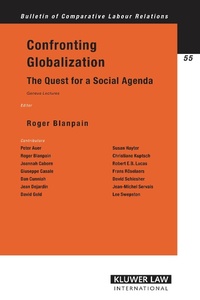
Confronting Globalization
The Quest for a Social Agenda, Geneva Lectures
Published on 14. April 2005
232 pages
978-90-411-5766-9 (ISBN)
Description

There is mounting evidence that the economic globalisation project initiated after the fall of the Soviet Union is not keeping its promise of open societies and a freer exchange of goods, knowledge, ideas and more social justice. In fac, there are strong indications that such benefits are not equally divided, so between north and south and developed and developing countries. Responding to this evidence, the International Labour Organisation (ILO) established the World Commission on the Social Dimension of Globalisation in February 2002. In February 2004, following numerous international and regional conferences and consultations, the Commission's report, A Fair Globalization: Creating Opportunities for All, was presented to the Governing Body of the International Labour Organization, to the Secretary General of the United Nations, and to the heads of other UN agencies, the World Bank, the International Monetary Fund, and the World Trade Organization. This volume represents the first in-depth evaluation of this important report.
The analyses and commentaries collected in this volume accomplish two essential tasks. They detail the findings and recommendations of the Commission, and they also spell out the implications of the Commission's report for the ongoing viability of economic globalisation in practice. The authors include ILO officials, representatives of both employers and labour unions, specialists in various work-related professions, and academics in disciplines related to work and society. Among the vital issues and topics covered are the following:
corporate social responsibility;
the challenge of child labour;
protected mobility for employment and decent work;
employment security;
the brain drain;
migration to the high-income countries;
psycho-social problems at work;
ageism; and
workers participation.
Several authors deal with the role played by other international organisations like the OECD and the EU regarding the social aspects of globalisation. Two important EU documents on the promotion of core labour standards and on the social dimension of globalisation are reprinted here.
Treating as it does one of the major problems our generation-how to see to it that globalisation benefits all of us and not only a few-Confronting Globalisation: The Quest for a Social Agenda promises to take its place as an indispensable resource for practitioners in many fields, from labour and employment law to health care and environmental policy. It is not too much to say that this book represents an immensely valuable contribution and commitment to the future well-being of the world we live in.
The analyses and commentaries collected in this volume accomplish two essential tasks. They detail the findings and recommendations of the Commission, and they also spell out the implications of the Commission's report for the ongoing viability of economic globalisation in practice. The authors include ILO officials, representatives of both employers and labour unions, specialists in various work-related professions, and academics in disciplines related to work and society. Among the vital issues and topics covered are the following:
corporate social responsibility;
the challenge of child labour;
protected mobility for employment and decent work;
employment security;
the brain drain;
migration to the high-income countries;
psycho-social problems at work;
ageism; and
workers participation.
Several authors deal with the role played by other international organisations like the OECD and the EU regarding the social aspects of globalisation. Two important EU documents on the promotion of core labour standards and on the social dimension of globalisation are reprinted here.
Treating as it does one of the major problems our generation-how to see to it that globalisation benefits all of us and not only a few-Confronting Globalisation: The Quest for a Social Agenda promises to take its place as an indispensable resource for practitioners in many fields, from labour and employment law to health care and environmental policy. It is not too much to say that this book represents an immensely valuable contribution and commitment to the future well-being of the world we live in.
More details
Other editions
Additional editions
Book
05/2005
Kluwer Law International
€299.10
Shipment within 10-20 days
Content
- Cover
- Half Title Page
- Title Page
- Copyright Page
- Table of Contents
- Introductory Remarks: The Globalization Debate at an Impasse
- List of Contributors
- 1. The Social Dimension of Globalization: Striking the Balance
- 1. INTRODUCTION
- 2. UNDERSTANDING GLOBALIZATION
- 3. IS GLOBALIZATION STRIKING THE BALANCE?
- 3.1 Economic growth
- 3.2 Employment, inequality and poverty
- 4. THE SOCIAL DIMENSION: A FAIR GLOBALIZATION THAT CREATES OPPORTUNITIES FOR ALL
- 4.1 Beginning at home
- 4.2 Fairer rules
- 4.3 Better policies
- 4.4 More accountable institutions
- 5. CONCLUSIONS
- 2. ILO Standards and Globalization
- 1. ILO STRUCTURE
- 2. THE ILO AND HUMAN RIGHTS - HOW THEY RELATE TO GLOBALIZATION
- 3. SUPERVISION OF RATIFIED CONVENTIONS
- 4. COMPLAINT PROCEDURES
- 4.1 Representations under Article 24 of the ILO Constitution
- 4.2 Complaints under Article 26 of the ILO Constitution
- 4.3 Special procedures for complaints concerning freedom of association
- 4.4 The Committee on Freedom of Association
- 4.5 The Fact-Finding and Conciliation Commission
- 5. RECENT DEVELOPMENTS CONCERNING STANDARDS AND GLOBALIZATION
- 3. International Labour Standards and Corporate Social Responsibility
- 1. CORPORATE CODES OF CONDUCT
- 1.1 Model codes and management frameworks
- 1.2. Operational corporate codes
- 2. LABELS AND OTHER PUBLIC ACKNOWLEDGEMENTS OF GOOD SOCIAL POLICY
- 2.1 Social labelling
- 2.2 Accreditation and certification programmes
- 2.3 Corporate social reporting
- 2.4 Socially responsible investment
- 3. THE ROLE OF GOVERNMENTAL AND INTERGOVERNMENTAL INSTITUTIONS
- 3.1 The OECD Guidelines for Multinational Enterprises
- 3.2 The ILO Tripartite Declaration of Principles concerning Multinational Enterprises and Social Policy
- 3.3 The initiatives launched by the United Nations
- 3.4 World Bank initiatives
- 3.5 European initiatives
- 3.6 National initiatives
- 4. CONCLUDING REMARKS
- 4. Globalization, Labour Law and Industrial Relations: Some Reflections
- 1. GLOBALIZATION AND FUNDAMENTAL HUMAN RIGHTS
- 2. THE ''DENATIONALISATION'' OF LABOUR LAW
- 3. THE ILO DECLARATION OF 1998
- 4. INDUSTRIAL RELATIONS BASED ON FREEDOM OF ASSOCIATION AND THE RIGHT TO COLLECTIVE BARGAINING
- 5. CONCLUDING REMARKS
- SELECTED BIBLIOGRAPHY
- 5. Promoting Core Labour Standards and Improving Social Governance in the Context of Globalization
- 1. INTRODUCTION
- 2. INTERNATIONAL DEVELOPMENTS IN SUPPORT OF CORE LABOUR STANDARDS
- 2.1 Towards better social governance internationally
- 3. BASIC TENETS OF THE EU APPROACH
- 3.1 Labour standards as a key element of EU social policy
- 3.2 Rejection of sanctions-based approaches in trade policy
- 3.3 Poverty reduction and respect for fundamental rights in development assistance and bilateral agreements
- 4. AN EU INITIATIVE TO MOVE INTERNATIONAL ACTIONS FORWARD
- 5. ELEMENTS FOR FURTHER ACTION AT THE EU AND INTERNATIONAL LEVEL
- 5.1 Enhancing action at the international level
- 5.2 Pooling together the EU policy tools
- 5.3 Private and voluntary schemes for the promotion of core labour standards: Social labelling and industry codes of conduct
- 6. CONCLUSIONS
- ANNEX
- 6. The Social Dimension of Globalization - The EU's Policy Contribution on Extending the Benefits to All
- 1. EXECUTIVE SUMMARY
- 2. BACKGROUND
- 3. THE RELEVANCE OF THE EU'S ECONOMIC AND SOCIAL MODEL
- 4. MANAGING THE CONSEQUENCES OF GLOBALIZATION IN THE EU
- 5. HARNESSING GLOBALIZATION - EU ACTION TO PROMOTE THE SOCIAL DIMENSION OF GLOBALIZATION
- 5.1 The social dimension of European bilateral and regional relations
- 5.2 Development and external cooperation
- 5.3 Ensuring that trade policy is fully supportive of social development
- 5.4 Promoting social development through market access for developing countries
- 5.5 Promoting private initiatives for social development
- 5.6 Governance at global level
- 6. CONCLUSION
- 7. The IOE
- 1. AFFILIATION CRITERIA
- 2. STRUCTURE
- 3. MISSION
- 3.1 Defend employers' interests at international level, particularly in the ILO
- 3.2 Promote free enterprises and their development
- 3.3 Help in the creation and reinforcement of employers' organisations at national level.
- 3.4 Facilitate the exchange of information and experiences between employers' organisations
- 4. PRESENCE OF THE IOE
- 4.1 The IOE and the main current issues
- 4.2 International labour standards:
- 4.3 ILO Declaration on Fundamental Principles and Rights at Work
- 4.4 Corporate social responsibility
- 8. The ICFTU and its Policies within the ILO Workers' Group
- 1. TRIPARTISM
- 2. DECENT WORK
- 3. LABOUR STANDARDS AND FUNDAMENTAL PRINCIPLES AND RIGHTS AT WORK
- 4. GREATER OPPORTUNITIES FOR DECENT EMPLOYMENT
- 5. SOCIAL PROTECTION
- 6. SOCIAL DIALOGUE
- 7. SECTORAL ACTIVITIES
- 8. TECHNICAL COOPERATION
- 9. GENDER EQUALITY
- 10. THE YOUTH
- 11. RESEARCH AND TRAINING
- 9. The Challenge of Child Labour
- 1. WHY CHILD LABOUR IS A PROBLEM
- 2. DEFINING CHILD LABOUR
- 3. CAUSES OF CHILD LABOUR
- 4. WHAT NEEDS TO BE DONE?
- 4.1 Finding out about child labour
- 4.2 Advocacy
- 4.3 Policy and legal reform
- 4.4 Specific programmes
- 4.5 Capitalizing on experiences
- 5. UN COORDINATION
- 6. THE COSTS AND BENEFITS OF ENDING CHILD LABOUR
- 6.1 Can the world afford to eliminate child labour? Can it afford not to?
- 7. A DAUNTING CHALLENGE
- 10. Protected Mobility for Employment and Decent Work: Employment Security in a Globalized World
- 1. INTRODUCTION
- 2. THE END OF STABLE JOBS?
- 3. ARE STABLE JOBS GOOD JOBS?
- 4. EMPLOYMENT STABILITY DOES NOT RESULT IN EMPLOYMENT SECURITY: A PARADOX
- 5. UPWARD MOBILITY
- 6. CONCLUSION: BETTER SECURITY FOR THE GLOBALIZED ECONOMY
- BIBLIOGRAPHY
- 11. Globalization and Higher Education: The Migration of Students from Developing Countries to Western Europe
- 1. INTRODUCTION
- 2. ''EDUCATIONAL FOREIGNERS'' vs. ''EDUCATIONAL INLANDERS''
- 3. RISING NUMBERS - HERE TO STAY
- 4. PARALLELS WITH THE GREAT WORKER SCHEMES OF THE 1960s
- 5. OBJECTIVES AND POSSIBLE IMPLICATIONS OF TODAY'S POLICIES
- 6. EDUCATIONAL COOPERATION TO REDUCE BRAIN-DRAIN EFFECTS
- 7. CONCLUSIONS
- REFERENCES
- 12. International Migration to the High-Income Countries: Some Consequences for Economic Development in the Sending Countries
- 1. MIGRATION TO NORTH AMERICA, EUROPE, ASIA, AND THE GULF STATES
- 2. THE EFFECTS OF ECONOMIC DEVELOPMENT ON MIGRATION OUTCOMES
- 3. THE ROLE OF REMITTANCES IN ECONOMIC DEVELOPMENT
- 3.1 The Effects of Remittances on Economic Development
- 3.2 Policy Influences on Remittances
- 3.3 A Summing Up on Remittances
- 4. BRAIN DRAIN AND BRAIN GAIN
- 4.1 Brain Drain
- 4.2 Brain Gain
- 4.3 Study Abroad
- 4.4 A Summing Up on the Brain Drain-Brain Gain
- 5. RETURN MIGRATION AND ''TEMPORARY'' MIGRANTS
- 5.1 Turnover, Settlement, and Return
- 5.2 Temporary Migration and Adjustment to Shocks
- 5.3 On the Permanence of Temporary Migration
- 6. CONCLUSION
- REFERENCES
- 13. The ILO's Educational Programme Addressing Psycho-Social Problems at Work
- 1. BACKGROUND
- 2. WHERE IS SOLVE TODAY?
- 14. Differences in Treatment and Discrimination Relating to the Age. A Society for All Ages
- 1. THE AGE FACTOR
- 2. A FUNDAMENTAL HUMAN RIGHT
- 3. SENIORITY IN AN AGE OF FLEXIBILITY
- 4. DISCRIMINATION OF OLDER WORKERS
- 4.1 Enormous costs
- 4.2 The greater loss
- 5. MANY FATHERS OF THE AGE DEFICIT
- 5.1 A question of mentality
- 5.2 Too expensive: Remuneration linked to age
- 5.3 Generous incentives
- 6. INCREASE THE PARTICIPATION OF OLDER WORKERS
- 7. REMEDIES
- 7.1 Elimination of discrimination: Direct or indirect
- 8. EXCEPTIONS OR DISCRIMINATION?
- 8.1 Child labour
- 8.2 Genuine occupational qualifications
- 8.3 Maximum age
- 8.4 Remuneration according to age and/or seniority
- 8.5 Mandatory retirement
- 9. PROMOTION OF EQUALITY
- 10. CONCLUSION
- 15. Globalization and Workers' Participation
- 1. TRENDS: GLOBALIZATION
- 1.1 Global
- 1.2 Local
- 1.3 Decision-makers
- 2. WORKERS' PARTICIPATION
- 2.1 Levels
- 2.2 Balance of power
- 2.3 Competences
- 2.4 Timing
- 3. CONCLUDING
- Back Cover
