

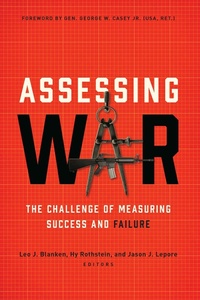
Assessing War
Description

Today's protracted asymmetrical conflicts confuse efforts to measure progress, often inviting politics and wishful thinking to replace objective evaluation.
In Assessing War, military historians, social scientists, and military officers explore how observers have analyzed the trajectory of war in American conflicts from the Seven Years' War through the war in Afghanistan. Drawing on decades of acquired expertise, the contributors examine wartime assessment in both theory and practice and, through alternative dimensions of assessment such as justice and proportionality, the war of ideas and economics. This group of distinguished authors grapples with both conventional and irregular wars and emerging aspects of conflict-such as cyberwar and nation building-that add to the complexities of the modern threat environment. The volume ends with recommendations for practitioners on best approaches while offering sobering conclusions about the challenges of assessing war without politicization or self-delusion.
Covering conflicts from the eighteenth century to today, Assessing War blends focused advice and a uniquely broad set of case studies to ponder vital questions about warfare's past-and its future. The book includes a foreword by Gen. George W. Casey Jr. (USA, Ret.), former chief of staff of the US Army and former commander, Multi-National Force-Iraq.
More details
Other editions
Additional editions
Persons
Leo J. Blanken is an associate professor in the Defense Analysis Department at the US Naval Postgraduate School and author of Rational Empires: Institutional Incentives and Imperial Expansion.
Hy Rothstein is a retired US Army colonel, a senior lecturer in the Department of Defense Analysis at the Naval Postgraduate School, and co-editor of Afghan Endgames: Strategy and Policy Choices for America's Longest War.
Jason J. Lepore is an associate professor of economics at California Polytechnic State University.
Content
Foreword by Gen. George W. Casey Jr. (USA, Ret.)
Introduction: The Challenge of Wartime Assessment
Leo J. Blanken and Jason J. Lepore
Part I. Theory
1. Principals, Agents, and Assessment
Leo J. Blanken and Jason J. Lepore
2. Civil-Military Relations and Operational Assessments
Hy Rothstein
3. Wartime Strategic Assessment: Concepts and Challenges
Scott Sigmund Gartner
Part II. Historical Cases
4. Assessing Proxy Forces: A Case Study of the Early Years of the Seven Years' War (1754?63) in North America
John Grenier
5. Assessing War: The Revolutionary War
Edward G. Lengel
6. Assessing Enemy Civilian Will: The United States Goes to War, 1861
Brooks D. Simpson
7. ?Keep 'Em Moving?: The Role of Assessment in US Cavalry Operations against the Plains Indians
Michael Richardson
8. Assessing the Philippine War
Brian McAllister Linn
9. Putting the Fuse to the Powder: Strategic Assessment in the First World War
D. Scott Stephenson
10. Assessment in World War II
Gerhard L. Weinberg
11. Measuring Gains on the Battlefield and at the Peace Table: Shifting Assessments during the Korean War
Conrad C. Crane
12. Choosing Progress: Evaluating the ?Salesmanship? of the Vietnam War in 1967
Gregory A. Daddis
Part III. Current Cases
13. Assessing Counterinsurgency: The Iraq War, 2004?5
William C. Hix and Kalev I. Sepp
14. Circular Logic and Constant Progress: IW Assessments in Afghanistan
Alejandro S. Hernandez, Julian Ouellet, and Christopher J. Nannini
15. Monitoring from Afar: How Al-Qaeda Assesses Its Progress
Mark Stout
Part IV. Alternative Dimensions of Assessment
16. Assessment, Proportionality, and Justice in War
Bradley J. Strawser and Russell Muirhead
17. Assessing Cyber War
Dorothy E. Denning
18. Assessing the War of Ideas during War
Robert Reilly
19. Assessing Economic Outcomes in Nation-building Operations
Aric P. Shafran
Conclusion: Can We Learn from the Assessment of War?
Anthony H. Cordesman and Hy Rothstein
Contributors
Index
