

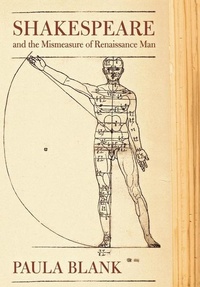
Shakespeare and the Mismeasure of Renaissance Man
1st Edition
Published on 5. July 2018
232 pages
978-1-5017-2685-9 (ISBN)
Description

Shakespeare's poems and plays are rich in reference to "measure, number, and weight," which were the key terms of an early modern empirical and quantitative imagination. Shakespeare's investigation of Renaissance measures of reality centers on the consequences of applying principles of measurement to the appraisal of human value. This is especially true of efforts to judge people as better or worse than, or equal to, one another. With special attention to the Sonnets, Measure for Measure, Merchant of Venice, Othello, King Lear, and Hamlet, Paula Blank argues that Shakespeare, in his experiments with measurement, demonstrates the incommensurability of the aims and operations of quantification with human experience.From scales and spans to squares and levels to ratings and rules, Shakespeare's rhetoric of measurement reveals the extent to which language in the Renaissance was itself understood as a set of alternative measures for figuring human worth. In chapters that explore attempts to measure human feeling, weigh human equalities (and inequalities), regulate race relations, and deduce social and economic merit, Blank shows why Shakespeare's measures are so often exposed as "mismeasures"-equivocal, provisional, and as unreliable as the men and women they are designed to assess.
More details
Language
English
Place of publication
NY
United States
Target group
College/higher education
Professional and scholarly
Edition type
Digital original
Illustrations
2 halftones
2 halftones
ISBN-13
978-1-5017-2685-9 (9781501726859)
Copyright in bibliographic data and cover images is held by Nielsen Book Services Limited or by the publishers or by their respective licensors: all rights reserved.
Schweitzer Classification
Other editions
Additional editions
Book
07/2006
Cornell University Press
€58.28
Shipment within 10-20 days
Person
BlankPaula:
Paula Blank is Associate Professor of English at the College of William & Mary. She is the author of Broken English: Dialects and the Politics of Language in Renaissance Writings.
Paula Blank is Associate Professor of English at the College of William & Mary. She is the author of Broken English: Dialects and the Politics of Language in Renaissance Writings.
Content
- Cover
- SHAKESPEARE and the Mismeasure of Renaissance Man
- Title
- Copyright
- CONTENTS
- Acknowledgments
- INTRODUCTION
- 1. THE RENAISSANCE ART OF MEASUREMENT
- 2. POETIC NUMBERS AND SHAKESPEARE'S "LINES OF LIFE
- 3. POUNDS OF FLESH Race Relations in the Venice Plays
- 4. SHAKESPEARE'S SOCIAL ARITHMETICS Checking the Math of King Lear
- 5. THE LESBIAN RULE OF MEASURE FOR MEASURE
- EPILOGUE: HOW SMART IS HAMLET? Shakespeare and Renaissance "Intelligence Testing
- Bibliography
- Index
