

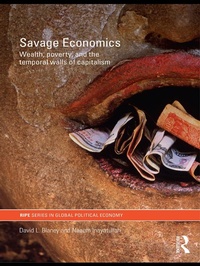
Savage Economics
Wealth, Poverty and the Temporal Walls of Capitalism
Published on 4. January 2010
248 pages
978-1-135-26504-5 (ISBN)
Description

This innovative book challenges the most powerful and pervasive ideas concerning political economy, international relations, and ethics in the modern world.
Rereading classical authors including Adam Smith, James Steuart, Adam Ferguson, Hegel, and Marx, it provides a systematic and fundamental cultural critique of political economy and critically describes the nature of the mainstream understanding of economics. Blaney and Inayatullah construct a powerful argument about how political economy and the capitalist market economy should be understood, demonstrating that poverty is a product of capitalism itself. They address the questions:
Is wealth for some bought at the cost of impoverishing, colonizing, or eradicating others?
What benefits of wealth might justify these human costs?
What do we gain and lose by endorsing a system of wealth creation?
Do even "savage cultures" contain values, critiques, and ways of life that the West still needs?
Opening the way for radically different policies addressing poverty and demanding a rethink of the connections between political economy and international relations, this thought-provoking book is vital reading for students and scholars of politics, economics, IPE and international relations.
Rereading classical authors including Adam Smith, James Steuart, Adam Ferguson, Hegel, and Marx, it provides a systematic and fundamental cultural critique of political economy and critically describes the nature of the mainstream understanding of economics. Blaney and Inayatullah construct a powerful argument about how political economy and the capitalist market economy should be understood, demonstrating that poverty is a product of capitalism itself. They address the questions:
Is wealth for some bought at the cost of impoverishing, colonizing, or eradicating others?
What benefits of wealth might justify these human costs?
What do we gain and lose by endorsing a system of wealth creation?
Do even "savage cultures" contain values, critiques, and ways of life that the West still needs?
Opening the way for radically different policies addressing poverty and demanding a rethink of the connections between political economy and international relations, this thought-provoking book is vital reading for students and scholars of politics, economics, IPE and international relations.
Reviews / Votes
'This is an exciting and innovative book. Blaney and Inayatullah draw on the rich tradition of classical political economy to construct critical theoretical ways of refusing misleading choices between modern and savage, economy and culture, capitalism and anti-capitalism in the analysis of contemporary international political economy. The book is a profound and thought-provoking contribution to postcolonial, time-travelling thinking in IR/IPE.' - Kim Hutchings, Professor of International Relations, London School of Economics, UK'In a provocative and brilliantly executed argument, Inayatullah and Blaney mobilize their postcolonial and ethnographic sensibilities in order to radically rethink the core concerns of - and solutions posited by - the classical political economy thinkers. After reading this seminal book no one will be able to doubt the intellectual and ethical urgency of building a cultural political economy approach.' - Robbie Shilliam, Political Science and International Relations Programme, Victoria University of Wellington
'Few people are able as well as Blaney and Inayatullah to connect important, pressing questions about the effects of capitalism - particularly poverty, inequality and violence - with a brilliant and sophisticated investigation of the ideas on which modern capitalism was founded and justified. Savage Economics is a tour de force in exposing the banality of much contemporary economic thought, and in reconnecting us to the ambivalence that its 18th and 19th century forebears had towards the world they saw unfolding and that we still live in.' - Matthew Paterson, University of Ottawa
'For too long the field of political economy has been dominated by technocratic analyses of market equilibria and inchoate rants about the evils of capitalist oppression. Inayatullah and Blaney's book suggests a profound reorientation of the entire discussion away from both minutia and sweeping generalization, and towards the kind of close reading that can generate a potent form of immanent critique. Their incisive discussion of some of the tradition's key texts discloses resources for ethical and political reflection that have been long obscured by the dominant mainstream reading of authors like Smith and Marx; our past is brought into dialogue with our present in a way that cannot help but dislocate the supposedly eternal verities of modern-day economics. This should be required reading for everyone who produces or consumes, especially for those producing and consuming political-economic knowledge.' - Patrick Thaddeus Jackson, Associate Professor, American University; author of Civilizing the Enemy (2006) and The Conduct of Inquiry in International Relations (2010)
More details
Series
Language
English
Place of publication
London
United Kingdom
Publishing group
Taylor & Francis Ltd
Target group
College/higher education
File size
2,38 MB
ISBN-13
978-1-135-26504-5 (9781135265045)
Copyright in bibliographic data and cover images is held by Nielsen Book Services Limited or by the publishers or by their respective licensors: all rights reserved.
Schweitzer Classification
Other editions
Additional editions
David L. Blaney | Naeem Inayatullah
Savage Economics
Wealth, Poverty and the Temporal Walls of Capitalism
Book
01/2010
1st Edition
Routledge
€231.80
Shipment within 15-20 days
David L. Blaney | Naeem Inayatullah
Savage Economics
Wealth, Poverty and the Temporal Walls of Capitalism
Book
12/2009
1st Edition
Routledge
€68.40
Shipment within 15-20 days
Persons
David L. Blaney is Professor in theDepartment of Political Science at Macalester University, USA. His research interests include the political and social theory of international relations, the history of political economic thought and contemporary international political economy, and democratic theory in a global age. His recent book (with Naeem Inayatullah), International Relations and the Problem of Difference (Routledge, 2004), explores the historical sources of the failure of international relations as a discipline to seriously confront issues of difference and the critical ethical resources attention to difference potentially uncovers.
Naeem Inayatullah is Associate Professor in theDepartment of Politics atIthaca College, USA. HIs research focuses on Political and Social Theory of International Relations, Third World Political Economy/Development Studies, History of Economic Thought, Culture and Identity in International Relations/International Political Economy and Theories of Learning.
Naeem Inayatullah is Associate Professor in theDepartment of Politics atIthaca College, USA. HIs research focuses on Political and Social Theory of International Relations, Third World Political Economy/Development Studies, History of Economic Thought, Culture and Identity in International Relations/International Political Economy and Theories of Learning.
Content
1. The Cultural Constitution of Political Economy 2. The Savage Smith and the Temporal Walls of Capitalism 3. Necro-economics and Steuart's Geocultural Political Economy 4. Capitalism's Wounds: Ferguson's International Political Economy 5. Shed No Tears: Hegel's Necro-Philosophy 6. Marx and Temporal Difference 7. Savage Times
