

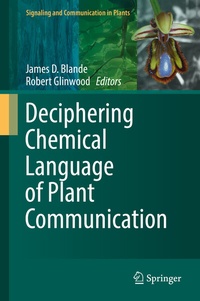
Deciphering Chemical Language of Plant Communication
Description

This book provides an overview of the intricacies of plant communication via volatile chemicals. Plants produce an extraordinarily vast array of chemicals, which provide community members with detailed information about the producer's identity, physiology and phenology. Volatile organic chemicals, either as individual compounds or complex chemical blends, are a communication medium operating between plants and any organism able to detect the compounds and respond. The ecological and evolutionary origins of particular interactions between plants and the greater community have been, and will continue to be, strenuously debated. However, it is clear that chemicals, and particularly volatile chemicals, constitute a medium akin to a linguistic tool. As well as possessing a rich chemical vocabulary, plants are known to detect and respond to chemical cues. These cues can originate from neighbouring plants, or other associated community members. This book beginswith chapters on the complexity of chemical messages, provides a broad perspective on a range of ecological interactions mediated by volatile chemicals, and extends to cutting edge developments on the detection of chemicals by plants.
More details
Other editions
Additional editions
Content
Section 1: Plant Volatiles - complexity of chemical messages.- 1. Temporal dynamics of plant volatiles: mechanistic bases and functional consequences.- 2. Environmental impacts on plant volatile emission.- 3. Impacts of induction of plant volatiles by individual and multiple stressors across multiple trophic levels.- 4. Measuring rapid changes in plant volatiles at different spatial levels.- Section 2: Ecology of volatile mediated communication processes.- 5. Who's listening to talking plants?.- 6. Ecological role of odour diversity.- 7. Neighbour recognition through volatile-mediated interactions.- 8. Calling in the dark: The role of volatiles for communication in the rhizosphere.- 9. Complexity of plant volatile-mediated interactions beyond the third trophic level.- 10. On the air: Broadcasting and reception of volatile messages in brood-site pollination mutualisms.- 11. Multifunctional and diverse floral scents mediate biotic interactions embedded in communities.- Section 3: Mechanisms of volatile detection by plants.- 12. Plant electrophysiology - early stages of the plant response to chemical signals.- 13. Uptake and conversion of volatile compounds in plant-plant communication.- Section 4 : Synthesis and future directions.- 14. Synthesis and future directions for deciphering plant chemical language.
