

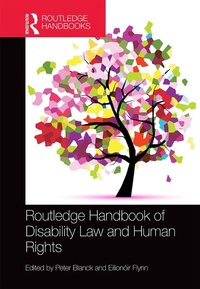
Routledge Handbook of Disability Law and Human Rights
1st Edition
Published on 7. July 2016
280 pages
978-1-317-04369-0 (ISBN)
Description

This handbook provides a comprehensive and authoritative state-of-the-art review of the current and emerging research and policy on disability law.
Bringing together a team of respected and experienced experts, the handbook offers a range of jurisdictional and multidisciplinary perspectives. The authors consider historical and contemporary, as well as comparative perspectives of disability law. Divided into three parts, the contributors provide a comprehensive reference to the theoretical underpinnings, ongoing debates and emerging fields within the subject. The study provides a strong basis for consideration of contemporary disability law, its research foundations, and progressive developments in the area. The book incorporates interdisciplinary and comparative country perspectives to capture the breadth of current discourse on disability law.
This handbook provides a valuable resource for a wide range of scholars, public and private researchers, NGOs, and practitioners working in the area of disability law, and across national and transnational disability schemes. The work will be of important interest to those in the fields of sociology, history, psychology, economics, political science, rehabilitation sciences, medicine, technology, and law, among others.
Bringing together a team of respected and experienced experts, the handbook offers a range of jurisdictional and multidisciplinary perspectives. The authors consider historical and contemporary, as well as comparative perspectives of disability law. Divided into three parts, the contributors provide a comprehensive reference to the theoretical underpinnings, ongoing debates and emerging fields within the subject. The study provides a strong basis for consideration of contemporary disability law, its research foundations, and progressive developments in the area. The book incorporates interdisciplinary and comparative country perspectives to capture the breadth of current discourse on disability law.
This handbook provides a valuable resource for a wide range of scholars, public and private researchers, NGOs, and practitioners working in the area of disability law, and across national and transnational disability schemes. The work will be of important interest to those in the fields of sociology, history, psychology, economics, political science, rehabilitation sciences, medicine, technology, and law, among others.
Reviews / Votes
The Ashgate Research Companion to Disability Law is an accessible but sophisticated treatment of the fast-moving field of disability law and policy. Addressing domestic, comparative, and international developments, it will become an important resource for researchers and practitioners in the many disciplines that touch the lives of people with disabilities. Michael Waterstone, Fritz B. Burns Dean, Loyola Law School.More details
Edition
1. Auflage
Language
English
Place of publication
London
United Kingdom
Publishing group
Taylor & Francis Ltd
Target group
College/higher education
Illustrations
7 Line drawings, black and white
File size
1,53 MB
ISBN-13
978-1-317-04369-0 (9781317043690)
Copyright in bibliographic data and cover images is held by Nielsen Book Services Limited or by the publishers or by their respective licensors: all rights reserved.
Schweitzer Classification
Other editions
Additional editions
Peter Blanck | Eilionoir Flynn
Routledge Handbook of Disability Law and Human Rights
Book
06/2020
1st Edition
Routledge
€71.60
Shipment within 15-20 days
Peter Blanck | Eilionoir Flynn
Routledge Handbook of Disability Law and Human Rights
Book
07/2016
1st Edition
Routledge
€326.82
Shipment within 10-20 days
Persons
Peter Blanck is University Professor and Chairman, Burton Blatt Institute, Syracuse University, USA. He is also Honorary Professor, Centre for Disability Law & Policy, at the National University of Ireland, Galway. Blanck is Chairman of the Global Universal Design Commission (GUDC), and President of Raising the Floor (RtF) USA. He has written articles and books on the Americans with Disabilities Act (ADA) and related laws, and received grants to study disability law and policy.
Eilionoir Flynn is the Deputy Director of the Centre for Disability Law and Policy, and Senior Lecturer at the School of Law, National University of Ireland Galway. Her interest in disability law stems from a broader interest in social justice and a recognition of the invisibility of people with disabilities in broader human rights discourse. Her current research interests in this field include legal capacity, disability advocacy and access to justice, and she has published widely in national and international peer reviewed journals on these issues, as well as producing a monograph on the implementation of the CRPD for Cambridge University Press.
Eilionoir Flynn is the Deputy Director of the Centre for Disability Law and Policy, and Senior Lecturer at the School of Law, National University of Ireland Galway. Her interest in disability law stems from a broader interest in social justice and a recognition of the invisibility of people with disabilities in broader human rights discourse. Her current research interests in this field include legal capacity, disability advocacy and access to justice, and she has published widely in national and international peer reviewed journals on these issues, as well as producing a monograph on the implementation of the CRPD for Cambridge University Press.
Content
Theoretical Underpinnings of Disability Law
Section I
1. The Social Model of Disability: Questions for Law and Legal Scholarship?
Anna Lawson & Mark Priestley
2. Beyond the Welfare State - What Next for the European Social Model?
Bjorn Hvinden
3. A Human Rights Model of Disability
Theresia Degener
Ongoing Debates in Disability Law
Section II Introduction
4. Today's Lesson is on Diversity
Rosemary Kayess & Jennifer Green
5. Equality of Opportunity in Employment? Disability Rights and Active Labour
Market Policies
Lisa Waddington & Mark Priestley & Betul Yalcin
6. Disabled People and Access to Justice: From Disablement to Enablement?
Anna Lawson
7. Hit and Miss: Procedural Accommodations Ensuring the Effective Access of
People with Mental Disabilities to the European Court of Human Rights
Constantin Cojocariu
8. Toward Inclusion: Political and Social Participation of People with Disabilities
Lisa Schur
Emerging Fields in Disability Law
Section III Introduction
9. Legal Capacity: A Global Analysis of Reform Trends
Lucy Series, Anna Arstein-Kerslake & Elizabeth Kamundia
10. Back to the Future? Article 19 and the Nordic Experience of Independent Living
and Personal Assistance
Ciara Brennan
11. eQuality: The Right to the Web
Peter Blanck
12. Disability and Ageing: Bridging the Divide? Social Constructions and Human Rights
Eilionoir Flynn
13. Disability and Genetics - New Forms of Discrimination?
Aisling dePaor
14. Inclusive Development Aid
Mary Keogh
15. Disability Family Policy and the United Nations Convention on the Rights of
Persons with Disabilities (CRPD): The Case of Israel
Arie Rimmerman and Michal Soffer
Section I
1. The Social Model of Disability: Questions for Law and Legal Scholarship?
Anna Lawson & Mark Priestley
2. Beyond the Welfare State - What Next for the European Social Model?
Bjorn Hvinden
3. A Human Rights Model of Disability
Theresia Degener
Ongoing Debates in Disability Law
Section II Introduction
4. Today's Lesson is on Diversity
Rosemary Kayess & Jennifer Green
5. Equality of Opportunity in Employment? Disability Rights and Active Labour
Market Policies
Lisa Waddington & Mark Priestley & Betul Yalcin
6. Disabled People and Access to Justice: From Disablement to Enablement?
Anna Lawson
7. Hit and Miss: Procedural Accommodations Ensuring the Effective Access of
People with Mental Disabilities to the European Court of Human Rights
Constantin Cojocariu
8. Toward Inclusion: Political and Social Participation of People with Disabilities
Lisa Schur
Emerging Fields in Disability Law
Section III Introduction
9. Legal Capacity: A Global Analysis of Reform Trends
Lucy Series, Anna Arstein-Kerslake & Elizabeth Kamundia
10. Back to the Future? Article 19 and the Nordic Experience of Independent Living
and Personal Assistance
Ciara Brennan
11. eQuality: The Right to the Web
Peter Blanck
12. Disability and Ageing: Bridging the Divide? Social Constructions and Human Rights
Eilionoir Flynn
13. Disability and Genetics - New Forms of Discrimination?
Aisling dePaor
14. Inclusive Development Aid
Mary Keogh
15. Disability Family Policy and the United Nations Convention on the Rights of
Persons with Disabilities (CRPD): The Case of Israel
Arie Rimmerman and Michal Soffer
