

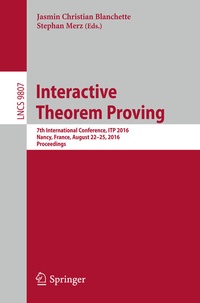
Interactive Theorem Proving
7th International Conference, ITP 2016, Nancy, France, August 22-25, 2016, Proceedings
Published on 8. August 2016
XVII, 502 pages
978-3-319-43144-4 (ISBN)
Description

This book constitutes the refereed proceedings of the 7th International Conference on Interactive Theorem Proving, ITP 2016, held in Nancy, France, in August 2016.
The 27 full papers and 5 short papers presented were carefully reviewed and selected from 55 submissions. The topics range from theoretical foundations to implementation aspects and applications in program verification, security and formalization of mathematical theories.
The 27 full papers and 5 short papers presented were carefully reviewed and selected from 55 submissions. The topics range from theoretical foundations to implementation aspects and applications in program verification, security and formalization of mathematical theories.
More details
Other editions
Additional editions
Jasmin Christian Blanchette | Stephan Merz
Interactive Theorem Proving
7th International Conference, ITP 2016, Nancy, France, August 22-25, 2016, Proceedings
Book
08/2016
Springer
€53.49
Shipment within 10-15 days
Content
- Intro
- Preface
- Organization
- Abstracts of Keynote Presentations
- Propositions as Programs, Proofs as Programs
- Formal Verification of Financial Algorithms, Progress and Prospects
- Dijkstra Monads for Free: A Framework for Deriving and Extending F*'s Effectful Semantics
- Contents
- Regular Contributions
- An Isabelle/HOL Formalisation of Green's Theorem
- 1 Introduction
- 2 Basic Concepts and Lemmas
- 3 More General Structures
- 3.1 Chains and Cubes
- 3.2 Dealing with Boundaries
- 4 Conclusion and Future Work
- References
- HOL Zero's Solutions for Pollack-Inconsistency
- 1 Introduction
- 1.1 Overview
- 1.2 Concepts, Terminology and Notation
- 2 The Need for Good Parsers and Printers
- 2.1 Proof Auditing
- 2.2 Usability
- 3 Classic Problems with HOL Parsers and Printers
- 3.1 Entities with Irregular Names
- 3.2 Entities with Keyword Names
- 3.3 Variable-Constant Overloading
- 3.4 Variable-Variable Overloading
- 3.5 Type Ambiguity in Printed Terms
- 3.6 Juxtaposition of Lexical Tokens in Printed Expressions
- 4 Lexical Solutions
- 4.1 Identifier Delimiters
- 4.2 Variable Marking
- 4.3 Spacing Between Tokens
- 5 Type Inference for Variable-Variable Overloading
- 5.1 Hindley-Milner Type Inference
- 5.2 A New Notion of Syntactic Scope for Variables
- 5.3 Adjustments to the Hindley-Milner Algorithm
- 6 Minimal Unambiguous Type Annotation
- 7 Conclusions
- References
- Infeasible Paths Elimination by Symbolic Execution Techniques
- 1 Introduction
- 2 Background: Isabelle and Isabelle/HOL
- 3 A Guided Run of ATRACER
- 3.1 Presenting ATRACER by an Example
- 4 The Formalization of ATRACER
- 4.1 The Theory of Red-Black Graphs
- 4.2 Graph-Transformations on Red-Black Graphs
- 4.3 Main Theorems of ATRACER
- 4.4 Summary
- 5 Conclusion
- References
- Proof of OS Scheduling Behavior in the Presence of Interrupt-Induced Concurrency
- 1 Introduction
- 2 Background and Big Picture
- 3 The Model
- 3.1 A Generic Model of Interrupt-Driven Interleaving
- 3.2 Instantiation to the eChronos OS
- 4 Proof Framework and Scheduler Proof
- 4.1 Framework and Compositionality Lemma
- 4.2 The Statement and Its Proof
- 4.3 Proof-Engineering Considerations
- 5 Related Work
- 6 Conclusion
- References
- POSIX Lexing with Derivatives of Regular Expressions (Proof Pearl)
- 1 Introduction
- 2 Preliminaries
- 3 POSIX Regular Expression Matching
- 4 Extensions and Optimisations
- 5 The Correctness Argument by Sulzmann and Lu
- 6 Conclusion
- References
- CoSMed: A Confidentiality-Verified Social Media Platform
- 1 Introduction
- 2 System Description
- 2.1 Isabelle Specification
- 2.2 Implementation
- 3 Stating Confidentiality
- 3.1 From CoCon to CoSMed
- 3.2 BD Security Recalled
- 3.3 CoSMed Confidentiality as BD Security
- 3.4 More Confidentiality Properties
- 4 Verifying Confidentiality
- 4.1 BD Unwinding Recalled
- 4.2 Unwinding Relations for CoSMed
- 5 Verification Summary
- 6 Related Work
- References
- Mechanical Verification of a Constructive Proof for FLP
- 1 Introduction
- 2 Preliminaries
- 2.1 Distributed Systems and Consensus
- 2.2 Isabelle/HOL
- 3 Model
- 3.1 Asynchronous System
- 3.2 Executions
- 4 FLP Formalization
- 4.1 FLPSystem
- 4.2 FLPTheorem
- 4.3 Proof Structure
- 4.4 Discussion
- 5 Conclusion
- References
- Visual Theorem Proving with the Incredible Proof Machine
- 1 Introduction
- 2 Proof Graphs
- 2.1 Conclusion and Assumption
- 2.2 Rule Blocks
- 2.3 Local Hypotheses
- 2.4 Predicate Logic
- 2.5 Helper Block
- 2.6 Custom Blocks
- 2.7 Custom Logics
- 3 Theory
- 3.1 Port Graphs
- 3.2 Scopes
- 3.3 Graph Shapes
- 3.4 Propositions
- 3.5 Scoped Variables
- 3.6 Example
- 3.7 Proof Conclusions
- 4 Implementation
- 5 Evaluation
- 5.1 Classroom Experience
- 5.2 Online Reception
- 6 Future Directions
- 7 Related Work
- 8 Conclusions
- References
- Proof Pearl: Bounding Least Common Multiples with Triangles
- 1 Introduction
- 2 Background
- 2.1 LCM Lower Bound for a List
- 2.2 Pascal's Triangle
- 2.3 Leibniz's Harmonic Triangle
- 3 Leibniz's Denominator Triangle and Its Triplets
- 3.1 LCM Exchange
- 4 Paths Through Triangles
- 4.1 Zig-Zag Paths
- 4.2 Wriggle Paths
- 4.3 Wriggling Inductions
- 5 LCM Lower Bound
- 6 Conclusion
- References
- Two-Way Automata in Coq
- 1 Introduction
- 2 Type Theory Preliminaries
- 3 Languages in Type Theory
- 4 One-Way Automata
- 5 Classifiers and Myhill-Nerode
- 6 Two-Way Finite Automata
- 7 Vardi Construction
- 8 Shepherdson Construction
- 9 Conclusion
- References
- Mostly Automated Formal Verification of Loop Dependencies with Applications to Distributed Stencil Algorithms
- 1 Introduction
- 1.1 Related Work
- 2 Verifying Stencil Code
- 2.1 Stencils and Their Representation
- 2.2 Programs: Syntax, Semantics, and Correctness
- 2.3 Verification Conditions and Symbolic Execution
- 3 Verifying Distributed Stencil Algorithms
- 3.1 Reduction to the Sequential Case
- 3.2 Distributed Kernels: Syntax, Semantics, and Correctness
- 3.3 Trace Generation
- 4 Implementation and Experimental Results
- 4.1 A Simple Example
- 4.2 Automation: Sets and Nonlinear Arithmetic
- 4.3 More Examples
- 5 Conclusions and Future Work
- References
- The Flow of ODEs
- 1 Introduction
- 2 Overview
- 3 The Flow of a Differential Equation
- 3.1 Composition of Solutions
- 3.2 Continuity of the Flow
- 3.3 Differentiability of the Flow
- 4 Rigorous Numerics for the Derivative of the Flow
- 5 Uniform Limit as Filter
- 6 Bounded Linear Functions
- 6.1 Type Classes for Mathematics in Isabelle/HOL
- 6.2 A Type of Bounded Linear Functions
- 6.3 Instantiations
- 6.4 Applications
- 7 Proofs About the Flow
- 7.1 Criteria for Unique Solution
- 7.2 The Frontier of the State Space
- 7.3 Continuity of the Flow
- 7.4 Differentiability of the Flow
- 7.5 Continuity of Derivative
- 8 Conclusion
- References
- From Types to Sets by Local Type Definitions in Higher-Order Logic
- 1 Motivation
- 2 HOL and Isabelle/HOL Recalled
- 2.1 Core Logic
- 2.2 Definitional Mechanisms of HOL
- 2.3 Definitional Mechanisms of Isabelle/HOL
- 3 Proposal of a Logic Extension: Local Typedef
- 4 From Types to Sets in HOL
- 5 From Types to Sets in Isabelle/HOL
- 5.1 Local Axiomatic Type Classes
- 5.2 Local Overloading
- 5.3 Example: Relativization of Topological Spaces
- 5.4 General Case
- 6 Transfer: Automated Relativization
- 7 Conclusion
- References
- Formalizing the Edmonds-Karp Algorithm
- 1 Introduction
- 2 The Ford-Fulkerson Method
- 3 Formalizing the Ford-Fulkerson Method
- 3.1 Presentation of Proofs
- 3.2 Presentation of Algorithms
- 4 Refinement in Isabelle/HOL
- 5 The Edmonds-Karp Algorithm
- 6 Refinement to Executable Code
- 6.1 Using Breadth First Search
- 6.2 Manipulating Residual Graphs Directly
- 6.3 Implementing Augmentation
- 6.4 Computing Successors
- 6.5 Using Efficient Data Structures
- 6.6 Network Checker
- 7 Benchmarking
- 8 Conclusion
- 8.1 Related Work
- 8.2 Future Work
- References
- A Formal Proof of Cauchy's Residue Theorem
- 1 Introduction
- 2 Background
- 2.1 Contour Integrals
- 2.2 Valid Path
- 2.3 Winding Number
- 2.4 Holomorphic Functions and Cauchy's Integral Theorem
- 2.5 Remarks on the Porting Efforts
- 3 Cauchy's Residue Theorem
- 3.1 Residue
- 3.2 Generalization to a Finite Number of Singularities
- 3.3 Applications
- 3.4 Remarks on the Formalization
- 4 The Argument Principle
- 4.1 Zeros and Poles
- 4.2 The Main Proof
- 4.3 Remarks
- 5 Rouché's Theorem
- 6 Related Work
- 7 Conclusion
- References
- Equational Reasoning with Applicative Functors
- 1 Introduction
- 1.1 Background on Applicative Functors
- 1.2 Motivating Example: Tree Labelling
- 2 Modelling Applicative Functors in HOL
- 3 Lifting with Applicative Functors
- 3.1 Conversion to Canonical Form
- 3.2 Lifting
- 4 Combinators
- 4.1 The Combinatorial Basis BCKW
- 4.2 Characterisation of Liftable Equations
- 4.3 Implementation via Bracket Abstraction
- 4.4 Application: The Stern-Brocot Tree
- 5 Related Work
- 6 Conclusion and Future Work
- A Definitions of Applicative Functors
- References
- Formally Verified Approximations of Definite Integrals
- 1 Introduction
- 2 Preliminaries
- 2.1 Notations and First Definitions
- 2.2 Elementary Real Analysis in Coq
- 2.3 Numerical Computations in Coq
- 3 Interval Methods to Approximate an Integral
- 3.1 Naive Integral Enclosure
- 3.2 Polynomial Approximation
- 3.3 Quality of the Integral Enclosures
- 3.4 Dichotomy and Adaptivity
- 4 Automating the Proof Process
- 4.1 Straight-Line Programs and Enclosures
- 4.2 Checking Integrability
- 4.3 Integration into a Tactic
- 4.4 Controlling the Tactic
- 5 Benchmarks
- 6 Conclusion
- References
- Certification of Classical Confluence Results for Left-Linear Term Rewrite Systems
- 1 Introduction
- 2 Preliminaries
- 3 Strongly Closed Critical Pairs
- 4 Parallel Closed Critical Pairs
- 5 Almost Parallel Closed Critical Pairs and Commutation
- 6 Certification and Experiments
- 7 Conclusion
- References
- Automatic Functional Correctness Proofs for Functional Search Trees
- 1 Introduction
- 2 Lists and Trees
- 3 Set Implementations
- 3.1 The Standard Approach
- 3.2 The inorder Approach
- 4 The Verification Framework
- 4.1 Proof Automation by Rewriting
- 5 An Arboretum
- 5.1 Unbalanced Trees
- 5.2 AVL Trees
- 5.3 Red-Black Trees
- 5.4 2-3 Trees
- 5.5 2-3-4 Trees
- 5.6 1-2 Brother Trees
- 5.7 AA Trees
- 5.8 Splay Trees
- 6 Maps
- 6.1 Specifications
- 6.2 Proof Automation
- 7 Conclusion
- References
- A Framework for the Automatic Formal Verification of Refinement from Cogent to C
- 1 Introduction
- 2 Overview and Background
- 2.1 COGENT
- 2.2 AutoCorres and C Monads in Isabelle/HOL
- 3 Refinement Framework
- 3.1 Refinement Statement
- 3.2 Data Relations
- 3.3 Refinement Theorem
- 3.4 Refinement Proof
- 4 Related Work
- 5 Take Away Lessons and Future Work
- 6 Conclusions
- References
- Formalization of the Resolution Calculus for First-Order Logic
- 1 Introduction
- 2 Overview
- 3 Clausal First-Order Logic
- 4 The Resolution Calculus
- 5 Herbrand Interpretations
- 5.1 Semantic Trees
- 5.2 Herbrand's Theorem
- 6 Completeness
- 6.1 Lifting Lemma
- 6.2 The Formal Completeness Proof
- 6.3 Standardizing Apart
- 6.4 Branches and Ground Clauses
- 6.5 The Derivation
- 7 Related Work
- 8 Conclusion
- References
- Verified Operational Transformation for Trees
- 1 Introduction
- 2 Formalization of OT Algorithms and Their Correctness Properties
- 2.1 Operation Model
- 2.2 Transformation of Composite Operations (file Comp.v)https://github.com/JetBrains/ot-coq/blob/master/Comp.v.
- 3 Examples of Verified Transformation Functions
- 3.1 The Case of Ordered Trees with Labels
- 3.2 The Case of Unordered Trees
- 4 Related Work
- 5 Conclusions and Future Work
- References
- Hereditarily Finite Sets in Constructive Type Theory
- 1 Introduction
- 2 Preliminaries
- 3 HF Structures
- 4 Categoricity
- 5 Set Operations
- 6 Ordinals
- 7 Cardinality
- 8 Binary Trees
- 9 Tree Model
- 10 Conclusion
- References
- Algebraic Numbers in Isabelle/HOL
- 1 Introduction
- 2 Resultants
- 2.1 Resultant Has Desired Roots
- 2.2 Resultant Is Non-Zero
- 3 Euclid-Like Computation of Resultants
- 3.1 The Algorithm and Its Correctness
- 3.2 Polynomial Division in Isabelle's Class Hierarchy
- 3.3 Performance Issues
- 4 Factorization of Rational Polynomials
- 4.1 Verified Kronecker's Factorization
- 4.2 Factorization Oracles
- 5 Real Algebraic Numbers
- 5.1 Separation of Roots
- 5.2 Comparisons of Algebraic Numbers
- 5.3 Types for Real Algebraic Numbers
- 6 Complex Algebraic Numbers
- 7 Displaying Algebraic Numbers
- 8 Conclusion
- References
- Modular Dependent Induction in Coq, Mendler-Style
- 1 Introduction
- 2 Initial Semantics and Impredicative Encoding
- 3 Modular Datatypes: An Example
- 4 Inductive Proofs with MTC Induction
- 5 Mendler-Style Induction
- 6 Conclusion
- References
- Formalized Timed Automata
- 1 Introduction
- 1.1 History and Related Work
- 2 Diagonal-Free Timed Automata in Isabelle/HOL
- 2.1 Syntactic Definition
- 2.2 Operational Semantics
- 2.3 Zone Semantics
- 3 Difference Bound Matrices
- 3.1 Fundamentals
- 3.2 Operations
- 3.3 DBM Operational Semantics
- 4 From Classic Decidability to a Correct Approximation
- 4.1 Regions
- 4.2 Decidability with Regions
- 4.3 Approximating Zone Semantics with Regions
- 5 Normalization
- 5.1 -approximation
- 5.2 Connecting Approx and Closure
- 5.3 Computing Approx
- 5.4 A Final Semantics
- 6 Conclusion
- References
- AUTO2, A Saturation-Based Heuristic Prover for Higher-Order Logic
- 1 Introduction
- 2 Objectives
- 3 Description of the System
- 3.1 Box Lattice
- 3.2 Item Types
- 3.3 Skolemization and Induction
- 3.4 Matching
- 3.5 Scoring
- 3.6 A Simple Example
- 3.7 Proof Scripts
- 3.8 Practical Usage
- 4 Case Studies
- 4.1 Elementary Theory of Prime Numbers
- 4.2 Verification of Imperative Programs
- 5 Related Work
- 6 Conclusion
- References
- Rough Diamonds
- What's in a Theorem Name?
- 1 Introduction
- 2 Parts of Names and Theorems
- 3 Learning Associations Between Names and Statements
- 4 Preliminary Evaluation
- 5 Conclusions
- References
- Cardinalities of Finite Relations in Coq
- 1 Introduction
- 2 Preliminaries
- 3 Relation Algebra in Coq
- 4 Applications
- 4.1 Linear Orders
- 4.2 Independence Number of a Graph
- 5 Conclusion
- References
- Formalising Semantics for Expected Running Time of Probabilistic Programs
- 1 Introduction
- 2 Preliminaries
- 3 Probabilistic Guarded Command Language (pGCL)
- 4 Simple Symmetric Random Walk
- 5 Coupon Collector
- 6 Related Work
- 7 Conclusion and Future Work
- References
- On the Formalization of Fourier Transform in Higher-order Logic
- 1 Introduction
- 2 Formalization of Fourier Transform
- 3 Formal Verification of Fourier Transform Properties
- 4 Application: Automobile Suspension System
- 5 Conclusions
- References
- CoqPIE: An IDE Aimed at Improving Proof Development Productivity
- 1 Introduction
- 2 An Overview of CoqPIE
- 3 Experience with Implementation
- 4 Related Work
- 5 Conclusion
- References
- Author Index
