

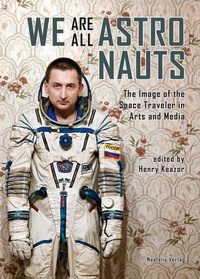
We Are All Astronauts
Description

"We are all astronauts", the American architect and thinker Richard Buckminster Fuller wrote in 1968 in his book Operating Manual for Spaceship Earth, where he compared Earth to a spaceship, provided only with exhaustible resources while flying through space.
These words show the presence the phenomenon of the astronaut and the cosmonaut had in the public mind from the second half of the twentieth century on: Buckminster Fuller was able to drive his point home by asking his audience to identify with one of the most prominent figures in the public sphere then: the space traveler. At the same time, Buckminster Fuller's words themselves seem to have played a significant role in further shaping the space-exploring human as a symbol and an image of humankind in general.
The twelve contributions in this book by authors from the fields of literature, music, politics, history, the visual arts, film, computer games, comics, social sciences, and media theory track the development, changes and dynamics of this symbol by analyzing the various images of the astronaut and the cosmonaut as constructed throughout the different decades of space exploration, from its beginning to the present day.
More details
Other editions
Additional editions

Persons
Henry Keazor wurde 1996 an der Universität Heidelberg promoviert. Anschließend unterrichtete er an der Goethe-Universität Frankfurt, war Gastprofessor am Institut für Kunstgeschichte an der Universität Mainz und wurde 2006 Heisenberg-Fellow der Deutschen Forschungsgemeinschaft. Von 2008 bis 2012 hatte er den Lehrstuhl für Kunstgeschichte an der Universität des Saarlandes inne. Seitdem ist er Lehrstuhlinhaber für Neuere und Neueste Kunstgeschichte an der Universität Heidelberg. Seine Forschungsschwerpunkte sind französische und italienische Malerei des 16. und 17. Jahrhunderts, zeitgenössische Medien und visuelle Kultur, das Phänomen der Kunstfälschung sowie zeitgenössische Architektur und ihr Verhältnis zu modernen Medien.
Content
- Cover
- Half Title
- Title Page
- Table of Contents
- Keazor: "We Are All Astronauts"
- Hersch: Redemptive Space
- Rossi: All We Mad Starmen
- Oswald: The Space Traveler
- Boyle: Through the Eyes of the Astronaut
- Hartmann: Female Space Travelers in Science Fiction Films 1898-2017
- Blancher: "Let's discover Space!"
- Peiler: Backlash of the Future
- Bonner: 'Climb the Penrose Stairs to Merge with the (In)Finite'
- Butler: The Future that Never Was
- Bonner, Hensel: Astronaut and Avatar
- Table of Figures
- Colophon
