

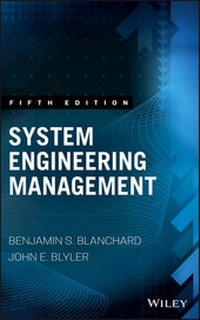
System Engineering Management
Description

More details
Other editions
Additional editions
Persons
Content
Preface xi
1 Introduction to System Engineering 1
1.1 Definition of a System 2
1.1.1 The Characteristics of a System 2
1.1.2 Categories of Systems 5
1.1.3 System of Systems (SOS) 8
1.2 The Current Environment: Some Challenges 9
1.3 The Need for System Engineering 15
1.3.1 The System Life Cycle 16
1.3.2 Definition of System Engineering 18
1.3.3 Requirements for System Engineering 25
1.3.4 System Architecture 26
1.3.5 System Science 26
1.3.6 System Analysis 27
1.3.7 Some Additional System Models 28
1.3.8 System Engineering in the Life Cycle (Some Applications) 32
1.4 Related Terms and Definitions 34
1.4.1 Concurrent/Simultaneous Engineering 35
1.4.2 Some Major Supporting Design Disciplines 36
1.4.3 Logistics and Supply-Chain Management (SCM) 38
1.4.4 Integrated System Maintenance and Support 40
1.4.5 Data and Information Management 43
1.4.6 Configuration Management (CM) 44
1.4.7 Total Quality Management (TQM) 45
1.4.8 Total System Value and Life-Cycle Cost (LCC) 45
1.4.9 Some Additional Terms And Definitions 46
1.5 System Engineering Management 47
1.6 Summary 51
Questions and Problems 51
2 The System Engineering Process 53
2.1 Definition of the Problem (Current Deficiency) 55
2.2 System Requirements (Needs Analysis) 56
2.3 System Feasibility Analysis 57
2.4 System Operational Requirements 59
2.5 The Logistics and Maintenance Support Concept 62
2.6 Identification and Prioritization of Technical Performance Measures (TPMs) 69
2.7 Functional Analysis 74
2.7.1 Functional Flow Block Diagrams (FFBDs) 77
2.7.2 Operational Functions 80
2.7.3 Maintenance and Support Functions 80
2.7.4 Application of Functional Analysis 81
2.7.5 Interfaces with Other Systems in a SOS Configuration 88
2.8 Requirements Allocation 90
2.8.1 Functional Packaging and Partitioning 90
2.8.2 Allocation of System-Level Requirements to the Subsystem Level and Below 92
2.8.3 Traceability of Requirements (Top-Down/Bottom-Up) 95
2.8.4 Allocation of Requirements in a SOS Configuration 95
2.9 System Synthesis, Analysis, and Design Optimization 97
2.10 Design Integration 105
2.11 System Test and Evaluation 108
2.11.1 Categories of Test and Evaluation 110
2.11.2 Integrated Test Planning 112
2.11.3 Preparation for Test and Evaluation 113
2.11.4 Test Performance, Data Collection, Analysis, and Validation 115
2.11.5 System Modifications 115
2.12 Production and/or Construction 117
2.13 System Operational Use and Sustaining Support 118
2.14 System Retirement and Material Recycling/Disposal 120
2.15 Summary 121
Questions and Problems 122
3 System Design Requirements 125
3.1 Development of Design Requirements and Design-To Criteria 128
3.2 Development of Specifications 129
3.3 The Integration of System Design Activities 135
3.4 Selected Design Engineering Disciplines 139
3.4.1 Software Engineering 139
3.4.2 Reliability Engineering 144
3.4.3 Maintainability Engineering 159
3.4.4 Human-Factors Engineering 174
3.4.5 Safety Engineering 185
3.4.6 Security Engineering 187
3.4.7 Manufacturing and Production Engineering 189
3.4.8 Logistics and Supportability Engineering 191
3.4.9 Disposability Engineering 199
3.4.10 Quality Engineering 200
3.4.11 Environmental Engineering 204
3.4.12 Value/Cost Engineering (Life-Cycle Costing) 207
3.5 SOS Integration and Interoperability Requirements 215
3.6 Summary 216
Questions and Problems 219
4 Engineering Design Methods and Tools 223
4.1 Conventional Design Practices 225
4.2 Analytical Methods 228
4.3 Information Technology, the Internet, and Emerging Technologies 229
4.4 Current Design Technologies and Tools 231
4.4.1 The Use of Simulation in System Engineering 235
4.4.2 The Use of Rapid Prototyping 235
4.4.3 The Use of Mock-Ups 236
4.5 Computer-Aided Design (CAD) 237
4.6 Computer-Aided Manufacturing (CAM) 245
4.7 Computer-Aided Support (CAS) 246
4.8 Summary 248
Questions and Problems 249
5 Design Review and Evaluation 251
5.1 Design Review and Evaluation Requirements 252
5.2 Informal Day-to-Day Review and Evaluation 256
5.3 Formal Design Reviews 262
5.3.1 Conceptual Design Review 264
5.3.2 System Design Reviews 265
5.3.3 Equipment/Software Design Reviews 266
5.3.4 Critical Design Review 267
5.4 The Design Change and System Modification Process 269
5.5 Supplier Review and Evaluation 272
5.6 Summary 274
Questions and Problems 274
6 System Engineering Program Planning 275
6.1 System Engineering Program Requirements 278
6.1.1 The Need for Early System Planning 278
6.1.2 Determination of Program Requirements 280
6.2 System Engineering Management Plan (SEMP) 282
6.2.1 Statement of Work 285
6.2.2 Definition of System Engineering Functions and Tasks 286
6.2.3 System Engineering Organization 293
6.2.4 Development of a Work Breakdown Structure (wbs) 296
6.2.5 Specification/Documentation Tree 303
6.2.6 Technical Performance Measures (TPM) 309
6.2.7 Development of Program Schedules 310
6.2.8 Preparation of Cost Projections 324
6.2.9 Program Technical Reviews and Audits 328
6.2.10 Program Reporting Requirements 329
6.3 Determination of Outsourcing Requirements 332
6.3.1 Identification of Potential Suppliers 334
6.3.2 Development of a Request for Proposal (RFP) 336
6.3.3 Review and Evaluation of Supplier Proposals 337
6.3.4 Selection of Suppliers and Contract Negotiation 344
6.3.5 Supplier Monitoring and Control 351
6.4 Integration of Design Specialty Plans 353
6.5 Interfaces with Other Program Activities 355
6.5.1 Interface Management 359
6.6 Management Methods/Tools 360
6.7 Risk Management Plan 361
6.8 Global Applications/Relationships 366
6.9 Summary 367
Questions and Problems 369
7 Organization for System Engineering 372
7.1 Developing the Organizational Structure 373
7.2 Customer, Producer, and Supplier Relationships 374
7.3 Customer Organization and Functions 376
7.4 Producer Organization and Functions (the Contractor) 378
7.4.1 Functional Organization Structure 379
7.4.2 Product-Line/Project Organization Structure 383
7.4.3 Matrix Organizational Structure 384
7.4.4 Integrated Product and Process Development (IPPD) 387
7.4.5 Integrated Product/Process Teams (IPTs) 389
7.4.6 System Engineering Organization 390
7.5 Tailoring the Process 396
7.5.1 Tailoring the Process 400
7.5.2 Middle-Out Approach 401
7.5.3 Managing from the Middle 404
7.6 Supplier Organization and Functions 406
7.6.1 Mapping Organization and Systems Structures 409
7.7 Human Resource Requirements 411
7.7.1 Creating the Proper Organizational Environment 411
7.7.2 Leadership Characteristics 414
7.7.3 The Needs of the Individual 415
7.7.4 Staffing the Organization 419
7.7.5 Personnel Development and Training 421
7.8 Summary 423
Questions and Problems 424
8 System Engineering Program Evaluation 426
8.1 Evaluation Requirements 428
8.2 Benchmarking 428
8.3 Evaluation of the System Engineering Organization 431
8.4 Program Reporting, Feedback, and Control 437
8.5 Summary 438
Questions and Problems 439
Appendix A Functional Analysis (Case-Study Examples) 440
Appendix B Cost Process and Models 447
Appendix c Selected Case Studies (Nine Examples) 481
Appendix d Design Review Checklist 529
Appendix E Supplier Evaluation Checklist 530
Appendix F Selected Bibliography 531
Index 539
Preface
Current trends indicate that, in general, the complexity of systems is increasing, and the challenges associated with bringing new systems into being are greater than ever! Requirements are constantly changing with the introduction of new technologies on a continuing and evolutionary basis; the life cycles of many systems are being extended, while at the same time, the life cycles of individual and specific technologies are becoming shorter; and systems are being viewed more in terms of interoperability requirements and within a system of systems (SOS) context. There is a greater degree of outsourcing and the utilization of suppliers throughout the world, and international competition is increasing in a global environment. Available resources are dwindling worldwide, and many of the systems (products) in use today are not meeting the needs of the customer/user in terms of performance, reliability, supportability, quality, and overall cost-effectiveness.
Given today's environment, there is an ever-increasing need to develop and produce systems that are robust, reliable and of high-quality, supportable, cost-effective from a total-life-cycle perspective and that are responsive to the needs of the customer/user in a satisfactory manner. Further, future systems must be designed with an open-architecture approach in mind in order to facilitate the incorporation of quick configuration changes and new technology insertions, and to be able to respond to system interoperability requirements on an expedited basis.
From past experience, the majority of the problems noted have been the direct result of not applying a tailored and total systems approach, from the beginning, in meeting the desired objectives. That is, the overall top-down requirements for the system in question were not very well defined initially; a bottom-up approach was followed in the system development process; the overall perspective pertaining to meeting the customer's need was relatively short-term; and, in many instances, the philosophy has been to "design-it-now-and-fix-it-later." In essence, the system design and development process has suffered somewhat from the lack of good early planning and the definition of requirements in a complete and methodical manner, and total-life-cycle considerations have basically been addressed after the fact! This approach has turned out to be quite costly in the long term, particularly in assessing the risks associated with the decision-making processes during the early stages of system development.
The combination of these and related factors has created a critical need-that is, the requirements for developing and producing (or constructing) well-integrated, high-quality, reliable, supportable, and cost-effective systems with complete customer (user) satisfaction in mind. In this highly competitive resource-constrained environment, it is now more important than ever to ensure that the principles and concepts of system engineering are properly implemented, both in the design and development of new systems and/or in the reengineering and modification of existing systems. System requirements must be well defined from the beginning. The system must be viewed in terms of all of its components on a totally integrated basis-to include prime equipment, software, operating personnel, facilities, associated data and information, its associated production and distribution process, and the elements of maintenance and support (and not limited to just those elements utilized to accomplish a specific mission scenario).
Computer-based models have become increasingly robust and useful in this endeavor. A top-down (and bottom-up) integrated approach must complement a middle-out mind-set, with the appropriate allocation of requirements from the system level and down to its various elements. The system must be addressed within a higher-level system of systems (SOS) context, as appropriate, and considering applicable interoperability requirements. Further, the system must be viewed in terms of its entire life cycle; that is, from conceptual through preliminary and detailed design, production and/or construction, system utilization, maintenance and support, and system retirement and material recycling and/or disposal. Decisions made in any one phase of the system life cycle will likely have a significant impact on the activities in the other phases. Thus, a total system's life-cycle approach must be assumed while being tailored to the unique context of each applicable project.
These concepts are not necessarily new or novel. System engineering, in its current context, has been a subject of interest since the late 1950s and early 1960s (and perhaps even earlier). The principles have been successfully applied in a few programs. However, in most instances, although we may believe that we utilize these methods successfully, we really do not implement them very well (if at all). The successful implementation of system engineering requires not only a technical thrust, but a management thrust as well. It is essential that one select the appropriate technologies, utilize the proper analytical tools, and apply the necessary resources to enhance the system engineering process. In addition, the proper organizational environment must be established to allow for the effective implementation of this process and mapping to the final end-product. Thus, it is necessary, first, to understand and believe in the process and, second, to establish the proper management and organizational structure that will allow it to happen! This approach, in turn, provides a cultural challenge for the future.
This text was developed with the preceding objectives in mind. The basic principles and concepts, the need for system engineering and its applications, and introduction to some key terms and definitions are covered in Chapter 1. This leads to a comprehensive presentation of the system engineering process in Chapter 2. This process commences with the identification of a consumer need and extends though the definition of system operational requirements and the maintenance and support concept; the identification and prioritization of technical performance measures (TPMs); a description of system architecture and the elements of the system in functional terms; the allocation of top system-level requirements to the various components of the system in form of input design-to criteria; system synthesis, analysis, and design optimization; test, evaluation, and validation; production and/or construction; distribution, installation, and system utilization in the user's environment; system maintenance and sustaining life-cycle support; and system retirement and material recycling and/or disposal. Key areas of emphasis for system engineering are noted throughout, including the growing influence of hardware-software embedded systems and intellectual property (IP) concerns. A thorough understanding of this process is fundamental in dealing with the overall subject area, and the material in Chapter 2 serves as a baseline for discussion in subsequent chapters.
Given the preceding overview, it is appropriate to delve further into some of the objectives of system engineering. One goal includes the integration of a wide variety of key design support disciplines into the total mainstream system design effort. Chapter 3 provides an introduction to some of these disciplines to include software engineering, reliability, and maintainability engineering, human factors and safety engineering, manufacturing and production, logistics and supportability, disposability, quality, environmental and value/cost engineering. Chapter 4 follows with a discussion pertaining to the application of design methods and tools, utilized in such a manner as to enhance the fulfillment of system engineering objectives. The appropriate application of electronic commerce (EC), information technology (IT), electronic data interchange (EDI), and computer-aided design (CAD) methods allows for "front-end" analysis, leading to a better system definition at an earlier stage in the life cycle. Chapter 5 discusses the checks and balances in the design process, provided through the accomplishment of formal design review, evaluation, feedback and control, and the initiation of changes for corrective action as necessary. An objective of system engineering is to provide a strong engineering leadership role relative to the initial definition of system requirements, the necessary integration of design activities to ensure effective and efficient results, and the follow-on measurement and evaluation functions to ensure that the initially specified requirements have been met.
The next step addresses the management issues pertaining to the application of system engineering requirements to different projects. Chapter 6 leads off with an in-depth discussion of planning and the development of the System Engineering Management Plan (SEMP). System engineering tasks, the development of a work breakdown structure (WBS), program task schedules, and the preparation of cost projections are included. Customer, producer (prime contractor), supplier activities, and interface management are covered. Of particular note is the identification, selection, and contracting with key suppliers. Chapter 7 addresses system engineering in a typical project organizational structure, highlighting the differences between functional, product-line, project, and matrix structures. Also covered are the effects of organizational structure on system and product development. The many interfaces between...
