

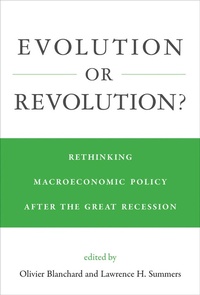
Evolution or Revolution?
Description

The Great Depression led to the Keynesian revolution and dramatic shifts in macroeconomic theory and macroeconomic policy. Similarly, the stagflation of the 1970s led to the adoption of the natural rate hypothesis and to a major reassessment of the role of macroeconomic policy. Should the financial crisis and the Great Recession lead to yet another major reassessment, to another intellectual revolution? Will it? If so, what form should it, or will it, take? These are the questions taken up in this book, in a series of contributions by policymakers and academics.
The contributors discuss the complex role of the financial sector, the relative roles of monetary and fiscal policy, the limits of monetary policy to address financial stability, the need for fiscal policy to play a more active role in stabilization, and the relative roles of financial regulation and macroprudential tools. The general message is a warning against going back to precrisis ways—to narrow inflation targeting, little use of fiscal policy for stabilization, and insufficient financial regulation.
Contributors David Aikman, Alan J. Auerbach, Ben S. Bernanke, Olivier Blanchard, Lael Brainard, Markus K. Brunnermeier, Marco Buti, Benoît Coeuré, Mario Draghi, Barry Eichengreen, Jason Furman, Gita Gopinath, Pierre-Olivier Gourinchas, Andrew G. Haldane, Philipp Hildebrand, Marc Hinterschweiger, Sujit Kapadia, Nellie Liang, Adam S. Posen, Raghuram Rajan, Valerie Ramey, Carmen Reinhart, Dani Rodrik, Robert E. Rubin, Jay C. Shambaugh, Tharman Shanmugaratnam, Jeremy C. Stein, Lawrence H. Summers
More details
Other editions
Additional editions
Persons
Lawrence H. Summers is Charles W. Eliot Professor and President Emeritus at Harvard University. He served as Secretary of the Treasury in the Clinton administration and as Director of the National Economic Council in the Obama administration.
