

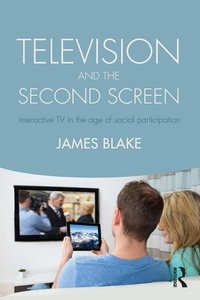
Television and the Second Screen
Interactive TV in the age of social participation
Published on 10. November 2016
206 pages
978-1-317-42851-0 (ISBN)
Description

Television is changing almost beyond recognition. In the battle for consumers, social media sites, smart phones and tablets have become rivals to traditional linear TV. However, audiences and producers are also embracing mobile platforms to enhance TV viewing itself. This book examines the emerging phenomenon of the second screen: where users are increasingly engaging with content on two screens concurrently. The practice is transforming television into an interactive, participatory and social experience.
James Blake examines interactive television from three crucial angles: audience motivation and agency, advances in TV production and the monetisation of second screen content. He also tracks its evolution by bringing together interviews with more than 25 television industry professionals - across the major UK channels - including commissioning editors, digital directors, producers and advertising executives. These reveal the successes and failures of recent experiments and the innovations in second screen projects.
As the second screen becomes second nature for viewers and producers, the risks and opportunities for the future of television are slowly beginning to emerge. Television and the Second Screen will offer students and scholars of television theory, industry professionals and anyone with an abiding interest in television and technology, an accessible and illuminating guide to this important cultural shift.
James Blake examines interactive television from three crucial angles: audience motivation and agency, advances in TV production and the monetisation of second screen content. He also tracks its evolution by bringing together interviews with more than 25 television industry professionals - across the major UK channels - including commissioning editors, digital directors, producers and advertising executives. These reveal the successes and failures of recent experiments and the innovations in second screen projects.
As the second screen becomes second nature for viewers and producers, the risks and opportunities for the future of television are slowly beginning to emerge. Television and the Second Screen will offer students and scholars of television theory, industry professionals and anyone with an abiding interest in television and technology, an accessible and illuminating guide to this important cultural shift.
Reviews / Votes
Very focused, topical, taps into a number of very interesting dynamics around television and social media. Hits all the key issues and has a good combination of practical case studies with wider conceptual trends and debates... It would be supplementary - it would best suit courses in broadcast journalism. - Charlie Beckett, LSE, UKThe book's topic and object of study are extremely relevant and timely. Little research has been done (or has been published yet) on the use of second screen in relation to television watching... Depending on how the research for the proposed textbook is conducted (Which key figures are interviewed? What knowledge is made accessible?), it promises to provide highly needed input in the field... I would definitely be interested in considering a book on this topic for a course. - Jaap Kooijman, University of Amsterdam, The Netherlands
There is, at present very little recognised peer-reviewed research which has been carried out and published into this subject...The proposal is a timely one...I would consider this a supplementary text for my course, but would recommend it to colleagues in Film and Television, Media Communications and Advertising as an essential text. - Russell Merryman, London College of Communication, UK
More details
Language
English
Place of publication
London
United Kingdom
Publishing group
Taylor & Francis Ltd
Target group
College/higher education
Illustrations
7 Illustrations, black and white
File size
1,02 MB
ISBN-13
978-1-317-42851-0 (9781317428510)
Copyright in bibliographic data and cover images is held by Nielsen Book Services Limited or by the publishers or by their respective licensors: all rights reserved.
Schweitzer Classification
Other editions
Additional editions
Book
10/2016
1st Edition
Routledge
€230.27
Shipment within 10-20 days
Book
10/2016
1st Edition
Routledge
€70.75
Shipment within 10-20 days
Person
James Blake is the Director of the Centre for Media and Culture at Edinburgh Napier University where he's a senior lecturer in TV and journalism. He spent more than 15 years in the TV industry and still works regularly for Channel 4 News and STV.
Content
List of illustrations
Acknowledgements
Introduction
1. The evolution of interactive TV
2. Recasting the active audience
3. Entertaining the interactive user: play-along, voting and gossip
4. Participating in the news agenda
5. Factual television: Reinventing the digital public space
6. Second screen as multi-platform transmedia storytelling
7. Monetising second screen gameplay
8. Advertising: "Disruption is at a maximum!"
9. The future for social participation in TV
Index
Acknowledgements
Introduction
1. The evolution of interactive TV
2. Recasting the active audience
3. Entertaining the interactive user: play-along, voting and gossip
4. Participating in the news agenda
5. Factual television: Reinventing the digital public space
6. Second screen as multi-platform transmedia storytelling
7. Monetising second screen gameplay
8. Advertising: "Disruption is at a maximum!"
9. The future for social participation in TV
Index
