

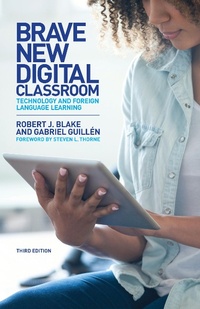
Brave New Digital Classroom
Description

Language Education / Education and Technology
"An indispensable introduction to the field of computer-assisted language learning that is both theoretically sound and highly practical, written in an accessible style palatable to advanced undergraduate and graduate students alike. Blake and Guillén persuasively guide language instructors on how to incorporate existing and evolving new technologies into the L2 classroom in a principled and impactful way."
-Bryan Smith, associate professor of applied linguistics, Department of English, Arizona State University
Brave New Digital Classroom reveals how technology can be used effectively to teach and learn a second language (L2). Robert J. Blake and Gabriel Guillén touch on the key concepts and challenges of teaching languages with technology, including which digital tools work for L2 learning, how games can be used, and what digital literacy and identity mean in the classroom.
This new edition reframes the conversation to account for technology's deep integration into our lives. With the goal that students become bilingual and bicultural, the authors demonstrate how digital tools can nudge students to notice what they do not know, help them make connections to people, and enhance and encourage both play and storytelling. With core terminology in a comprehensive glossary, a short list for further reading, and discussion questions at the end of each chapter, the book can be easily adapted for classroom use or self-study. Videos of short interviews with computer-assisted language learning scholars to enhance each chapter's discussions are available at press.georgetown.edu.
Robert J. Blake is a distinguished professor of Spanish linguistics and director of the Davis Language Center at the University of California, Davis. He has developed online Spanish courses and, with Eve Zyzik, coauthored El español y la lingüística aplicada.
Gabriel Guillén is an assistant professor of Spanish at the Middlebury Institute of International Studies at Monterey and an active practitioner in the field of language learning and technology. His research focuses on local and online intercultural exchanges and the use of language-learning social networks in the context of hybrid language education.
More details
Other editions
Additional editions
Persons
Robert J. Blake is a distinguished professor of Spanish linguistics and director of the Davis Language Center at the University of California, Davis. He has developed online Spanish courses and, with Eve Zyzik, coauthored El español y la lingüística aplicada.
Gabriel A. Guillén is an assistant professor of Spanish at the Middlebury Institute of International Studies at Monterey and an active practitioner in the field of language learning and technology. His research focuses on local and online intercultural exchanges and the use of language-learning social networks in the context of hybrid language education.
Content
Foreword, Steven L. Thorne
Introduction: From Talking to Telling Tales in a Multilingual Digital World
1. Can Technology Help with L2 Learning?
2. What Is the Right Technological Fit for L2 Learning?
3. How Does the Digital World Shape Our Social Interactions?
4. Which Digital Tools Work for L2 Learning?
5. Games for Language Learning
6. Digital Literacy and L2 Identity
Epilogue: Brave New Digital L2 Classroom, Revisited
Glossary
References
Index
About the Authors
