

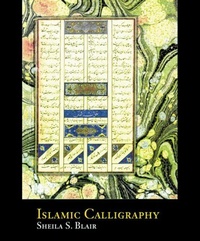
Islamic Calligraphy
1st Edition
Published on 19. January 2020
736 pages
978-1-4744-6447-5 (ISBN)
Description

This stunning book is an important contribution to a key area of non-western art, being the first reference work on the art of beautiful writing in Arabic script. It includes more than 150 colour illustrations, as well as 100 black-and-white details that highlight the salient features of the individual scripts and hands.
More details
Other editions
Additional editions
Sheila S. Blair
Islamic Calligraphy
Book
10/2008
Edinburgh University Press
€85.00
Article not available at the moment
Content
- Intro
- Contents
- List of Figures
- List of Abbreviations
- Glossary
- Preface
- PART I INTRODUCTION
- Chapter One Arabic Script: Its Role and Principles
- The importance of writing in Islamic culture
- Principles of Arabic script
- The Koranic text
- Chapter Two Materials
- Supports
- Special papers
- Pens and pen cases
- Ink and inkwells
- PART II THE DEVELOPMENT OF ARABIC SCRIPT IN EARLY ISLAMIC TIMES
- Chapter Three The Standardization of Arabic Script
- The origins of Arabic script
- The development of Arabic script in the seventh century
- The evolution of a calligraphic style
- Chapter Four Early Manuscripts of the Koran
- Physical characteristics
- Methodologies for dating
- Considerations for further study
- Chapter Five The Adoption of Round Scripts
- PART III THE PRE-EMINENCE OF ROUND SCRIPTS IN THE EARLY MIDDLE PERIOD
- Chapter Five The Adoption of Round Scripts
- Round book script
- The canonization of broken cursive
- Broken cursive and Ibn Muqla
- The standardization of round scripts under Ibn al-Bawwab
- What caused the canonization of round scripts?
- Chapter Six The Proliferation of Round Scripts
- The stylization of broken cursive
- Other round scripts
- Toward a codification of round scripts
- Pairs of text scripts
- Maghribi script
- PART IV THE EMERGENCE OF REGIONAL STYLES IN THE LATER MIDDLE PERIOD
- Chapter Seven Calligraphy in Iran and its Environ sunder the Mongols and Turkomans
- The Six Pens under the Ilkhanids and Jalayirids
- The Six Pens under the Timurids and Turkomans
- The hanging scripts
- Chapter Eight Rectilinear and Curvilinear Scripts in Egypt and Syria under the Mamluks
- Rectilinear scripts
- Curvilinear scripts
- Hybrid scripts
- Chapter Nine Other Styles and Centers
- Anatolia
- India
- The Maghrib
- PART V DYNASTIC STYLES IN THE AGE OF EMPIRES
- Chapter Ten The Safavids, the Qajars, and their Contemporaries in Iran and Central Asia
- Refinement of the Six Pens
- Refinement of the hanging scripts
- Pictorial writing
- Chapter Eleven The Ottomans in Anatolia, the Balkans, and the Eastern Mediterranean
- The canonization of naskh as text script
- The canonization of thuluth as display script
- The hanging scripts
- Chapter Twelve Other Styles and Centers
- The Mughals and their contemporaries in India
- The Indian Ocean
- The Maghrib
- Sub-Saharan Africa
- PART VI THE MANY FACES OF ISLAMIC CALLIGRAPHY IN MODERN TIMES
- Chapter Thirteen From Traditional Styles to Graphic Design and Calligraphic Art
- Traditional styles
- Printing, typography, and computer graphics
- Calligraphic art
- Bibliography
- Copyright Acknowledgments
- Index
