

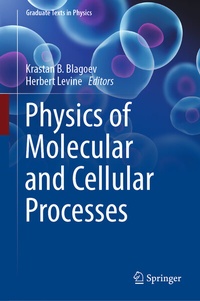
Physics of Molecular and Cellular Processes
Description

This is a graduate-level introduction to quantitative concepts and methods in the science of living systems. It relies on a systems approach for understanding the physical principles operating in biology. Physical phenomena are treated at the appropriate spatio-temporal scale and phenomenological equations are used in order to reflect the system of interest. Biological details enter to the degree necessary for understanding specific processes, but in many cases the approach is not reductionist. This is in line with the approach taken by physics to many other complex systems.
The book bridges the gap between graduate students' general physics courses and research papers published in professional journals. It gives students the foundations needed for independent research in biological physics and for working in collaborations aimed at quantitative biology and biomedical research. Also included are modern mathematical and theoretical physics methods, giving the student a broad knowledge of tools that can shed light on the sophisticated mechanisms brought forth by evolution in biological systems.
The content covers many aspects that have been the focus of active research over the past twenty years, reflecting the authors' experience as leading researchers and teachers in this field.
More details
Other editions
Additional editions
Persons
Krastan B. Blagoev is a Program Director at the US National Science Foundation and is a Research Scientist at the Johns Hopkins University, Department of Biophysics. His research is focused on applying methods of non-equilibrium physics and control theory to gain insight in the function and architecture of living systems. His research has been featured in Physics Today, Physics World, Science Daily, Aznei-News. Blagoev is a Fellow of the American Physical Society. Heworked on the creation and establishment of the International Graduate Student Research Network, The International Physics of Living Systems Teachers Network, and the Cancer Convergence Education Network.
Herbert Levine is a Distinguished Professor of Physics and Bioengineering at Northeastern Univ.. He is a pioneer in using theory to expand experimental findings and in the development of well-parameterized computational models that can be used to garner new insights into biological and biomedical systems. Levineis an elected member of the American Academy of Arts and Sciences, an elected member of the National Academy of Science, a fellow of the American Physical Society, and past chair of the American Physical Society's Division of Biological Physics. He is the author of more than 300 peer-reviewed publications. His research has been featured in the New York Times, Scientific American, the Today Show and many other popular science forums. Levine is a co-director of Center for Theoretical Biological Physics, an NSF-sponsored effort to apply physical science to the living world. Also, Dr. Levine is the coordinator of an international network of graduate students conducting research into the Physics of Living Systems.
