

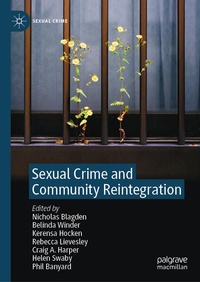
Sexual Crime and Community Reintegration
Description

This book captures the experience of transitioning from prison to the community, the tensions between risk management, public protection and enabling flourishing in those that have been released from prison. It explores what is required for successful community re-entry for men with sexual convictions, examines barriers as men (re)integrate and the ways in which men can be assisted with desistance. Combining empirical chapters, theoretical reviews, service-user voices and a consideration of the latest approach to community reintegration, this book will be relevant to psychologists, criminologists, social workers, practitioners and students. It highlights experiences of transition from prison to the community, the barriers and challenges to (re)integration, but also how we can move forward, how we can help men live meaningful pro-social lives and in doing so fulfil the goal of reducing sexual (re) victimisation.
More details
Other editions
Additional editions
Persons
Nicholas Blagden is Professor of Criminological Psychology at the University of Derby, UK, co-Director of the Centre for Applied Social Sciences, Policy, Practice and Research (CASSPPR), Chartered Psychologist and Registered Psychotherapist.
Belinda Winder is Professor of Forensic Psychology and Head of the Centre for Crime, Offending, Prevention and Engagement (COPE) at Nottingham Trent University, UK.
Kerensa Hocken is a Registered Forensic Psychologist at HMPPS Whatton, UK. She has oversight for the assessment and treatment of people in prison for sexual offending in the Midlands region.
Rebecca Lievesley is Associate Professor in Psychology at Nottingham Trent University, UK and has conducted research within the criminal justice system for many years.
Craig A. Harper is Associate Professor in Psychology at Nottingham Trent University, UK. He specializes in topics related to forensic and political psychology.
Helen Swaby is Lecturer in Counselling at Bishop Grosseteste University, UK. She is a qualified integrative psychotherapist and has a background in forensic psychology research.
Phil Banyard is Head of Psychology at Nottingham Trent University, UK. He was honoured with the British Psychological Society's Award for Distinguished Contributions to Psychology Education.
Content
Chapter 1: Mortification and Mythology: Challenges in the Reintegration of People with Sexual Offence Convictions.- Chapter 2: Examining the tensions between policing people convicted of sexual offending and promoting the desistance process.- Chapter 3: Negotiating identity as a 'sex offender' on release from prison and the negative impact of restrictions.- Chapter 4: Navigating life with a sexual conviction: 'Anticipatory disclosure' and the impact of living in a perpetual biopsychological state of fight or flight.- Chapter 5: The transition from prison to the community for people with sexual convictions: Do we want them to succeed or fail.- Chapter 6: Life After Release and the Impact of Community Support - Service User Speaks.- Chapter 7 Sledgehammer cracking the nut .The experience of licence conditions and impact on community reintegration.- Chapter 8: Exploring Trauma-Informed Care in a High-Intensity Programme.
