

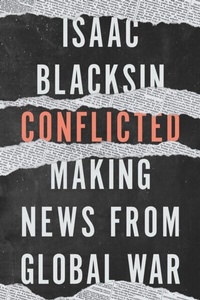
Conflicted
Making News from Global War
Published on 2. July 2024
330 pages
978-1-5036-3945-4 (ISBN)
Description

How is popular knowledge of war shaped by the stories we consume, what are the boundaries of this knowledge, and how are these boundaries policed or contested by journalists producing knowledge from war zones? Based on years of fieldwork in Iraq, Syria, Lebanon, Afghanistan, and Ukraine, Conflicted challenges normative conceptions of war by revealing how representational authority comes to be. Turning the lens on journalists from The New York Times, The Washington Post, The Wall Street Journal, and other prominent publications, Isaac Blacksin shows why news coverage of contemporary conflict, widely presumed to function as a critique of excessive violence, instead serves to sanction official rationales for war.
Blacksin argues that journalism's humanitarian frame-now hegemonic in conflict coverage-serves to depoliticize and remoralize war, transforming war from an effect of policy on populations to a matter of violence against the innocent. Exploring the tension between experience and expression in conditions of violence, and tracking how journalists respond to dominant expectations of reality, Conflicted tells the story of war, reporters, and the consequences of their convergence. As new wars, and new reportage, continue to shape our understanding of armed conflict, this book makes visible both the power and the particularity of war reportage.
Blacksin argues that journalism's humanitarian frame-now hegemonic in conflict coverage-serves to depoliticize and remoralize war, transforming war from an effect of policy on populations to a matter of violence against the innocent. Exploring the tension between experience and expression in conditions of violence, and tracking how journalists respond to dominant expectations of reality, Conflicted tells the story of war, reporters, and the consequences of their convergence. As new wars, and new reportage, continue to shape our understanding of armed conflict, this book makes visible both the power and the particularity of war reportage.
Reviews / Votes
"Blacksin's clear interpretive voice plies journalism's unconscious, bringing to the fore the fear and trauma that is excised from reporting. Conflicted is a truly extraordinary book - written with aplomb, thoroughly researched, and thoughtful through and through. A landmark text in the literature on the mediation of war." -Alex Fattal, author of Guerrilla Marketing: Counterinsurgency and Capitalism in Colombia"We live in an age of war and depend for our war stories on the men and women who serve as our witnesses. War reporters are a legendary breed whose vital work has gone largely unexamined - until now. Conflicted is quite simply the most thorough, intelligent, and unflinching examination of conflict reporting ever attempted. Isaac Blacksin has been there and his provocative account made me nod in recognition, grin in appreciation, and shout in outrage. For those transfixed by war-and determined to learn how we really know what we think we know about it-this book is essential reading." -Mark Danner, author of Stripping Bare the Body: Politics Violence War and Spiral: Trapped in the Forever War
"A thoughtful work that draws on extensive ethnographic fieldwork and psychoanalysis, Conflicted does not make for light reading. It does, however, provide a corrective to a practice like drone warfare and the seemingly easy acceptance of civilian casualties resulting from 'the Global War on Terrorism.' It also calls into question the 'bearing witness' of journalistic professions.... Recommended."-R. C. Cottrell, CHOICE
"Conflicted offers a compelling critique of war journalism that challenges conventional narratives and advocates for a more detailed and critical approach to conflict reporting.... This book is essential for anyone interested in the intersection of media, war, and society."-Mahedi Hasan, Journalism & Mass Communication Quarterly "Conflicted: Making News from Global War constitutes a major intervention for critical scholarship, in my view, and as such is essential reading not only for those concerned with war reportage but also for anyone endeavoring to rethink familiar presumptions about journalistic form, practice, and epistemology."-Stuart Allan, International Journal of Press/Politics
All prices
More details
Edition
New edition
Language
English
Place of publication
Palo Alto
United States
Target group
Professional and scholarly
Edition type
New edition
ISBN-13
978-1-5036-3945-4 (9781503639454)
Copyright in bibliographic data and cover images is held by Nielsen Book Services Limited or by the publishers or by their respective licensors: all rights reserved.
Schweitzer Classification
Other editions
Additional editions
Book
07/2024
Stanford University Press
€131.50
Shipment within 15-20 days
Book
07/2024
Stanford University Press
€32.50
Shipment within 15-20 days
Person
Isaac Blacksin is an ethnographer and Assistant Professor of Critical Media Studies in the Department of Communication and Journalism at Texas A&M University.
Content
Preface
Introduction: War's Lobby: The Displacements of Journalism in Wartime
Interlude: Cheapening Experience
Part I: The Language of War Reportage and Its Conditions
1. Folklore of the Future: The Certainty of Journalistic Expression
2. Visible System and Invisible Rules: Commodifying Common Sense
Interlude: Available Stories
Part II: The Meaning of War Reportage and Its Exclusions
3. Extermination as Protection: Depoliticizing War, Remoralizing Violence
4. Power Speaking to Truth: Struggles with the Problem of War
Interlude: What to Make of It
Part III: The Practice of War Reportage and Its Contradictions
5. Writing Conflicts: The Tension Between Experience and Expression
6. Agitation at the Margins: Return of the Journalistically Repressed
Interlude: Leaving Mosul
Conclusion: War's Exit: Entangled Possibility in the Age of Endless Conflict
Epilogue: From Mosul to Mariupol
Acknowledgments
Notes
Bibliography
Index
Introduction: War's Lobby: The Displacements of Journalism in Wartime
Interlude: Cheapening Experience
Part I: The Language of War Reportage and Its Conditions
1. Folklore of the Future: The Certainty of Journalistic Expression
2. Visible System and Invisible Rules: Commodifying Common Sense
Interlude: Available Stories
Part II: The Meaning of War Reportage and Its Exclusions
3. Extermination as Protection: Depoliticizing War, Remoralizing Violence
4. Power Speaking to Truth: Struggles with the Problem of War
Interlude: What to Make of It
Part III: The Practice of War Reportage and Its Contradictions
5. Writing Conflicts: The Tension Between Experience and Expression
6. Agitation at the Margins: Return of the Journalistically Repressed
Interlude: Leaving Mosul
Conclusion: War's Exit: Entangled Possibility in the Age of Endless Conflict
Epilogue: From Mosul to Mariupol
Acknowledgments
Notes
Bibliography
Index

