

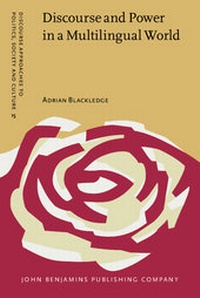
Discourse and Power in a Multilingual World
1st Edition
Published on 16. September 2005
X, 252 pages
978-90-272-9422-7 (ISBN)
Description

In Discourse and Power in a Multilingual World the discourse of politicians and policy-makers in Britain links languages other than English, and therefore speakers of these languages, with civil disorder and threats to democracy, citizenship and nationhood. These powerful arguments travel along 'chains of discourse' until they gain the legitimacy of the state, and are inscribed in law. The particular focus of this volume is on discourse linking 'race riots' in England in 2001 with the Nationality, Immigration and Asylum Act 2002, which extended legislation to test the English language proficiency of British citizenship applicants.
Adrian Blackledge develops a theoretical and methodological framework which draws on critical discourse analysis to reveal the linguistic character of social and cultural processes and structures; on Bakhtin's notion of the dialogic nature of discourse to demonstrate how voices progressively gain authority; and on Bourdieu's model of symbolic domination to illuminate the way in which linguistic-minority speakers may be complicit in the misrecognition, or valorisation, of the dominant language.
Adrian Blackledge develops a theoretical and methodological framework which draws on critical discourse analysis to reveal the linguistic character of social and cultural processes and structures; on Bakhtin's notion of the dialogic nature of discourse to demonstrate how voices progressively gain authority; and on Bourdieu's model of symbolic domination to illuminate the way in which linguistic-minority speakers may be complicit in the misrecognition, or valorisation, of the dominant language.
More details
Other editions
Additional editions
Adrian Blackledge
Discourse and Power in a Multilingual World
Book
09/2005
John Benjamins Publishing Co
€116.60
Shipment within 10-15 days
Person
Content
- Discourse and Power in a MultilingualWorld
- Editorial page
- Title page
- LCC data
- Table of contents
- Preface
- Acknowledgements
- Language, ideology and power
- CDA as theory
- CDA as method
- Discourse
- Genre
- Context
- Voice
- Criticism of CDA
- Theory and method in analysis of political discourse
- Discourse strategies
- Referential strategies
- Predicational strategies
- Argumentation and perspectivation strategies
- Intensifying and mitigation strategies
- Investigating discourses of discrimination
- Discourse strategies and linguistic means
- Language ideologies in multilingual contexts
- Language and ideology
- Multilingualism and identity
- Language ideologies and national identity
- Language ideological debates in multilingual contexts
- Language and hegemony
- Language and symbolic racism
- Language testing for citizenship
- The idealised native speaker
- Multilingualism and society
- Discourse and discrimination in the social arena
- Positioning the researcher in research on multilingualism
- Immigration and multiculturalism in Britain
- Britain as a multilingual nation-state
- Discriminatory discourse in the local news media
- Argumentation strategies in discourse of representation
- Representation in news discourse
- Discourse and discrimination in the local press
- `Voice' and represented discourse
- The `already-said-elsewhere'
- Double voiced discourse
- The principle of equal treatment
- Recontextualisation of political argument: Claiming authority
- Idioms of `common-sense'
- `Show concessions' and ambiguity
- Consensus and the rhetorical question
- Language ideological debate in a local context
- 3.1. Appendix
- 3.2. Appendix
- Political discourse and the rhetoric of discrimination
- The discourse of political speeches
- The `intention' of political discourse
- Absences, allusions and assumptions in political discourse
- Illiberal discourse in a liberal setting
- `The time has come'
- Defining the criminal minority
- Rhetorical questions as dialogic discourse
- `Let us consider the causes'
- `Some remedies': Language as iconic representation
- `A Belfast-like situation'
- Political discourse and the construction of the social world
- 4.1. Appendix
- Political discourse and the media
- Recontextualisation and authoritative discourse
- Recontextualisation of political discourse
- Recontextualisation and the authoritative voice
- `The men say ``They don't need it'''
- The issue of citizenship
- The familiar arguments made legitimate
- Recontextualisation of political discourse in liberal news media
- Headlines
- Liberal representation of political discourse
- Expanding the debate
- Substitution: People, spouses, and husbands and wives
- Anticipating voices in opposition
- Metonymic representation
- Transformation by addition
- Transformation of discourse and ideology
- 5.1. Appendix
- 5.2. Appendix
- Working knowledge of English could become compulsory for immigrants
- 5.3. Appendix
- English lessons may become condition of UK citizenship
- 5.4. Appendix
- Blunkett `English for passports' plan
- 5.5. Appendix
- Blunkett fuels English lessons row
- Representing the voice of the people
- Representing the voice of the people in official reports
- The Bradford review
- Genre chains
- Representation of Bradfordian voices
- The Oldham review
- Between reported speech and the reporting context
- The role of the English language
- Language, suspicion, and fear
- Representing women in the voice of the people
- Representing extreme views
- The Burnley review
- Representing racist discourse
- The role of racist political discourse
- The Cantle report
- Language and law
- The promotion of new values
- The discourse of official reports as language ideological debate
- The threat of minority Asian languages
- Language, culture and representing the `Other'
- Language and responsibility
- Abuse and resentment
- Language and the nation
- The legitimation of discriminatory discourse
- The symbolic power of language
- Secure Borders, Safe Haven
- Language and cultural practices
- Practical knowledge about British life or language
- Language and democracy
- The certification of language
- The legal authority of discriminatory argument
- Integration with diversity
- `People must be free'
- `It helps overcome the schizophrenia'
- `Political correctness' and the politics of despair
- The Nationality, Immigration and Asylum Act
- The consecration of language
- Discourse, power and the multilingual world
- Multilingualism and symbolic domination
- Practical knowledge and linguistic resources
- Multilingualism and the State
- Multilingualism and citizenship
- Multilingualism and symbolic racism
- Racist discourse and polyphonic voice
- Multilingualism and gender
- The New and the Old
- The debate moves on
- Monolingual ideology in a multilingual state
- Multilingual Britain: Some ways forward
- Notes
- Chapter 1
- -28pt
- Chapter 4
- -28pt
- Chapter 5
- -28pt
- Chapter 6
- -28pt
- Chapter 7
- -28pt
- Chapter 8
- -28pt
- References
- Name index
- Subject index
- The series Discourse Approaches to Politics, Society and Culture
