

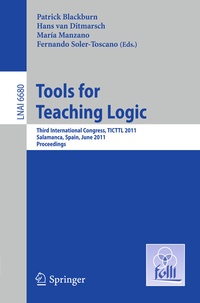
Tools for Teaching Logic
Third International Congress, TICTTL 2011, Salamanca, Spain, June 1-4, 2011, Proceedings
Published on 11. June 2011
XI, 257 pages
978-3-642-21350-2 (ISBN)
Description

This book constitutes the proceedings of the Third International Congress on Tools for Teaching Logic, TICTTL 2011, held in Salamanca, Spain, in June 2011.
The 30 papers presented were carefully reviewed and selected from 62 submissions. The congress focusses on a variety of topics including: logic teaching software, teaching formal methods, logic in the humanities, dissemination of logic courseware and logic textbooks, methods for teaching logic at different levels of instruction, presentation of postgraduate programs in logic, e-learning, logic games, teaching argumentation theory and informal logic, and pedagogy of logic.
More details
Other editions
Additional editions
Patrick Blackburn | Hans Van Ditmarsch | Maria Manzano
Tools for Teaching Logic
Third International Congress, TICTTL 2011, Salamanca, Spain, June 1-4, 2011, Proceedings
Book
05/2011
1st Edition
Springer
€53.49
Shipment within 7-9 days
Content
- Title Page
- Preface
- Organization
- Table of Contents
- Teaching Argumentation Theory and Practice: The Case of 12 Angry Men
- Introduction
- The Internal Discourse in 12AM: The Pragma-Dialectical Model of Critical Discussion
- The External Discourse in 12AM: The Argument by Example
- References
- E-learning and Semantic Technologies: Tools and Concepts
- Automated Deduction Applications
- Transition: From Presentations to E-learning Platforms
- Presentations
- E-learning Platforms
- Mark-Up Technolgies
- Semantic Technologies and Tagged Text
- Towards a New Model
- Case Studies
- References
- CT2.0: A Collaborative Database of Examples for Teaching Informal Logic
- Introduction
- Teaching from Example
- My Solution: CT2.0
- References
- Araucaria-PL: Software for Teaching Argumentation Theory
- Araucaria
- Teaching Argumentation Theory in Poland
- Araucaria-PL
- Application in Pedagogy
- Persuasive and Dialogical Context of Argumentation
- Corpus of Analyzed Polish Argumentation
- Conclusions
- References
- Teaching Logic in Philosophy
- Introduction
- Logic and Undergraduate Studies
- Logic and Argumentation
- Conclusion
- References
- ORGANON: Learning Management System for Basic Logic Courses
- Motivation of the Project
- Description of the LMS ORGANON
- Database of Exercises
- The Grading Module of ORGANON
- The Practicing Module of ORGANON
- The Process of the Project
- Conclusion
- References
- Variables in Mathematics Education
- Introduction
- Mathematical Uses of Variables
- Variables Used to Express Unknown Quantities
- Variables Used in Functional Relationships
- Variables Used to Express Universal Statements
- Dummy Variables and Questions of Scope
- Variables Used as Generic Elements in Discussions
- Conclusion
- References
- Logic Training through Algorithmic Problem Solving
- Introduction and Overview
- An Educational Experiment
- An Algorithmic Problem: The Chameleons of Camelot
- Conclusions
- References
- Concrete Epistemic Modal Logic: Flatland
- Introduction
- The Logic Framework of Flatland
- Running Example
- Beyond the Scene
- Conclusion
- References
- Satoulouse: The Computational Power of Propositional Logic Shown to Beginners
- Introduction
- Interaction with SAToulouse
- Be Familiar with the Notion of Satisfiability
- Logic Programming
- An Application to Genetics
- Highlighting the Difficulty of SAT
- Behind the Scenes
- The Graphical User Interface
- The SAT Solver
- Connection between the SAT Solver and the Graphical User Interface
- Loading and Saving a Problem
- Evaluation and Further Work
- References
- Panda: A Proof Assistant in Natural Deduction for All. A Gentzen Style Proof Assistant for Undergraduate Students
- Introduction
- Constructing Proofs in Natural Deduction
- Starting a Proof
- Forward- and Backward Reasoning
- Proof Tree Manipulation
- First-Order Reasoning
- Saving and Loading
- Behind the Scenes
- The General Graphical User Interface
- Pattern-Matching to Select Rules
- Cancel and Redo
- Load and Save Rules
- Related Tools
- Further Work
- References
- The Question of the Question in Critical Thinking?
- Introduction
- Assumptions and Processes
- A Broader Coherent Basis
- Objections and Responses
- Conclusion
- References
- Adding a Dimension to Logic Diagramming
- Introduction: Gardner-Inspired Design of Teaching Materials
- Design for the Blind
- Sight Restored
- Advantages of Son of Sylloid over Both Sylloid and Venn
- Conclusion
- References
- The Many Rewards of Putting Absolutely Everything into Introductory Logic
- What's Wrong Right Now
- Irrelevance
- Fear
- Tedium
- Indifference
- Cowardice, or Possibly Lethargy
- The Course That Will Fix All That
- Two Sides
- Formal Logic and Critical Reasoning
- Client Departments
- Other Stuff and Lots of It
- Serious Fun
- Logic Outreach
- Deep Thoughts
- Syllabus
- Too Much Material
- What This Course Does
- It Meets Expectations
- It Grows Logicians
- It Opens the Campus to Debate
- It Is Immeasurably Successful
- It Pleases the Administration
- It Pleases Me
- To Sum Up
- The SELL Project: A Learning Tool for E-Learning Logic
- Introduction
- Description of the SELL Project
- Design
- Implementation
- Description of the Logic E-Learning Assistant
- Evaluation
- Conclusions
- References
- Ten Years of Computer-Based Tutors for Teaching Logic 2000-2010: Lessons Learned
- Introduction
- Basic Features of Tools for Learning Logic
- Functional Characteristics
- Interactivity, Feedback and Advice
- Assessment, Statistics, Reports
- A Classification of Tools for Learning Logic
- Conclusions
- References
- Logic in Action An Open Logic Courseware Project
- Introduction
- The Logic in Action initiative
- Manuscripts
- Classical Systems
- Knowledge, Action and Interaction
- Methods
- Electronic Support
- Animated Illustrations
- Applications
- Additional Contents
- Logic in Action Today and in the Future
- Logic in Action at Work
- Graduate Courses
- Pre-academic Education
- Conclusions
- References
- A Teaching Tool for Proving Equivalences between Logical Formulae
- Introduction
- Rewriting Formulae into DNF
- Proving Equivalences between Formulae
- A Strategy for Proving Equivalences
- Towards Disjunctive Normal Form (Part 1)
- Towards Equal Forms (part 2)
- Examples
- Related Work
- Conclusions
- References
- Mhy Bib I Fail Logic? Dyslexia in the Teaching of Logic
- Introduction
- The Dyslexic Student in the Classroom
- The Teacher Faced with the Dyslexic
- Suggestions for the Logic Teacher Regarding the Issue of Dyslexia
- Conclusions
- References
- Information-Theoretic Perspective for Teaching Logic
- Introduction
- Argumentation in Informational Terms
- A Treatment of Information Content
- Concluding Remarks
- References
- Teaching Sound Principles about Invalidity
- Introduction: The Asymmetry between Validity and Invalidity
- Invalidity and Logical Form
- Persisting in Error: A Case Study
- Conclusions
- References
- Systematic Errors as an Input for Teaching Logic
- Introduction
- Looking at Errors from a Different Point of View
- Systematic Errors in the Learning and Teaching of Logic
- Systematic Errors in Logic Teachers' Education
- References
- The AProS Project: Teaching Logic to Business and Engineering Students
- Context
- Logic & Proofs
- The Strategic Approach
- Making Logic Relevant
- Conclusion
- References
- Using a Learner- and Teacher-Friendly Environment for Turing Machine Programming and Testing
- Introduction
- Turing Machines in Our Basic Course of Mathematical Logic
- First Version of TM Interpreter
- Second Version of TM Interpreter
- Using the Second Version
- References
- Using an Argument Ontology to Develop Pedagogical Tool Suites
- Introduction
- The Argument Interchange Format
- Critical Thinking and Argument Analysis: OVA
- Dialogue and Mixed Initiative Argumentation in Pedagogy
- Implementing Mixed Initiative Argumentation: Arvina
- Implementing Pedagogical Dialogue: Parley
- Concluding Remarks
- References
- Visual Tools for Teaching Propositional Logic
- The Hypothesis
- A Didactic Plan
- A Diagram-Based Proposal for Teaching Propositional Logic
- Formulas
- Rules for Derivations
- References
- Logicamente: A Virtual Learning Environment for Logic Based on Learning Objects
- Introduction
- The Virtual Learning Environment: Logicamente
- Logicamente on e-learning: Learning Objects and Modules
- The (Non)Sequitur Super-Module
- The Modeling and Implementation of Logicamente
- Future Works and Final Remarks
- References
- A Framework for Coping with Logically-Minded Arguments in Philosophy
- Introduction
- Object-Level and Meta-level Arguments
- Meta-level Arguments and Modal Force
- Working Out an Example
- Conclusion
- References
- A Logic Teaching Tool Based on Tableaux for Verification and Debugging of Algorithms
- Motivation
- The Logic Teaching Tool
- Tool Usage
- Tool Implementation
- Verification of Algorithms
- Algorithmic Debugging
- An Educational Experience with TABLEAUX
- Design of the Experiences
- Results
- Conclusions
- References
- Designing an Introductory Course to Elementary Symbolic Logic within the Blackboard E-learning Environment
- Introduction
- Design Issues
- Symbolism
- Training, Testing and Grading of Online-Assignments
- Automated Check of Gentzen-Style Proofs
- Programing Considerations
- General Considerations
- Final Exam
- Lessons
- References
- Author Index
