

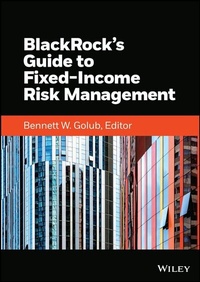
BlackRock's Guide to Fixed-Income Risk Management
1st Edition
Published on 25. October 2023
448 pages
978-1-119-88489-7 (ISBN)
Description

An irreplaceable roadmap to modern risk management from renowned experts on the subject
Edited by a co-founder and the former Chief Risk Officer of BlackRock--the world's largest asset manager--BlackRock's Guide to Fixed-Income Risk Management delivers an insightful blueprint to the implementation of a comprehensive investment risk management framework for buy-side firms. Leveraging the unprecedented academic and professional experience of current and former senior leaders in BlackRock's risk and portfolio management functions, as well as trading, financial modeling, and analytics experts, the book serves a practitioner's guide to investment risk management, leveraging BlackRock's risk management framework. The included chapters combine to provide chief investment officers, risk managers, portfolio managers, researchers, and compliance professionals an approach to investment risk management well-suited for today's and tomorrow's markets. The book also presents:
* Critical elements that underpin a strong risk management program and culture
* Fixed income risk management concepts and theories that can be applied to other asset classes
* Lessons learned from financial crises and the COVID-19 Pandemic
Ideal for undergraduate students and students and scholars of business, finance, and risk management, BlackRock's Guide to Fixed-Income Risk Management is a one-of-a-kind combination of modern theory with proven, practical risk management strategies.
Edited by a co-founder and the former Chief Risk Officer of BlackRock--the world's largest asset manager--BlackRock's Guide to Fixed-Income Risk Management delivers an insightful blueprint to the implementation of a comprehensive investment risk management framework for buy-side firms. Leveraging the unprecedented academic and professional experience of current and former senior leaders in BlackRock's risk and portfolio management functions, as well as trading, financial modeling, and analytics experts, the book serves a practitioner's guide to investment risk management, leveraging BlackRock's risk management framework. The included chapters combine to provide chief investment officers, risk managers, portfolio managers, researchers, and compliance professionals an approach to investment risk management well-suited for today's and tomorrow's markets. The book also presents:
* Critical elements that underpin a strong risk management program and culture
* Fixed income risk management concepts and theories that can be applied to other asset classes
* Lessons learned from financial crises and the COVID-19 Pandemic
Ideal for undergraduate students and students and scholars of business, finance, and risk management, BlackRock's Guide to Fixed-Income Risk Management is a one-of-a-kind combination of modern theory with proven, practical risk management strategies.
More details
Other editions
Additional editions
Book
06/2023
Wiley
€93.00
Shipment within 15-20 days
Persons
Bennett W. Golub is one of the original founders of BlackRock. During his 34-year career at BlackRock, Dr. Golub was a member of BlackRock's Global Executive Committee, co-head of its Risk & Quantitative Analysis group and served as BlackRock's Chief Risk Officer from 2009--2022. Additionally, he co-founded BlackRock Solutions. Currently, Dr. Golub serves as a Senior Advisor to BlackRock.
Content
- Cover
- Title Page
- Copyright
- Contents
- Frequently Used Abbreviations
- Foreword
- Preface
- Acknowledgments
- Section I An Approach to Fixed-Income Investment Risk Management
- Chapter 1 An Investment Risk Management Paradigm
- 1.1 Introduction
- 1.2 Elements of Risk Management
- 1.3 BlackRock's Investment and Risk Management Approach
- 1.4 Introduction to the BlackRock Investment Risk Management Paradigm
- Notes
- Chapter 2 Parametric Approaches to Risk Management
- 2.1 Introduction
- 2.2 Measuring Interest Rate Exposure: Analytical Approaches
- 2.2.1 Macaulay and Modified Duration and Convexity
- 2.2.2 Option-Adjusted Framework: OAV, OAS, OAD, OAC
- 2.2.3 Dynamic Nature of Local Risk Measures: Duration and Convexity Drift
- 2.2.4 Interest Rate Scenario Analysis
- 2.3 Measuring Interest Rate Exposure: Empirical Approaches
- 2.3.1 Coupon Curve Duration
- 2.3.2 Empirical (Implied) Duration
- 2.4 Measuring Yield Curve Exposure
- 2.4.1 Key Rate Durations
- 2.5 Measuring and Managing Volatility Related Risks
- 2.5.1 Volatility Duration
- 2.5.2 Option Usage in Portfolio Management
- 2.6 Measuring Credit Risk
- 2.6.1 Spread Duration
- 2.6.2 Duration Times Spread (DxS)
- 2.7 Measuring Mortgage-Related Risks
- 2.7.1 Prepayment Duration
- 2.7.2 Mortgage/Treasury Basis Duration
- 2.8 Measuring Impact of Time
- Notes
- Chapter 3 Modeling Yield Curve Dynamics
- 3.1 Probability Distributions of Systematic Risk Factors
- 3.2 Principal Component Analysis: Theory and Applications
- 3.2.1 Introduction
- 3.2.2 Principal Components Analysis
- 3.2.3 The First Principal Component and the Term Structure of Volatility
- 3.2.4 Example: Historical Steepeners and Flatteners of the US Treasury Curve
- 3.3 Probability Distributions of Interest Rate Shocks
- Notes
- Chapter 4 Portfolio Risk: Estimation and Decomposition
- 4.1 Introduction
- 4.2 Portfolio Volatility and Factor Structure
- 4.3 Covariance Matrix Estimation
- 4.3.1 Weighting of Historical Data
- 4.3.1.1 Exponential Decay Weighting
- 4.3.1.2 Alternative Weighting Schemes and Stress Scenarios
- 4.3.1.3 Enhancing Volatility Responsiveness Dynamically
- 4.3.2 Asynchronicity
- 4.3.2.1 Overlapping Covariance Matrix
- 4.3.2.2 Newey-West Estimation
- 4.3.3 Factor Model Structure: Generalizations
- 4.3.3.1 Optimization of the Error-Bias Trade-Off
- 4.3.3.2 Misspecification and Omitted Covariation
- 4.3.4 Covariance Matrix Estimation: Summary and Recommendations
- 4.4 Ex Ante Risk and VaR Methodologies
- 4.4.1 VaR Estimation Approaches
- 4.4.2 Enhanced HVaR
- 4.4.2.1 EHVaR Systematic Risk Methodology
- 4.4.2.2 EHVaR Idiosyncratic Risk Methodology
- 4.4.3 VaR Estimation: Summary
- 4.5 Introduction to Risk Decomposition
- 4.6 Alternative Approaches to Risk Decomposition
- 4.6.1 A Comparison of the Different Approaches
- 4.7 Risk Decomposition Using CTR
- 4.7.1 Security-Level Contributions and Aggregations
- 4.7.2 Factor-Level Contributions and Aggregations
- 4.7.3 Decomposing Contribution to Risk into Atomic Contributions
- 4.7.4 Decomposing Contribution to Risk into Exposure, Volatility, and Correlation
- 4.7.5 Decomposing Contribution to Risk Using ANOVA
- 4.8 Risk Decomposition Through Time
- 4.9 Risk Decomposition: Summary
- Appendix A. EHVaR: Idiosyncratic Risk Estimation
- Appendix B. EHVaR: Aggregation
- Notes
- Chapter 5 Market-Driven Scenarios: An Approach for Plausible Scenario Construction
- 5.1 Introduction
- 5.2 Implied Stress Testing Framework
- 5.2.1 Market-Driven Scenario Framework
- 5.2.2 Scenario Likelihood
- 5.2.3 From Likelihood to Probability
- 5.2.4 Decomposing the Scenario Z-Score
- 5.2.5 Specifying a Covariance Matrix
- 5.3 Developing Useful Scenarios
- 5.3.1 Scenario Definition
- Step 1: Define a Market Event or Macro Regime
- Step 2: Select Policy Variables
- Step 3: Calibrate Shock Sizes to the Policy Variables
- Step 4: Generate Nonpolicy Factor Shocks from the Policy Factor Shocks
- Step 5: Generate Portfolio Stress Test P&L
- 5.4 A Market-Driven Scenario Example: Brexit
- 5.4.1 Describing Different Brexit Scenario Outcomes
- 5.4.2 Identifying Key Policy Shocks in Soft Brexit Scenario
- 5.5 Conclusion
- Appendix: Decomposition of Scenario Z-score
- Notes
- Chapter 6 A Framework to Quantify and Price Geopolitical Risks
- 6.1 Introduction
- 6.2 Setting the Scene
- 6.2.1 Short and Sharp
- 6.2.2 Shades of Gray
- 6.3 BlackRock's Framework for Analyzing Geopolitical Risks
- 6.4 Global Trade Deep Dive
- 6.4.1 Calibrating the Shocks
- 6.5 What Is Already Priced In?
- 6.5.1 Is It Priced In?
- 6.5.2 Adjusted Impacts
- 6.5.3 Assessing Likelihood
- 6.5.4 Takeaways
- 6.6 Taking Action
- 6.6.1 Key Drivers
- 6.6.2 BGRI-Specific Assets
- 6.6.3 The Path Forward
- 6.7 Caveats and Cautions
- Notes
- Chapter 7 Liquidity Risk Management
- 7.1 Introduction
- 7.2 A BRIEF HISTORY OF LIQUIDITY RISK MANAGEMENT
- 7.3 A Fund Liquidity Risk Framework
- 7.4 Asset Liquidity
- 7.4.1 Importance of Data Modeling for Liquidity Risk Management
- 7.4.2 Asset Liquidity: Days-to-Liquidate
- 7.4.3 Asset Liquidity: Corporate Bond Transaction Costs (T-Costs)
- 7.5 Redemption Risk
- 7.5.1 Managing Redemptions and Outflow Risk
- 7.6 Liquidity Stress Testing
- 7.7 Extraordinary Measures
- 7.8 Fixed-income Data Availability Limitations
- 7.8.1 Modeling Asset Liquidity
- 7.8.1.0 Modeling Trading Volumes
- 7.8.1.0 Modeling Transaction Costs
- 7.8.1.0 Similarity and Localization of Models
- 7.8.2 Modeling Redemption-at-Risk
- 7.8.3 Modeling Liquidity Optimization
- 7.9 Conclusion
- Notes
- Chapter 8 Using Portfolio Optimization Techniques to Manage Risk
- 8.1 Risk Measurement Versus Risk Management
- 8.2 Typical Fixed-income Hedges
- 8.3 Parametric Hedging Techniques
- 8.4 Generalized Approach to Hedging
- 8.4.1 Hedging as Constrained Portfolio Optimization
- 8.4.2 Mathematical Formulation
- 8.4.2.1 Exposure Hedging
- 8.4.2.2 Managing a Portfolio Against a Benchmark
- 8.4.2.3 Stress Scenario Hedging
- 8.4.3 Examples of Optimized Risk Management Strategies
- 8.4.3.1 Creating an ESG Tilt While Managing a Fixed-Income Portfolio Relative to a Benchmark
- 8.4.3.2 Hedging Stress Scenario Exposure
- 8.5 Advanced Portfolio Optimization and Risk Management Techniques
- 8.5.1 Risk Budgeting/Parity
- 8.5.2 Going Beyond a Single Fund/Single Period in Portfolio Risk Management
- 8.5.2.1 Multi-Fund Portfolio Construction and Risk Management
- 8.5.2.2 Multi-Period Portfolio Construction and Risk Management
- 8.5.2.3 Risk Management Using Scenario Optimization
- 8.5.3 Example: Risk Budgeting for Factor-Based Investing
- Notes
- Chapter 9 Risk Governance
- 9.1 Introduction
- 9.2 Risk Scan Standard Framework
- 9.3 Risk and Performance Target (RPT) Framework
- 9.4 Governance
- Notes
- Chapter 10 Risk-Return Awareness and Behavioral Finance
- 10.1 Introduction
- Deliberate, Diversified, and Scaled Risks
- 10.2 Portfolio and Risk Manager Partnership
- 10.3 Behavioral Risk Management for Fixed Income
- 10.4 Decision-making Analytics
- 10.4.1 Loss Aversion
- 10.4.1.1 The Disposition Bias
- 10.4.1.2 The Endowment Effect
- 10.5 Investment Process
- 10.5.1 Leveraging the Wisdom of the Crowds
- 10.5.2 Bolster System II Thinking
- 10.5.3 Facilitate Continuous Learning
- 10.6 Conclusion
- Notes
- Chapter 11 Performance Attribution
- 11.1 Introduction
- 11.2 Brinson Attribution and Beyond
- 11.2.1 Comparing Market Value Brinson Attribution to Beta-Adjusted Attribution
- 11.3 Factor-based Attribution
- 11.4 Equity Fundamental Factor-based Attribution
- Notes
- Chapter 12 Performance Analysis
- 12.1 Introduction
- 12.2 Performance Governance
- 12.3 Performance Metrics
- 12.3.1 Active Performance Measurement
- 12.3.1.1 Alpha Target Ratio
- 12.3.1.2 Weighted Peer Percentile
- 12.3.1.3 Strengths and Weaknesses of the ATR and Weighted Peer Percentile
- 12.3.1.4 Alpha Dollars
- 12.3.1.5 Strengths and Weaknesses of Alpha Dollars
- 12.3.2 Index Performance Metrics
- 12.3.2.1 Direct Tracking Basis Points (BP)
- 12.3.2.2 Strengths and Weaknesses of Direct Tracking BP
- 12.4 Conclusion
- Notes
- Chapter 13 Evolving the Risk Management Paradigm
- 13.1 Introduction
- 13.2 Traditional Buy-side Risk Management Framework
- 13.3 Evolving the IRMP: In Pursuit of Investment Risk Management at Scale
- 13.4 Risk Governance
- 13.5 Supporting Risk Governance Through Technology
- 13.6 Implementing a Risk Governance Framework Through Aladdin
- 13.7 Aladdin's Risk Radar Example
- 13.7.1 Aladdin's Risk Radar Overview
- 13.7.2 Rules and Portfolio Subscriptions
- 13.7.3 Exceptions and Tasks
- 13.7.4 Exception Classification
- 13.7.5 Risk Exception Reporting and Audit
- 13.7.6 What Is Next for Technology-Enabled Investment Risk Oversight?
- 13.8 Conclusion
- Notes
- Section II Fixed-Income Risk Management-Then and Now
- Chapter 14 The Modernization of the Bond Market
- 14.1 Charting the Evolution of Bond Markets
- 14.1.1 The Current State of Bond Market Liquidity
- 14.1.2 The Modernization of Bond Market Structure
- 14.1.3 Continued Growth in Electronic Bond Trading
- 14.2 The Development of an Index-based Ecosystem
- 14.2.1 Fixed-Income ETFs: Continued Strong Growth and Adoption
- 14.2.2 Portfolio Trading and Fixed-Income ETFs
- 14.2.3 Continued Growth in Bond Index Derivatives Markets
- 14.2.4 Fixed-Income ETF Options
- 14.3 Implications for Investing, Portfolio Management, and Risk Management
- 14.3.1 Use Cases for Fixed-Income ETFs and Other Index Exposures
- 14.4 The Future State of Portfolio Construction
- 14.4.1 Portfolio Engineering and Construction
- 14.5 Conclusion
- Notes
- Chapter 15 The LIBOR Transition
- 15.1 Introduction
- 15.2 Implications to Portfolio and Risk Management
- 15.3 Shift from LIBOR to SOFR
- 15.4 Risk Management Impact and Coordination
- 15.5 Reflections on a Benchmark Reforms
- Notes
- Chapter 16 Derivatives Reform: The Rise of Swap Execution Facilities and Central Counterparties
- 16.1 The Call for Change: 2008 Global Financial Crisis
- 16.1.1 SEFs
- 16.1.2 CCPs
- 16.2 The Value of Derivatives in Fixed-income Portfolios
- 16.3 Trading Fixed-income Derivatives: The Rise of SEFs
- 16.4 Clearing Fixed-income Derivatives: The Rise of CCPs
- 16.5 CCP Risk Mitigation Techniques
- 16.5.1 CCP Risk Mitigation Techniques: What Could Go Wrong?
- 16.6 The Call for Change: Market Participants Ask for Stronger CCPs
- 16.7 Conclusion
- Notes
- Section III Lessons from the Credit Crisis and Coronavirus Pandemic
- Chapter 17 Risk Management Lessons Worth Remembering from the Credit Crisis of 2007-2009
- 17.1 Introduction
- 17.2 The Paramount Importance of Liquidity
- 17.2.1 Price ? Intrinsic Value Unless Special Conditions Hold
- 17.2.2 Cash and Cash Flow Are the Only Robust Sources of Liquidity
- 17.2.3 Complexity and Opacity Matter More Than You Think
- 17.2.4 Collateralization Can Be a Two-edged Sword
- 17.2.5 Liquidity Is a Common Risk Factor
- 17.3 Investors in Securitized Products Need to Look Past the Data to the Underlying Behavior of the Assets
- 17.4 Certification Is Useless During Systemic Events
- 17.5 Market Risk Can Change Dramatically
- 17.6 The Changing Nature of Market Risk
- 17.7 By the Time a Crisis Strikes, It's Too Late to Start Preparing
- 17.8 Conclusion
- Notes
- Chapter 18 Reflections on Buy-Side Risk Management After (or Between) the Storms
- 18.1 Introduction
- 18.2 Risk Management Requires Institutional Buy-In
- 18.3 The Alignment and Management of Institutional Interests
- 18.4 Getting Risk Takers to Think Like Risk Managers
- 18.5 Independent Risk Management Organizations
- 18.6 Clearly Define Fiduciary Obligations
- 18.7 Bottom-up Risk Management
- 18.8 Risk Models Require Constant Vigilance
- 18.9 Risk Management Does Not Mean Risk Avoidance
- Notes
- Chapter 19 Lessons Worth Considering from the COVID-19 Crisis
- 19.1 Introduction
- 19.2 Background
- 19.3 Core Principles Underpinning Recommendations
- 19.4 March 2020: Capital Markets Highlights and Official Sector Intervention
- 19.5 COVID-19 Lessons: What Worked and What Needs to be Addressed
- 19.6 Recommendations to Enhance the Resilience of Capital Markets
- 19.6.1 Recommendations Regarding Bank Regulations
- 19.6.2 Recommendations Regarding Market Structure
- 19.6.2.1 Treasuries
- 19.6.2.2 Short-Term Markets
- 19.6.2.3 Fixed-Income Markets
- 19.6.2.4 Central Clearing Counterparties (CCPs)
- 19.6.2.5 Equities
- 19.6.2.6 Indices
- 19.6.2.7 Data
- 19.6.3 Recommendations Regarding Asset Management
- 19.7 Concerns with Macroprudential Controls
- 19.8 Conclusion
- 19.9 Postscript
- Notes
- Bibliography
- About the Website
- About the Editor
- About the Contributors
- Index
- EULA
