

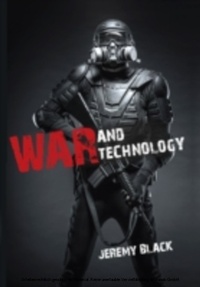
War and Technology
Description

In this engaging book, Jeremy Black argues that technology neither acts as an independent variable nor operates without major limitations. This includes its capacity to obtain end results, as technology's impact is far from simple and its pathways are by no means clear. After considering such key conceptual points, Black discusses important technological advances in weaponry and power projection from sailing warships to aircraft carriers, muskets to tanks, balloons to unmanned drones-in each case, taking into account what difference these advances made. He addresses not only firepower but also power projection and technologies of logistics, command, and control. Examining military technologies in their historical context and the present centered on the Revolution in Military Affairs and Military Transformation, Black then forecasts possible future trends.
"Clear, concise, and thoughtful. An eminently readable synthesis of historical literature on technology and war."-John France, author of Perilous Glory: The Rise of Western Military Power
"An interesting, thought provoking work by a major military historian . . . whose depth and wide range of knowledge across the entire sweep of world military history is without parallel.... Those who read this book closely will be richly rewarded for it is a mine of useful information and grist for discussion."-Spencer C. Tucker, author of The European Powers in the First World War
"A most useful introduction to a very complex subject, and particularly valuable for its notes and references to other works. Provocative and vigorously argued . . . Highly recommended."- Choice
All prices
More details
Other editions
Additional editions
Person
Jeremy Black has recently retired as Professor of History at the University of Exeter. Graduating from Cambridge with a starred first, he did postgraduate work at Oxford and then taught at Durham, eventually as professor, before moving to Exeter in 1996. He has lectured extensively in Australia, Canada, Denmark, France, Germany, Italy, New Zealand, and the United States, where he has held visiting chairs at West Point, Texas Christian University, and Stillman College. He was appointed to the Order of Membership of the British Empire for services to stamp design. His books include The British Seaborne Empire, Contesting History and Rethinking World War Two.
Content
Preface Acknowledgments List of Abbreviations
Introduction: The Key Themes 1. Early Modern Western Warships: Technologies of Power Projection and Lethality 2. Gunpowder Technology, 1490-1800 3. Firepower, Steamships, Railways, Telegraphs, Radio: Technologies of Killing, Logistics, Command, and Control, 1775-1945 4. The Internal Combustion Engine: The Technology of Decentralized Power, 1910-2013 5. A New Sphere: Air Power, 1903-2013 6. Revolution, Transformation, and the Present 7. Into the Future Conclusions Postscript
Notes Selected Further Reading Index
