

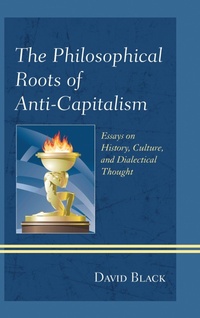
The Philosophical Roots of Anti-Capitalism
Essays on History, Culture, and Dialectical Thought
1st Edition
Published on 11. December 2013
144 pages
979-8-216-30410-4 (ISBN)
Description

Alfred Sohn-Rethel located the origin of philosophical abstraction in the "false conciousness" brought about by the new money economy of Greek Antiquity. In the Enlightenment the conceptual barrier Kant put between phenomenal reality and the "thing-in-itself" expressed, in Sohn-Rethel's view, the reified consciousness stemming from commodity-exchange and the division of mental and manual labor. Because Sohn-Rethel saw the entire history of philosophy as branded by a timeless universal logic, he dismissed Hegel's concept of "totality" as "idealist" and Hegel's critique of Kantian dualism as irrelevant to Marx's critique of political economy.
David Black, in the title essay of The Philosophical Roots of Anti-Capitalism, suggests, contra Sohn-Rethel, that Marx's exposition of the fetishism of commodities is historically-specific to capitalist production, and therefore cannot explain the origins of philosophy, which Black shows to have involved various historical developments in Greek society and culture as well as monetization. Just as Hegel's critique of Kantian formalism informs Marx's critique of capital, Hegel's writings on how the proper organization of labor might abolish the barrier Aristotle put between production and the "Realm of Freedom" prefigure Marx's efforts to formulate of an alternative to capitalism.
Part Two, Critique of the Situationist Dialectic: Art, Class Consciousness and Reification, begins with Surrealism, whose "disappearance" as a revolutionary artistic and social force Guy Debord and the Situationists sought to make up for by superseding the poetry of Art with the poetry of Life. As well highlighting Debord's achievements in both theory and practice, Black points to his philosophical shortcomings and relates these to Debord's later "pessimistic" assessment of the possibility of revolutionary class consciousness within globalizing capitalism. The four essays in Part Three cover the Aristotelian anarchism, the ambivalent legacy of Lukács' theory of reification, Raya Dunayevskaya's Hegelian-Marxist concept of "absolute negativity" as "revolution in permanance", and Gillian Rose's philosophical challenge to both postmodernism and "traditional" Marxism.
David Black, in the title essay of The Philosophical Roots of Anti-Capitalism, suggests, contra Sohn-Rethel, that Marx's exposition of the fetishism of commodities is historically-specific to capitalist production, and therefore cannot explain the origins of philosophy, which Black shows to have involved various historical developments in Greek society and culture as well as monetization. Just as Hegel's critique of Kantian formalism informs Marx's critique of capital, Hegel's writings on how the proper organization of labor might abolish the barrier Aristotle put between production and the "Realm of Freedom" prefigure Marx's efforts to formulate of an alternative to capitalism.
Part Two, Critique of the Situationist Dialectic: Art, Class Consciousness and Reification, begins with Surrealism, whose "disappearance" as a revolutionary artistic and social force Guy Debord and the Situationists sought to make up for by superseding the poetry of Art with the poetry of Life. As well highlighting Debord's achievements in both theory and practice, Black points to his philosophical shortcomings and relates these to Debord's later "pessimistic" assessment of the possibility of revolutionary class consciousness within globalizing capitalism. The four essays in Part Three cover the Aristotelian anarchism, the ambivalent legacy of Lukács' theory of reification, Raya Dunayevskaya's Hegelian-Marxist concept of "absolute negativity" as "revolution in permanance", and Gillian Rose's philosophical challenge to both postmodernism and "traditional" Marxism.
More details
Other editions
Additional editions
David Black
The Philosophical Roots of Anti-Capitalism
Essays on History, Culture, and Dialectical Thought
Book
04/2016
Lexington Books
€63.20
Shipment within 15-20 days
Person
David Black is an independent scholar and journalist. His previous books are 1839: The Chartist Insurrection with co-author Chris Ford, Helen Macfarlane: A Feminist, Revolutionary Journalist and Philosopher in Mid-19th Century England, and Acid: A New Secret History of LSD.
Content
Introduction
Part One
The Philosophical Roots of Anti-Capitalism
1 - The 'Secret Identity' of the Commodity Form
2 - The Capitalism of Philosophy? The Greek Origins of Abstraction
3 - Rethinking the 'Origins of Abstraction'
4 - Comedy and Tragedy
5 - The Poiesis of Orpheus -Fragmentation and Wholeness
6 - Hegel's Minerva
7 - Community and Civil Society
8 - Kant and the 'Autonomous Intellect'
9 - Capitalism: De-Socialized Labor
10 - Absolute Negativity as Anti-Capitalism
Part Two
Critique of the Situationist Dialect: Art, Class-Consciousnesness, and Reification
1 - Art
Surrealism and the Crisis of the Object
In the Beginning was the Letter
Unitary Urbanism, Dérive and Détournement
Asger Jorn, the Artists and the Founding of the Situationist International
2 - Class Consciousness
Socialisme ou Barbarie
The Critique of Everyday Life and the Hegelian Dialectic
3 - Reification
The Theory of the Spectacle-Commodity and the Influence of Georg Lukács
Situationist Council Communism
The Integrated Spectacle and Globalization
Part Three
Essays
Labor and Value: from the Greek Polis to Globalized State-Capitalism
Reification in the 21st Century - Lukács' Dialectic
Ends of History and New Beginnings: Hegel and the 'Dialectics of Philosophy and Organization'
Conclusion - Philosophy and Revolution in the Twenty-First Century
Part One
The Philosophical Roots of Anti-Capitalism
1 - The 'Secret Identity' of the Commodity Form
2 - The Capitalism of Philosophy? The Greek Origins of Abstraction
3 - Rethinking the 'Origins of Abstraction'
4 - Comedy and Tragedy
5 - The Poiesis of Orpheus -Fragmentation and Wholeness
6 - Hegel's Minerva
7 - Community and Civil Society
8 - Kant and the 'Autonomous Intellect'
9 - Capitalism: De-Socialized Labor
10 - Absolute Negativity as Anti-Capitalism
Part Two
Critique of the Situationist Dialect: Art, Class-Consciousnesness, and Reification
1 - Art
Surrealism and the Crisis of the Object
In the Beginning was the Letter
Unitary Urbanism, Dérive and Détournement
Asger Jorn, the Artists and the Founding of the Situationist International
2 - Class Consciousness
Socialisme ou Barbarie
The Critique of Everyday Life and the Hegelian Dialectic
3 - Reification
The Theory of the Spectacle-Commodity and the Influence of Georg Lukács
Situationist Council Communism
The Integrated Spectacle and Globalization
Part Three
Essays
Labor and Value: from the Greek Polis to Globalized State-Capitalism
Reification in the 21st Century - Lukács' Dialectic
Ends of History and New Beginnings: Hegel and the 'Dialectics of Philosophy and Organization'
Conclusion - Philosophy and Revolution in the Twenty-First Century
