

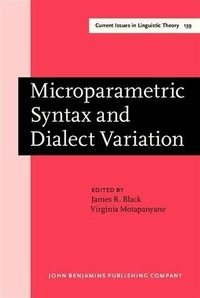
Microparametric Syntax and Dialect Variation
1st Edition
Published on 7. November 1996
XVIII, 269 pages
978-90-272-7622-3 (ISBN)
Description

Richard Kayne's introduction to this volume stresses that comparative work on the syntax of very closely related languages and dialects is a research tool promising to provide both a broad understanding of parameters at their finest-grained and an approach to the question of the minimal units of syntactic variation. The 11 articles in this collection demonstrate the use of this tool in analyzing microparametric variation, principally with reference to Chomsky's Minimalist program, in a variety of languages. Topics include se/si constructions, hypothetical infinitives and adverbial quantifiers in French and other Romance languages; that-trace variation, Scandinavian possessive constructions, reflexives and subject-verb agreement in Icelandic & Faroese, and verb clusters in continental West Germanic dialects; anaphoric agreement in Labrador Inuttut; negative particle questions in Chinese; imperative inversion in Belfast English; and the second person singular interrogative in the traditional vernacular of Bolton.
More details
Other editions
Additional editions
James R. Black | Virginia Motapanyane
Microparametric Syntax and Dialect Variation
Book
11/1996
John Benjamins Publishing Co
€116.60
Shipment within 10-15 days
Persons
Content
- MICROPARAMETRIC SYNTAX AND DIALECT VARIATION
- Editorial page
- Title page
- Copyright page
- Table of contents
- PREFATORY NOTE
- MICROPARAMETRICSYNTAX: SOME INTRODUCTORY REMARKS
- REFERENCES
- UNE ANALYSE MICROPARAMÉTRIQUE DES MOYENS DANS LES LANGUES ROMANES
- Abstract
- 0. Dela problématique de deux propriétés dites 'caractéristiques' des moyens
- 1. Dedeux analyses divergentes de la voix moyenne dans les langues romanes
- 2. Dequatre tests qui distinguent les arguments externes qui sont actifs en syntaxe de ceux qui ne le sont pas
- 3. Applicationdes tests aux moyens dans les langues romanes
- 4. Delhypothesed'un argument externe explicite dans les moyens des langues romanes
- 5. Uneanalyse microparamétrique des moyens dans les langues romanes
- BIBLIOGRAPHIE
- TREATING THAT-TRACE VARIATION
- Introduction
- 1. The thai-trace effect in verb-second complements
- 2. The variable thai-trace effect in English
- 3. Conclusion
- REFERENCES
- NEGATIVEPARTICLE QUESTIONS: A DIALECTAL COMPARISON
- 1. Introduction
- 1.1 Are NPQs reduced A-not-A or VP-not-V questions
- 1.1.1 Preverbal adjuncts
- 1.1.2 Co-occurrence with ma/ne
- 2. Negation Forms
- 2.1 Mandarín
- 2.2 Cantonese
- 2.3 Taiwanese
- 3. Classical Chinese
- 4. Dialectal differences in NPQs
- 5. Analysis
- 5.1 Agreement vs. non-agreement dialects
- 5.3 Content of negation
- 5.4 Extension
- 6. Conclusion
- Appendix Comparison of NPQs with other kinds of yes-no questions
- REFERENCES
- IMPERATIVE INVERSION IN BELFAST ENGLISH
- Introduction
- 1. Overt-subject imperatives in Belfast English: an o
- 2. The unrestricted inversion dialect
- 3. The restricted inversion dialect
- 4. The whole-verb inversion dialect
- 5. Conclusion
- REFERENCES
- SCANDINAVIAN POSSESSIVECONSTRUCTIONS FROM A NORTHERN SWEDISH VIEWPOINT
- Introduction
- 1. Major and minor parameters
- 2. Postnominal possessors in Scandinavian
- 3. Sentence structure and NP structure
- 4. Why MSc does not have N-POSS
- 5. Postnominal possessors in Northern Swedish
- 6. Prenominai possessors
- 7. Possessor Shift and Object Sh
- 8. Conclusions
- REFERENCES
- THE OCCASIONAL ABSENCE OF ANAPHORIC AGREEMENT IN LABRADOR INUTTUT
- Introduction
- 1. Anaphoric agreement in the Inuit language
- 1.1 A paradigm gap in Labrador Inuttut
- 2. Clause structure and the Labrador Parameter
- 2.1 Participialvs.indicative mood in Qairnirmiutut
- 2.2 The Labrador Parameter
- 3. The Labrador Parameter and anaphoric agreement.
- 3.1 NP adjunction and the indicative mood
- 4. Conclusion and implications for other analyses
- REFERENCES
- HYPOTHETICAL INFINITIVES ANDCROSSLINGUISTIC VARIATIONS INCONTINENTAL AND QUEBEC FRENCH
- 1. Introduction
- 2. Base generation vs. movement to Topic position
- 3. Hypothetical Infinitives project to the Complementizer Phrase
- 3.1 Arguments from the internal struc
- 3.2 Free alternation with si-conditional clauses
- 4. Hypothetical Infinitives as finite clauses
- 4.1 Hypothetical Complementizers carry [+qu] features
- 4.2 V-to-I-to-C and non-finitene ss
- 5. Finiteness from abstract modals
- 5.1 Kayne's (1992) abstract modal
- 5.2 A temporal operator
- 5.3 Hypothetical Infinitives with de
- 6. Cross-linguistic variation: the licensing of null subjects
- 6.1 Evidence for pro-drop in QF
- 6.2 Expletive pro in QF
- 6.3 The null subject parameter in QF HI clauses
- 6.4 Final remarks
- REFERENCES
- THE SECOND PERSON SINGULARINTERROGATIVE IN THE TRADITIONALVERNACULAR OF THE BOLTONMETROPOLITAN AREA
- Abstract
- 1. Introduction
- 2. Second person pronouns
- 3. Phonology and morphology of cliticized second person singular interrogative forms incorporating the pronoun
- 4. Distribution of cliticized interrogative forms
- 5. Historical background
- 6. Earlier scholarship
- 7. Conclusions
- REFERENCES
- REFLEXIVES PRONOUNS AND SUBJECT/VERB AGREEMENT IN ICELANDIC AND FAROESE
- 1. Introduction
- 2. Subject /verb agreement
- 2.1. Feature checking and movement to SPEC
- 2.2. The syntax of? redication
- 2.3. Oblique subjects and subject/verb agreement
- 2.4. Nominative subjects and subject/verb agreement
- 2.5. Icelandic object/verb agreement
- 2.6. Summary
- 3. Reflexives and pronouns
- 3.1. sig cannot be a nominative object
- 3.2. Sig and Economy of Representation
- 3.3. A surprising case of bound non-reflexive pronouns
- 3.4. Summary
- 4. Icelandic vs Faroese
- 4.1. The contrasts
- 4.2. A single parameter ?
- 4.3. Summary
- 5. Conclusion
- REFERENCES
- ADVERBIAL QUANTIFIERS AND DIALECTAL VARIATION IN A MINIMALIST FRAMEWORK
- Introduction
- 1. Adverbial quantifiers in Quebec French
- 2. Lexical properties of adverbial quantifiers
- 2.1 Adjectival-quantifiers
- 2.2. The inner structure of adjectival-quantifiers
- 3. NEG as a licenser for benben
- 3.1 The syntactic domain of benben
- 4. Conclusion
- REFERENCES
- VERB CLUSTERS IN CONTINENTAL WEST GERMANIC DIALECTS
- 1. Introduction
- 2. Verb clusters in Continental West Germanic
- 3. Analysis of the verb clusters from an OV point of view
- 4. Analysis of the verb clusters from a VO point of view
- 5. Patterns of optional movement
- 6. Patterns in the word order variation.
- 7. Conclusion
- REFERENCES
- GENERAL INDEX
