

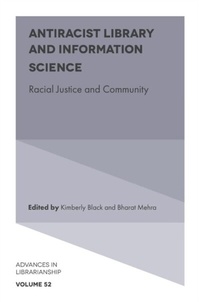
Antiracist Library and Information Science
Racial Justice and Community
1st Edition
Published on 21. March 2023
280 pages
978-1-80262-099-3 (ISBN)
Description

Antiracist Library and Information Science: Racial Justice and Community presents the scholarship and insights of seasoned academic researchers and experienced practitioners as well as emerging scholars, graduate students, new professionals and activists in the field of LIS on the topic of antiracism. The chapters represent a combination of critical, scholarly and reflective perspectives on the theory, practice and progress made towards the actualization of antiracism in LIS and the creation of racially just communities.
This volume has been divided into three main sections. The first section, 'Theoretical Groundings,' addresses the philosophical, ontological, axiological, theoretical and epistemological perspectives on race-based oppression, racial justice and anti-racist values and ethics. The second section, 'Dimensions of the Problem of Race in LIS and Community,' presents explorations of the specific problems of racism in LIS practice - racism embedded in the tools and technologies of the profession and its services, in social relations and in the practices of LIS workplaces. The final section, 'Developing Antiracist LIS and Creating the Beloved Community' presents practical solutions for realizing the vision of an antiracist LIS and the creation of racially justice communities.
The contributors have provided a response and initial solutions for how the LIS professions can meet their espoused ideals for providing the best services for their communities. This work provides scholarship, food for thought, frameworks, and proposals for discussions for achieving the end of racism in LIS and the creation of just world.
This volume has been divided into three main sections. The first section, 'Theoretical Groundings,' addresses the philosophical, ontological, axiological, theoretical and epistemological perspectives on race-based oppression, racial justice and anti-racist values and ethics. The second section, 'Dimensions of the Problem of Race in LIS and Community,' presents explorations of the specific problems of racism in LIS practice - racism embedded in the tools and technologies of the profession and its services, in social relations and in the practices of LIS workplaces. The final section, 'Developing Antiracist LIS and Creating the Beloved Community' presents practical solutions for realizing the vision of an antiracist LIS and the creation of racially justice communities.
The contributors have provided a response and initial solutions for how the LIS professions can meet their espoused ideals for providing the best services for their communities. This work provides scholarship, food for thought, frameworks, and proposals for discussions for achieving the end of racism in LIS and the creation of just world.
More details
Series
Language
English
Place of publication
Bingley
United Kingdom
Target group
Professional and scholarly
File size
10,32 MB
ISBN-13
978-1-80262-099-3 (9781802620993)
Copyright in bibliographic data and cover images is held by Nielsen Book Services Limited or by the publishers or by their respective licensors: all rights reserved.
Schweitzer Classification
Persons
Kimberly Black is an Associate Professor in Department of Computing, Information, and Mathematical Sciences and Technologies at Chicago State University (CSU). She is the author of What Books by African American Women Were Acquired by American Academic Libraries?: A Study of Institutional Legitimization, Exclusion, and Implicit Censorship (2009).
Bharat Mehra is EBSCO Endowed Chair in Social Justice, and Professor in the School of Library and Information Studies at the University of Alabama. His research promotes diversity and social justice through information and communication technologies to empower minority and underserved populations to make meaningful changes in their everyday lives.
Bharat Mehra is EBSCO Endowed Chair in Social Justice, and Professor in the School of Library and Information Studies at the University of Alabama. His research promotes diversity and social justice through information and communication technologies to empower minority and underserved populations to make meaningful changes in their everyday lives.
Content
Introduction; Kimberly Black and Bharat Mehra
PART I - THEORETICAL GROUNDINGS
Chapter 1. Epistemicide and Anti-Blackness in Libraries, Archives, and Museums: Working Towards Equity through Epistemic Justice Practices; Beth J.H. Patin, Melissa Smith, Tyler Youngman, Jieun Yeon, and Jeanne Kambara
Chapter 2. Antiracism and Spiritual Practice: An Exegesis of Race and LIS; Kimberly Black
Chapter 3. {Reflection Essay} Unearthing Racism in the Soil: Developing Collective Anti-Racist Consciousness in a Library and Information Science; Classroom LaVerne Gray
Chapter 4. {Reflection Essay} Dismantling the Myths: Evidence Based Antiracist School Librarianship; Janice Moore Newsum
PART II - DIMENSIONS OF THE PROBLEM OF RACE IN LIS AND COMMUNITY
Chapter 5. Beyond the Diversity Audit: Uncovering Whiteness in Our Collections Amanda; Rybin Koob, Alexander Watkins, Frederick C. Carey, Xiang Li, Arthur Aguilera, and Natalia Tingle
Chapter 6. Shutting Down the Tent Revival: The Call for Inclusive Leadership in LIS; Nicole Cooke and Lucy Santos Green
Chapter 7. Slave Cases & Ingrained Racism in Legal Information Infrastructures; Jennifer Elisa Chapman
Chapter 8. Collegiality as a Weapon to Maintain Status Quo in a White-Privileged and Entrenched LIS; Academy Bharat Mehra, Laurie Bonnici, and Steven L. MacCall
Chapter 9. {Reflection Essay} Bad Things Keep Happening in Our Town; Ferial Pearson, Sandra Rodriguez-Arroyo, and Gabriel Gutierrez
Chapter 10. {Reflection Essay} Cultural Humility and Black Males in the Library; Conrad Pegues
Chapter 11. {Reflection Essay} With Head & Heart -Exploring Autoethnographic Antiracist Research in Pediatric Cancer Communities; Shalonda Capers
Chapter 12. {Reflection Essay} Publishing while Latina: My Journey as an LIS Scholar in Search of the Academic Stool's Third Leg; Mo?nica Colo?n-Aguirre
PART III - DEVELOPING ANTIRACIST LIS AND CREATING THE 'BELOVED COMMUNITY'
Chapter 13. Black Librarians and Racial and Informational Justice for the Brazilian Black Population; Franciele Carneiro Garces da Silva, Dirnele Carneiro Garcez and Leyde Klebia Rodrigues da Silva
Chapter 14. Immigrants in Alabama: Community-Engaged Scholarship as a Lens for Racial Justice; Baheya Jaber
Chapter 15. White Pricks to Decenter Shades of White Privilege in Professional Association's Leadership Networks of LIS Education towards Antiracist Praxis; Bharat Mehra
Chapter 16. {Reflection Essay} Engaging Conversations: Foregrounding Twitter Feeds in Library Guides to Center Traditionally Marginalized Voices and Engage in Critical Discourse; Anders Tobiason
Chapter 17. {Reflection Essay} We the People......An Essay on the Survival of America; Robert Johnson
Chapter 18. {Reflection Essay} The Charlottesville Virginia Tragedy & Historical Artifacts: An Essay Reviewing Public Culture & Libraries' Responsibility in Changing the Narrative; Briana Christensen
PART I - THEORETICAL GROUNDINGS
Chapter 1. Epistemicide and Anti-Blackness in Libraries, Archives, and Museums: Working Towards Equity through Epistemic Justice Practices; Beth J.H. Patin, Melissa Smith, Tyler Youngman, Jieun Yeon, and Jeanne Kambara
Chapter 2. Antiracism and Spiritual Practice: An Exegesis of Race and LIS; Kimberly Black
Chapter 3. {Reflection Essay} Unearthing Racism in the Soil: Developing Collective Anti-Racist Consciousness in a Library and Information Science; Classroom LaVerne Gray
Chapter 4. {Reflection Essay} Dismantling the Myths: Evidence Based Antiracist School Librarianship; Janice Moore Newsum
PART II - DIMENSIONS OF THE PROBLEM OF RACE IN LIS AND COMMUNITY
Chapter 5. Beyond the Diversity Audit: Uncovering Whiteness in Our Collections Amanda; Rybin Koob, Alexander Watkins, Frederick C. Carey, Xiang Li, Arthur Aguilera, and Natalia Tingle
Chapter 6. Shutting Down the Tent Revival: The Call for Inclusive Leadership in LIS; Nicole Cooke and Lucy Santos Green
Chapter 7. Slave Cases & Ingrained Racism in Legal Information Infrastructures; Jennifer Elisa Chapman
Chapter 8. Collegiality as a Weapon to Maintain Status Quo in a White-Privileged and Entrenched LIS; Academy Bharat Mehra, Laurie Bonnici, and Steven L. MacCall
Chapter 9. {Reflection Essay} Bad Things Keep Happening in Our Town; Ferial Pearson, Sandra Rodriguez-Arroyo, and Gabriel Gutierrez
Chapter 10. {Reflection Essay} Cultural Humility and Black Males in the Library; Conrad Pegues
Chapter 11. {Reflection Essay} With Head & Heart -Exploring Autoethnographic Antiracist Research in Pediatric Cancer Communities; Shalonda Capers
Chapter 12. {Reflection Essay} Publishing while Latina: My Journey as an LIS Scholar in Search of the Academic Stool's Third Leg; Mo?nica Colo?n-Aguirre
PART III - DEVELOPING ANTIRACIST LIS AND CREATING THE 'BELOVED COMMUNITY'
Chapter 13. Black Librarians and Racial and Informational Justice for the Brazilian Black Population; Franciele Carneiro Garces da Silva, Dirnele Carneiro Garcez and Leyde Klebia Rodrigues da Silva
Chapter 14. Immigrants in Alabama: Community-Engaged Scholarship as a Lens for Racial Justice; Baheya Jaber
Chapter 15. White Pricks to Decenter Shades of White Privilege in Professional Association's Leadership Networks of LIS Education towards Antiracist Praxis; Bharat Mehra
Chapter 16. {Reflection Essay} Engaging Conversations: Foregrounding Twitter Feeds in Library Guides to Center Traditionally Marginalized Voices and Engage in Critical Discourse; Anders Tobiason
Chapter 17. {Reflection Essay} We the People......An Essay on the Survival of America; Robert Johnson
Chapter 18. {Reflection Essay} The Charlottesville Virginia Tragedy & Historical Artifacts: An Essay Reviewing Public Culture & Libraries' Responsibility in Changing the Narrative; Briana Christensen
