

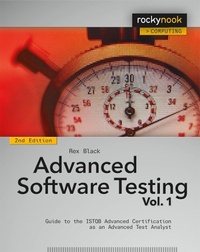
Advanced Software Testing - Vol. 1, 2nd Edition
Guide to the ISTQB Advanced Certification as an Advanced Test Analyst
Published on 5. January 2016
376 pages
978-1-68198-110-9 (ISBN)
Description

This book is written for the test analyst who wants to achieve advanced skills in test analysis, design, and execution. With a hands-on, exercise-rich approach, this book teaches you how to define and carry out the tasks required to put a test strategy into action.
Learn how to analyze the system, taking into account the user's quality expectations. Additionally, learn how to evaluate system requirements as part of formal and informal reviews, using an understanding of the business domain to determine requirement validity. You will be able to analyze, design, implement, and execute tests, using risk considerations to determine the appropriate effort and priority for tests. You will also learn how to report on testing progress and provide necessary evidence to support your evaluations of system quality.
With a quarter-century of software and systems engineering experience, author Rex Black is President of RBCS, a leader in software, hardware, and systems testing, and is the most prolific author practicing in the field of software testing today. He published several books on testing that sold tens of thousands of copies worldwide. He is President of the International Software Testing Qualifications Board (ISTQB) and is a Director of the American Software Testing Qualifications Board (ASTQB).
This book will also help you prepare for the ISTQB Advanced Test Analyst exam. Included are sample exam questions, at the appropriate level of difficulty, for most of the learning objectives covered by the ISTQB Advanced Level syllabus. The ISTQB certification program is the leading software tester certification program in the world. With about 400,000 certificate holders and a global presence in 50 countries, you can be confident in the value and international stature that the Advanced Test Analyst certificate can offer you.
The 2nd edition has been thoroughly revised and is aligned with the curriculum. In addition, some minor corrections have been included.
Learn how to analyze the system, taking into account the user's quality expectations. Additionally, learn how to evaluate system requirements as part of formal and informal reviews, using an understanding of the business domain to determine requirement validity. You will be able to analyze, design, implement, and execute tests, using risk considerations to determine the appropriate effort and priority for tests. You will also learn how to report on testing progress and provide necessary evidence to support your evaluations of system quality.
With a quarter-century of software and systems engineering experience, author Rex Black is President of RBCS, a leader in software, hardware, and systems testing, and is the most prolific author practicing in the field of software testing today. He published several books on testing that sold tens of thousands of copies worldwide. He is President of the International Software Testing Qualifications Board (ISTQB) and is a Director of the American Software Testing Qualifications Board (ASTQB).
This book will also help you prepare for the ISTQB Advanced Test Analyst exam. Included are sample exam questions, at the appropriate level of difficulty, for most of the learning objectives covered by the ISTQB Advanced Level syllabus. The ISTQB certification program is the leading software tester certification program in the world. With about 400,000 certificate holders and a global presence in 50 countries, you can be confident in the value and international stature that the Advanced Test Analyst certificate can offer you.
The 2nd edition has been thoroughly revised and is aligned with the curriculum. In addition, some minor corrections have been included.
More details
Other editions
Additional editions
Rex Black
Advanced Software Testing - Vol. 1, 2nd Edition
Guide to the ISTQB Advanced Certification as an Advanced Test Analyst
E-Book
01/2016
2nd Edition
Rocky Nook
€48.99
Available for download
Rex Black
Advanced Software Testing - Vol. 1, 2nd Edition
Guide to the ISTQB Advanced Certification as an Advanced Test Analyst
Book
12/2015
2nd Edition
Rocky Nook
€56.00
Shipment within 3-4 weeks
Content
- Cover
- Table of Contents
- Preface
- Acknowledgements
- Introduction
- 1 Testing Process
- 1.1 Introduction
- 1.2 Testing in the Software Development Lifecycle
- 1.3 Test Planning, Monitoring, and Control
- 1.4 Test Analysis
- 1.5 Test Design
- 1.6 Test Implementation
- 1.7 Test Execution
- 1.8 Evaluating Exit Criteria and Reporting
- 1.9 Test Closure Activities
- 1.10 Sample Exam Questions
- 2 Test Management: Responsibilities for the Test Analyst
- 2.1 Introduction
- 2.2 Test Progress Monitoring and Control
- 2.3 Distributed, Outsourced, and Insourced Testing
- 2.4 The Test Analyst's Tasks in Risk-Based Testing
- 2.5 Sample Exam Questions
- 3 Test Techniques
- 3.1 Introduction
- 3.2 Specification-Based Techniques
- 3.2.1 Equivalence Partitioning
- 3.2.2 Boundary Value Analysis
- 3.2.3 Decision Tables
- 3.2.4 Cause-Effect Graphs
- 3.2.5 Use Case Testing
- 3.2.6 State Transition Testing
- 3.2.7 Combinatorial Testing Techniques
- 3.2.8 User Story Testing
- 3.2.9 Domain Analysis
- 3.2.10 Applying Techniques to Requirements
- 3.3 Defect-Based Techniques
- 3.4 Experience-Based Techniques
- 3.5 Sample Exam Questions
- 4 Testing Software Quality Characteristics
- 4.1 Introduction
- 4.2 Quality Characteristics for Business Domain Testing
- 4.3 Sample Exam Questions
- 5 Reviews
- 5.1 Introduction
- 5.2 Using Checklists in Reviews
- 5.3 Sample Exam Questions
- 6 Defect Management
- 6.1 Introduction
- 6.2 When Can a Defect Be Detected?
- 6.3 Defect Report Fields
- 6.4 Defect Classification
- 6.5 Root Cause Analysis
- 6.6 Sample Exam Questions
- 7 Test Tools
- 7.1 Introduction
- 7.2 Test Tools and Automation
- 7.3 Sample Exam Questions
- 8 Preparing for the Exam
- 8.1 Learning Objectives
- 8.2 ISTQB Advanced Exams
- Appendix
- A: Bibliography
- Advanced Test Analysis Syllabus Referenced Standards
- Advanced Test Analysis Syllabus Referenced Works
- Other Referenced Works
- B: HELLOCARMS The Next Generation of Home Equity Lending System Requirements Document
- I: Table of Contents
- II: Versioning
- III: Glossary
- 000 Introduction
- 001 Informal Use Case
- 003 Scope
- 004 System Business Benefits
- 010 Functional System Requirements
- 020 Reliability System Requirements
- 030 Usability System Requirements
- 040 Efficiency System Requirements
- 050 Maintainability System Requirements
- 060 Portability System Requirements
- A: Acknowledgement
- C: Answers to Sample Questions
- Index
- A
- B
- C
- D
- E
- F
- H
- I
- K
- L
- M
- O
- P
- Q
- R
- S
- T
- U
- V
- W
