

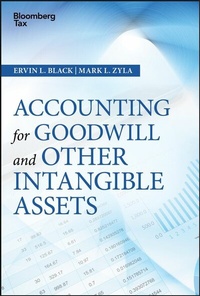
Accounting for Goodwill and Other Intangible Assets
Description

Accounting for Goodwill and Other Intangible Assets is a guide to one of the most challenging aspects of business valuation. Not only must executives and valuation professionals understand the complicated set of rules and practices that pertain to intangibles, they must also be able to recognize when to apply them. Inside, readers will find these many complexities clarified. Additionally, this book assists professionals in overcoming the difficulties of intangible asset accounting, such as the lack of market quotes and the conflicts among various valuation methodologies.
Even the rarest and most problematic situations are treated in detail in Accounting for Goodwill and Other Intangible Assets. For example, the authors analyze principles for identifying finite intangible assets and appropriately accounting for amortization expenses or impairment losses. Using the information in this book, the results of these calculations can also be reported with precision on financial statements. These topics are especially important for ensuring the success of any asset acquisition or business combination. In these special cases, the utmost accuracy is essential. This book provides:
* Rules for identifying and recognizing intangible assets in business combinations and asset acquisitions
* Guidance on the accurate valuation and carrying amount calculation of acquired and self-created intangibles
* Tips for overcoming the challenges unique to intangible assets, including impairment testing
* Clear instructions for disclosing intangible assets, goodwill, and amortization expenses
Accounting for Goodwill and Other Intangible Assets is an indispensable reference for valuation students and specialists. Ervin L. Black and Mark L. Zyla provide thorough instructions for understanding, accounting for, and reporting this challenging asset class.
More details
Other editions
Additional editions
Persons
ERVIN L. BLACK, PHD, holds the Rath Chair in Accounting and is a Professor of Accounting at the University of Oklahoma. Widely published on financial and international accounting, he currently serves as the editor of the Journal of International Accounting Research and is co-author of the BNA Tax and Accounting Portfolio 5170, Business Combinations (Accounting Policy and Practice Series).
MARK L. ZYLA, CPA/ABV, CFA, ASA, is a Managing Director of Acuitas Inc., a valuation and litigation consultancy firm. He is the author of Fair Value Measurements: Practical Guidance and Implementation, and co-author of Bloomberg BNA's Tax and Accounting Portfolio 5127, Fair Value Measurements: Valuation Principles and Auditing Techniques (Accounting Policy and Practice Series).
Content
Introduction v
CHAPTER 1 Recognizing Intangible Assets 1
CHAPTER 2 Initial Measurement of Acquired Intangible Assets 47
CHAPTER 3 Amortizing Intangible Assets 89
CHAPTER 4 Impairment Testing for Goodwill and Other Intangible Assets 111
CHAPTER 5 Financial Statement Presentation and Disclosures 191
CHAPTER 6 Deferred Tax Consequences of Goodwill and Intangible Assets 215
Working Papers 237
About the Authors 265
Index 267
Introduction
A. Scope of Book
The purpose of this book is to examine the application of the FASB Accounting Standards Codification provisions concerning goodwill and other intangible assets, as well as to explain common practices in valuing such assets. Relevant International Financial Reporting Standards (IFRS) are also examined for goodwill and other intangible assets throughout the book.
In 2001, the Financial Accounting Standards Board (FASB) eliminated the amortization of goodwill and other indefinite-lived intangible assets when a new standard on business combinations (FAS 141) was approved. In addition, this new standard resulted in the recognition of many more types of other intangible assets. In the years since, the FASB and International Accounting Standards Board (IASB) have revised their business combinations guidance and have also amended the accounting for goodwill and other intangible assets several times.
The chapters in this book cover the rules under U.S. GAAP and IFRS, as well as some of the exceptions for small and medium enterprises (SMEs) or private companies. Chapter 1 examines the recognition of goodwill and other intangible assets. Chapter 2 examines the initial measurement of acquired goodwill and other intangible assets, followed by Chapter 3, which examines the amortization of intangible assets with finite useful lives. Chapter 4 analyzes impairments and impairment testing of goodwill and other indefinite-lived intangible assets. Chapter 5 discusses financial statement presentation and required disclosures, and Chapter 6 discusses, in brief, the deferred tax consequences of goodwill and other intangible assets.
B. Definitions and Origins
1. U.S. GAAP Synopsis
Intangible Assets Other Than Goodwill
For financial reporting purposes, "intangible assets" consist of assets (not including financial assets) that lack physical substance. (The term intangible assets is used to refer to intangible assets other than goodwill.)1 Intangible assets that are acquired either individually or with a group of assets must be recognized in the financial statements. In general, only acquired intangible assets are recognized, as most costs of internally developing intangible assets are expensed as incurred.2
This work is intended to provide authoritative information regarding the subject matter covered, but is not intended to provide legal or accounting advice or any other professional service. The information is not relevant for any particular client or use and may not reflect all relevant laws applicable to any particular factual situation. Although diligent effort has been made to ensure accuracy of the information, the authors and publisher assume no responsibility for any reader's reliance on the information or opinions expressed herein, and encourage the reader to verify all items by reviewing the original sources. To ensure compliance with IRS requirements, any discussion of U.S. federal tax matters contained in the publication is not intended or written to be used, and cannot be used, for the purpose of (1) avoiding tax penalties that may be imposed on the recipient or any other taxpayer, or (2) promoting, marketing, or recommending to another party any arrangement or other transaction addressed herein.
There are dozens of types of intangible assets, but most fall into one of four general categories: marketing/customer-related intangibles, artistic-related intangibles, contract-based intangibles, and technology-based intangibles. For a list of many different intangibles see Exhibit 1.1 in Chapter 1.
Intangible assets, besides goodwill, can be acquired in a business combination or in other transactions, including individually or with a group of other assets. An intangible asset is considered distinct (separately identifiable) from goodwill if it meets one of the following two criteria:
- If it arises from contractual or other legal rights (regardless of whether those rights are tradable or separate from the acquired entity or from other rights and obligations), or
- If it is separable, that is, it is capable of being separated or divided from the acquired entity and sold, transferred, licensed, rented, or exchanged (regardless of whether there is an intent to do so).3
If intangible assets are acquired in a business combination, they are initially recognized under the guidance in ASC 805-10 and ASC 805-30, but are subsequently accounted for under the guidance in ASC 350. If they are acquired in a transaction that does not qualify as a business combination, they are initially recognized under ASC 805-50 and subsequently accounted for under ASC 350.
Goodwill
Goodwill is a specific category of intangible asset that arises only when an entity acquires one or more other entities in a business combination. The definition of goodwill is "[a]n asset representing the future economic benefits arising from other assets acquired in a business combination . that are not individually identified and separately recognized."4
Goodwill is measured as a residual (i.e., the excess of consideration transferred over the fair value of assets acquired and liabilities assumed). Therefore, goodwill is a single value that represents the sum of all the indistinguishable or inseparable intangible assets that comprise it. The initial recognition of goodwill is governed by ASC 805-20 and subsequent accounting for goodwill is governed by ASC 350.
What Constitutes a Business?
When intangible assets are acquired, it is important to determine whether the acquisition transaction is a business combination and thus governed by ASC 805-10, ASC 805-20 (goodwill), and ASC 805-30 (other intangible assets). Whether an acquisition transaction is a business combination depends in part on whether the assets (or assets and liabilities) acquired constitute a business.
Prior to the revised standard on business combinations, EITF 98-3, Paragraph 6, defined a business as the following:
A business is a self-sustaining integrated set of activities and assets conducted and managed for the purpose of providing a return to investors. A business consists of: (a) inputs, (b) processes applied to those inputs, and (c) resulting outputs that are used to generate revenues. For a transferred set of activities and assets to be a business, it must contain all of the inputs and processes necessary for it to continue to conduct normal operations after the transferred set is separated from the transferor, which includes the ability to sustain a revenue stream by providing its outputs to customers.
ASC 805 currently defines a business as "an integrated set of activities and assets that is capable of being conducted and managed for the purpose of providing a return in the form of dividends, lower costs, or other economic benefits directly to investors or other owners, members, or participants."5 The key terms in the definition are that a business must be "capable of being conducted" and "managed to provide a return to investors." Examples given by the FASB as a function of a business include managed for lower costs, a capital return, or other economic benefit.
Comment
The net effect of the revised current definition of a business is that it removes the self-sustaining requirement from previous guidance. Thus the current definition results in more acquisitions qualifying as businesses (such as those involving start-up companies), and thus more goodwill will be recognized. The current definition also assumes a hypothetical acquirer, so the acquiring entity need not intend to operate the business, as long as the business is capable of being operated when acquired.6
This business definition contains a rebuttal presumption of a business as a going concern. A consequence of this presumption is that if the acquisition is a going concern, then goodwill should be present. One clarifying point is that intangible assets acquired in an acquisition not qualifying as a business combination must still be recognized in accordance with ASC 350. In these types of acquisitions, there would not be any residual goodwill.7
What Constitutes a Business Combination?
The FASB Codification defines a "business combination" as "[a] transaction or other event in which an acquirer obtains control of one or more businesses. Transactions sometimes referred to as true mergers or mergers of equals also are business combinations."8 With the current definition, certain types of acquisitions that were classified as asset acquisitions under previous guidance may now be classified as business combinations.
Measuring and Subsequently Accounting for Goodwill and Other Intangible Assets
Once intangible assets are identified, an entity must determine whether they have measurable (i.e., estimable) lives. Some intangible assets have measurable lives while others have uncertain durations or indefinite lives. Identifiable intangible assets with measurable useful lives are amortized over their estimated useful lives. Intangible assets with indefinite useful lives (i.e., intangible assets whose lives cannot be reasonably estimated) and goodwill are not amortized. However, these indefinite-lived intangibles, including goodwill, must be regularly tested for impairment. Intangible assets with estimated...
