

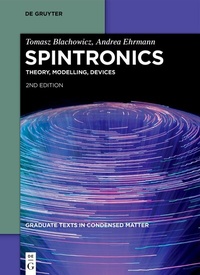
Spintronics
Description

Spintronics, being a part of electronics, is under intense development for about forty years and mainly concerns transport of electronics spin in low-dimensional structures. This field, based on often difficult theoretical concepts of quantum physics, has surprisingly strong and real technological and application consequences. Thus, spintronic solutions concern memory systems, information processing devices and are used as sensors to detect variety of physical fields. The early development of this field can be associated with the names of such scientists as: E. I. Rashba, A. Fert, P. Grünberg, J. Barnas, B. Hillebrands, G. Güntherodt, I. K. Schuller, M. Grimsditch, A. Hoffman, P. Vavassori, and S. Datta. This list is absolutely not closed and might be easily extended, however, it results rather from scientific history and contacts with people who influenced the research carriers of the authors. The authors give in this up-dated 2nd edition an insight into this emerging field providing theoretical and experimental aspects of spintronics and guide readers from a basic understanding of fundamental processes to recent applications and future possibilities opened by ongoing research.
The textbook is suited for students and for interested scientists who were discouraged by the theoretical formalism only.
More details
Other editions
Additional editions
Previous edition
Persons
Tomasz Blachowicz currently works as full professor at the Institute of Physics - Center for Science and Education, Silesian University of Technology, Gliwice, Poland. He does research in applied physics and material science as well as within the emerging field of big industrial data analysis including machine learning methods. He is member and co-creator of the VIARAM (Virtual Institute of Applied Research on Advanced Materials). Since two years he is also the head of the R&D department at PROPOINT SA company, operating in the field of industrial automation. He holds 4 patents, authored or co-authored 2 books and 152 papers indexed in the Web of Science. His dominating research disciplines are: physics of materials, physical computing and simulations as well as geo-physical data analysis, spintronics, geomorphology, optics, magnetic materials, micromagnetic simulations, signal processing, fractals, and deterministic chaos. The last industrial activities concern detection of failures, so called predictive maintenance problem. In the recent scientific publications the author took the problem related to analysis of the exchange-bias phenomenon in low-dimensional magnetic structures as well as reported practical issues like the use of fibrous materials for shielding of electromagnetic radiation or for medical sensing applications.
Andrea Ehrmann is a full professor at Bielefeld University of Applied Sciences and Arts in Germany, responsible for physics, measurement technologies and lectures in the range of materials sciences. Her research includes a broad range of topics, from magnetism to optical technologies, from additive manufacturing to nanotechnology. She is a member and co-founder of the Virtual Institute of Applied Research on Advanced Materials (VIARAM). She holds several national and international patents, has published around 250 papers indexed in the Web of Science, is co-author of two scientific books and editor of several books. In most of her publications, she aims at interdisciplinarily combining several of her research interests.
