

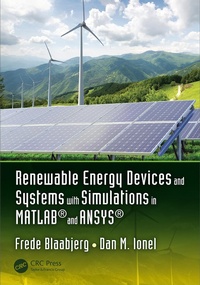
Renewable Energy Devices and Systems with Simulations in MATLAB (R) and ANSYS (R)
1st Edition
Published on 18. May 2017
414 pages
978-1-4987-6583-1 (ISBN)
Description

Due to the increasing world population, energy consumption is steadily climbing, and there is a demand to provide solutions for sustainable and renewable energy production, such as wind turbines and photovoltaics. Power electronics are being used to interface renewable sources in order to maximize the energy yield, as well as smoothly integrate them within the grid. In many cases, power electronics are able to ensure a large amount of energy saving in pumps, compressors, and ventilation systems. This book explains the operations behind different renewable generation technologies in order to better prepare the reader for practical applications. Multiple chapters are included on the state-of-the-art and possible technology developments within the next 15 years. The book provides a comprehensive overview of the current renewable energy technology in terms of system configuration, power circuit usage, and control. It contains two design examples for small wind turbine system and PV power system, respectively, which are useful for real-life installation, as well as many computer simulation models.
Reviews / Votes
"Renewable Energy Devices and Systems with Simulations in MATLAB and ANSYS explains the operations behind different renewable generation technologies in order to better prepare the reader for practical applications. Multiple chapters are included on the current state-of-the-art technology and possible technology developments within the next 15 years. The book provides a comprehensive overview of the current renewable energy technology in terms of system configuration, power circuit usage, and control. It contains two design examples for small wind turbine system and PV power system, respectively, which are useful for real-life installation, as well as many computer simulation models."-MathWorks
"It should be stressed that despite the overlapping authorship of many chapters, no repetition can be found in the book, and the presented material is well balanced. The volume can be strongly recommended for a wide audience of both undergraduate and graduate students, engineering educators, and practicing engineers in the industry who are interested in the subject of modern renewable energy systems."
-IEEE Industrial Electronics Magazine, June 2018 Issue
More details
Language
English
Place of publication
London
United Kingdom
Publishing group
Taylor & Francis Ltd
Target group
College/higher education
Professional and scholarly
Illustrations
95 farbige Abbildungen, 283 s/w Abbildungen
95 Illustrations, color; 283 Illustrations, black and white
File size
30,15 MB
ISBN-13
978-1-4987-6583-1 (9781498765831)
Copyright in bibliographic data and cover images is held by Nielsen Book Services Limited or by the publishers or by their respective licensors: all rights reserved.
Schweitzer Classification
Other editions
Additional editions
Frede Blaabjerg | Dan M. Ionel
Renewable Energy Devices and Systems with Simulations in MATLAB (R) and ANSYS (R)
Book
09/2020
1st Edition
CRC Press
€75.51
Shipment within 15-20 days
Frede Blaabjerg | Dan M. Ionel
Renewable Energy Devices and Systems with Simulations in MATLAB (R) and ANSYS (R)
Book
05/2017
1st Edition
CRC Press
€207.50
Article not available at the moment
Persons
Frede Blaabjerg was at ABB-Scandia, Randers, Denmark, from 1987 to 1988. From 1988 to 1992, he was a Ph.D. Student with Aalborg University, Aalborg, Denmark. He became an Assistant Professor in 1992, an Associate Professor in 1996, and a Full Professor of power electronics and drives in 1998. His current research interests include power electronics and its applications (such as in wind turbines), PV systems, reliability, harmonics, and adjustable speed drives. He has received 17 IEEE Prize Paper Awards, the IEEE PELS Distinguished Service Award in 2009, the EPE-PEMC Council Award in 2010, the IEEE William E. Newell Power Electronics Award 2014 and the Villum Kann Rasmussen Research Award 2014. Professor Blaabjerg was an Editor-in-Chief of the IEEE TRANSACTIONS ON POWER ELECTRONICS from 2006 to 2012. He has been Distinguished Lecturer for the IEEE Power Electronics Society from 2005 to 2007 and for the IEEE Industry Applications Society from 2010 to 2011. In 2014, he was nominated by Thomson Reuters to be one of the 250 most cited researchers in Engineering in the world. Professor Blaabjerg has published more than 300 journal publications in the field.
Dan M. Ionel is Professor of Electrical Engineering and the L. Stanley Pigman Chair in Power at University of Kentucky, Lexington, KY. He previously worked in industry, most recently as Chief Engineer for Regal Beloit Corp., and, before that, as the Chief Scientist for Vestas Wind Turbines. Concurrently with his industrial appointments, Professor Ionel also served as Visiting and Research Professor at University of Wisconsin and Marquette University in Milwaukee, WI. He contributed to technology developments with long lasting industrial impact, including US' most successful range of PM motor drives and the world's most powerful wind turbine. He published more than one hundred and fifty technical papers, including three winners of IEEE Best Paper Awards, and holds more than thirty patents, including a medal winner at the Geneva Invention Fair. An IEEE Fellow, he was the inaugural Chair of the IEEE Industry Applications Society Renewable and Sustainable Energy Conversion Systems Committee, Editor of IEEE Transactions on Sustainable Energy, and Technical Program Chair for IEEE ECCE 2015. He is the General Chair of the IEEE 2017 IEMDC Conference and the Editor-in-Chief of the Electric Power Components and Systems Journal.
Dan M. Ionel is Professor of Electrical Engineering and the L. Stanley Pigman Chair in Power at University of Kentucky, Lexington, KY. He previously worked in industry, most recently as Chief Engineer for Regal Beloit Corp., and, before that, as the Chief Scientist for Vestas Wind Turbines. Concurrently with his industrial appointments, Professor Ionel also served as Visiting and Research Professor at University of Wisconsin and Marquette University in Milwaukee, WI. He contributed to technology developments with long lasting industrial impact, including US' most successful range of PM motor drives and the world's most powerful wind turbine. He published more than one hundred and fifty technical papers, including three winners of IEEE Best Paper Awards, and holds more than thirty patents, including a medal winner at the Geneva Invention Fair. An IEEE Fellow, he was the inaugural Chair of the IEEE Industry Applications Society Renewable and Sustainable Energy Conversion Systems Committee, Editor of IEEE Transactions on Sustainable Energy, and Technical Program Chair for IEEE ECCE 2015. He is the General Chair of the IEEE 2017 IEMDC Conference and the Editor-in-Chief of the Electric Power Components and Systems Journal.
Content
Preface
Editors
Contributors
Chapter 1 Renewable Energy Systems: Technology Overview and Perspectives
Chapter 2 Solar Power Sources: PV, Concentrated PV, and Concentrated Solar Power
Chapter 3 Overview of Single-Phase Grid-Connected Photovoltaic Systems
Chapter 4 Three-Phase Photovoltaic Systems: Structures, Topologies, and Control
Chapter 5 Overview of Maximum Power Point Tracking Techniques for Photovoltaic Energy Production Systems
Chapter 6 Design of Residential Photovoltaic Systems
Chapter 7 Small Wind Energy Systems
Chapter 8 Power Electronics and Controls for Large Wind Turbines and Wind Farms
Chapter 9 Electric Generators and their Control for Large Wind Turbines
Chapter 10 Design Considerations for Wind Turbine Systems
Chapter 11 Marine and Hydrokinetic Power Generation and Power Plants
Chapter 12 Power Conversion and Control for Fuel Cell Systems in Transportation and Stationary Power Generation
Chapter 13 Batteries and Ultracapacitors for Electric Power Systems with Renewable Energy Sources
Chapter 14 Microgrid for High-Surety Power: Architectures, Controls, Protection, and Demonstration
Index
Editors
Contributors
Chapter 1 Renewable Energy Systems: Technology Overview and Perspectives
Chapter 2 Solar Power Sources: PV, Concentrated PV, and Concentrated Solar Power
Chapter 3 Overview of Single-Phase Grid-Connected Photovoltaic Systems
Chapter 4 Three-Phase Photovoltaic Systems: Structures, Topologies, and Control
Chapter 5 Overview of Maximum Power Point Tracking Techniques for Photovoltaic Energy Production Systems
Chapter 6 Design of Residential Photovoltaic Systems
Chapter 7 Small Wind Energy Systems
Chapter 8 Power Electronics and Controls for Large Wind Turbines and Wind Farms
Chapter 9 Electric Generators and their Control for Large Wind Turbines
Chapter 10 Design Considerations for Wind Turbine Systems
Chapter 11 Marine and Hydrokinetic Power Generation and Power Plants
Chapter 12 Power Conversion and Control for Fuel Cell Systems in Transportation and Stationary Power Generation
Chapter 13 Batteries and Ultracapacitors for Electric Power Systems with Renewable Energy Sources
Chapter 14 Microgrid for High-Surety Power: Architectures, Controls, Protection, and Demonstration
Index
