

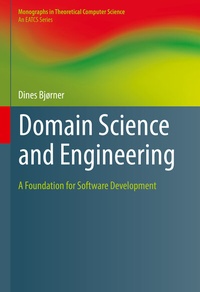
Domain Science and Engineering
Description

In this book the author explains domain engineering and the underlying science, and he then shows how we can derive requirements prescriptions for computing systems from domain descriptions. A further motivation is to present domain descriptions, requirements prescriptions, and software design specifications as mathematical quantities.
The author's maxim is that before software can be designed we must understand its requirements, and before requirements can be prescribed we must analyse and describe the domain for which the software is intended. He does this by focusing on what it takes to analyse and describe domains. By a domain we understand a rationally describable discrete dynamics segment of human activity, of natural and man-made artefacts, examples include road, rail and air transport, container terminal ports, manufacturing, trade, healthcare, and urban planning. The book addresses issues of seemingly large systems, not small algorithms, and it emphasizes descriptionsas formal, mathematical quantities.
This is the first thorough monograph treatment of the new software engineering phase of software development, one that precedes requirements engineering. It emphasizes a methodological approach by treating, in depth, analysis and description principles, techniques and tools. It does this by basing its domain modeling on fundamental philosophical principles, a view that is new for a computer science monograph.
The book will be of value to computer scientists engaged with formal specifications of software. The author reveals this as a field of interesting problems, most chapters include pointers to further study and exercises drawn from practical engineering and science challenges. The text is supported by a primer to the formal specification language RSL and extensive indexes.
More details
Other editions
Additional editions
Content
Part I, Setting the Scope.- Concepts.- Philosophy.- Space, Time and Matter.- Logic and Mathematics.- Part II, Domains.- Domains: A Taxonomy: External Qualities.- Domains: An Ontology: Internal Qualities.- Transcendental Deduction.- Domains: A Dynamics Ontology: Perdurants.- Domain Facets.- Part III, Requirements.- Requirements.- Part IV, Closing.- Demos, Simulators, Monitors and Controllers.- Winding Up.- References.- Appendix A: Pipelines Domain: Endurants.- Appendix B: Mereology, A Model.- Appendix C: Four Languages.- Appendix D: An RSL Primer.- Appendix E: Indexes.- List of Figures
