

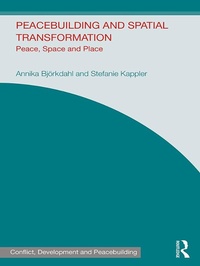
Peacebuilding and Spatial Transformation
Peace, Space and Place
Published on 18. May 2017
166 pages
978-1-317-40941-0 (ISBN)
Description

This book investigates peacebuilding in post-conflict scenarios by analysing the link between peace, space and place.
By focusing on the case studies of Cyprus, Kosovo, Bosnia-Herzegovina, Northern Ireland and South Africa, the book provides a spatial reading of agency in peacebuilding contexts. It conceptualises peacebuilding agency in post-conflict landscapes as situated between place (material locality) and space (the imaginary counterpart of place), analysing the ways in which peacebuilding agency can be read as a spatial practice. Investigating a number of post-conflict cases, this book outlines infrastructures of power and agency as they are manifested in spatial practice. It demonstrates how spatial agency can take the form of conflict and exclusion on the one hand, but also of transformation towards peace over time on the other hand. Against this background, the book argues that agency drives place-making and space-making processes. Therefore, transformative processes in post-conflict societies can be understood as materialising through the active use and transformation of space and place.
This book will be of interest to students of peacebuilding, peace and conflict studies, human geography and IR in general.
By focusing on the case studies of Cyprus, Kosovo, Bosnia-Herzegovina, Northern Ireland and South Africa, the book provides a spatial reading of agency in peacebuilding contexts. It conceptualises peacebuilding agency in post-conflict landscapes as situated between place (material locality) and space (the imaginary counterpart of place), analysing the ways in which peacebuilding agency can be read as a spatial practice. Investigating a number of post-conflict cases, this book outlines infrastructures of power and agency as they are manifested in spatial practice. It demonstrates how spatial agency can take the form of conflict and exclusion on the one hand, but also of transformation towards peace over time on the other hand. Against this background, the book argues that agency drives place-making and space-making processes. Therefore, transformative processes in post-conflict societies can be understood as materialising through the active use and transformation of space and place.
This book will be of interest to students of peacebuilding, peace and conflict studies, human geography and IR in general.
Reviews / Votes
'This impressive book is the most significant contribution thus far to the growing literature on "the spatial turn" in peace and conflict studies. Because conflict and peace take place in particular spaces, peacemaking is an inherently spatial project. Yet too often geography has been assumed as the inert stage for (supposedly) more fundamental processes. Drawing on fieldwork from around the world, Annika Bjoerkdahl and Stefanie Kappler demonstrate how spatiality is crucial to understanding the role of agency in peacebuilding. Their sophisticated analysis of how this occurs at the intersections of space and place is required reading for anyone wanting to understand how violent places can be transformed into peaceful ones - and why attempts to do this so often fail.' -- Nick Megoran, Newcastle University, UK'Annika Bjoerkdahl and Stefanie Kappler have made me look at the rebuilt historic bridge in Mostar afresh, so I now can see that it is a place that has been turned into a space for stoking on-going distrust. This book also, though, shows how even modest physical places can be transformed, by commitment and creativity, into spaces where post-war tensions can be reduced.' -- Cynthia Enloe, Clark University, USA
More details
Series
Language
English
Place of publication
London
United Kingdom
Publishing group
Taylor & Francis Ltd
Target group
College/higher education
Product notice
Reflowable
Illustrations
6 s/w Photographien bzw. Rasterbilder
6 Halftones, black and white
File size
1,05 MB
ISBN-13
978-1-317-40941-0 (9781317409410)
Copyright in bibliographic data and cover images is held by Nielsen Book Services Limited or by the publishers or by their respective licensors: all rights reserved.
Schweitzer Classification
Other editions
Additional editions
Book
10/2018
1st Edition
Routledge
€57.03
Shipment within 15-20 days
Book
05/2017
1st Edition
Routledge
€215.77
Shipment within 10-20 days
Persons
Annika Bjoerkdahl is Professor of Political Science, Lund University, Sweden, and is author/editor of numerous titles, including Peacebuilding and Friction (Routledge 2016) and Spatializing Peace and Conflict (2015).
Stefanie Kappler is Lecturer in Conflict Resolution and Peace Building, Durham University, UK, and is author of Local Agency and Peacebuilding (2014).
Stefanie Kappler is Lecturer in Conflict Resolution and Peace Building, Durham University, UK, and is author of Local Agency and Peacebuilding (2014).
Content
Foreword, Johan Galtung
Introduction: Space, Place and Agency: Mapping Peace Across Sites
1. Space, place and agency
2. Cyprus: Contesting the Island
3. Kosovo: Emplacing the State and Peace(s)
4. Bosnia-Herzegovina: The Ethnic Peace
5. Northern Ireland: The "Maze of Peace"
6. South Africa: Perpetuating Spatial Apartheid?
Conclusion: Reading the Politics of Peace and Conflict Spatially
Introduction: Space, Place and Agency: Mapping Peace Across Sites
1. Space, place and agency
2. Cyprus: Contesting the Island
3. Kosovo: Emplacing the State and Peace(s)
4. Bosnia-Herzegovina: The Ethnic Peace
5. Northern Ireland: The "Maze of Peace"
6. South Africa: Perpetuating Spatial Apartheid?
Conclusion: Reading the Politics of Peace and Conflict Spatially
