

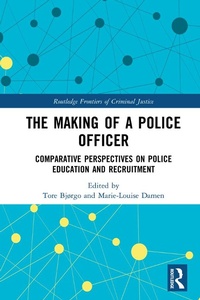
The Making of a Police Officer
Comparative Perspectives on Police Education and Recruitment
1st Edition
Published on 17. February 2020
266 pages
978-1-000-03374-8 (ISBN)
Description

Does a more academic type of police education produce new police officers that are reluctant to patrol the streets? What is the impact of gender diversity and political orientation on a police students' career aspirations and attitudes to policing? These are some of the questions addressed by this longitudinal project, following police students in seven European countries. The unique data material makes it possible to explore a wide range of topics relevant to the future development of policing, police education and police science more generally.
Part I presents an overview of the different goals and models of police education in the seven participating countries. Part II describes what type of student is attracted to police education, taking into consideration educational background, political orientation and career aspirations. Part III shows the social impact of police education by examining students' orientations towards emerging competence areas; students' career aspirations; and students' attitudes concerning trust, cynicism and legalism.
The overall results show that police students are strikingly similar across different types of police education. Students in academic institutions are at least as interested in street patrolling as students in vocational training institutions. Gender and recruitment policies matters more in relation to career preferences than education models. The national context plays a more important role than the type of police education system. Written in a clear and direct style, this book will appeal to students and scholars in policing, criminology, sociology, social theory and cultural studies and those interested in how police education shapes its graduates.
Part I presents an overview of the different goals and models of police education in the seven participating countries. Part II describes what type of student is attracted to police education, taking into consideration educational background, political orientation and career aspirations. Part III shows the social impact of police education by examining students' orientations towards emerging competence areas; students' career aspirations; and students' attitudes concerning trust, cynicism and legalism.
The overall results show that police students are strikingly similar across different types of police education. Students in academic institutions are at least as interested in street patrolling as students in vocational training institutions. Gender and recruitment policies matters more in relation to career preferences than education models. The national context plays a more important role than the type of police education system. Written in a clear and direct style, this book will appeal to students and scholars in policing, criminology, sociology, social theory and cultural studies and those interested in how police education shapes its graduates.
Reviews / Votes
The international and comparative research on police education and training described in this book offers fundamental empirical insights regarding an aspect of vital concern in police studies. Researchers and policy makers alike will find in this volume a wealth of information and detail that will provide insights into career entry and early professional socialization into the police organization in seven European countries. Original research of this kind practically demonstrates the important contribution of independent academic research on the public understanding of police institutions.James Sheptycki, Professor of Criminology, York University, Canada
The book answers important questions about how to recruit and train police, and ways to nurture healthy perspectives among officers and launch successful careers in law enforcement. Sweeping across seven regions of the northern hemisphere, the research behind these findings and recommendations promises to be applicable to a broad variety of policing traditions. There is nothing else like it.
Wesley G. Skogan, Professor of Political Science, Institute for Policy Research, Northwestern University, USA
This book is an eye-opener for all those engaged in policing. The authors address the broader issues related to police recruitment, education and its academisation. Debunking widespread myths, they add essential nuances to its complexity and offer a research agenda for the future.
Marleen Easton, Professor Governing & Policing Security, Faculty of Economics and Business Administration, Ghent University
How can we 'make' police officers? What we need is a consistent democratic approach from recruitment to further education. But how can we neither produce Dirty Harrys nor Legalists? How can we implement the right philosophy of policing into police students? This study by a European group of police scholars provides us with substantial data and interpretation. A must read for police educators all over Europe.
Thomas Feltes, Senior professor in Criminology and Police Science, Ruhr-University Bochum, Germany
More details
Series
Edition
1. Auflage
Language
English
Place of publication
London
United Kingdom
Publishing group
Taylor & Francis Ltd
Target group
College/higher education
Product notice
Reflowable
Illustrations
34 Tables, black and white; 45 Line drawings, black and white; 45 Illustrations, black and white
ISBN-13
978-1-000-03374-8 (9781000033748)
Copyright in bibliographic data and cover images is held by Nielsen Book Services Limited or by the publishers or by their respective licensors: all rights reserved.
Schweitzer Classification
Other editions
Additional editions
Tore Bjorgo | Marie-Louise Damen
The Making of a Police Officer
Comparative Perspectives on Police Education and Recruitment
Book
06/2022
1st Edition
Routledge
€65.50
Shipment within 10-20 days
Tore Bjorgo | Marie-Louise Damen
The Making of a Police Officer
Comparative Perspectives on Police Education and Recruitment
Book
02/2020
1st Edition
Routledge
€206.60
Shipment within 15-20 days
Persons
Tore Bjorgo is a professor at the University of Oslo and an adjunct professor of police science at the Norwegian Police University College. He is also director of the Center for Research on Extremism (C-REX). He initiated the RECPOL project in 2008 and has been leading it since the start until recently. He has published extensively in the fields of violent extremism and terrorism, criminal gangs, crime prevention, policing and vigilantism.
Marie-Louise Damen is an associate professor in quantitative research methods at the Norwegian Police University College in Oslo. Her research interests are sociology of higher education, stratification, cultural sociology, social movements and research methodology. Since October 2017 she has been involved in the RECPOL-project and has gradually taken over as coordinator.
Marie-Louise Damen is an associate professor in quantitative research methods at the Norwegian Police University College in Oslo. Her research interests are sociology of higher education, stratification, cultural sociology, social movements and research methodology. Since October 2017 she has been involved in the RECPOL-project and has gradually taken over as coordinator.
Content
1. A longitudinal and comparative European study of Recruitment, Education and Careers in the Police (RECPOL): what this project contributes to the development of police science, Tore Bjorgo and Marie-Louise Damen, 2. Police education in seven European countries in the framework of their police Systems, Kjersti Hove and Lola Valles. 3. Diversity and academisation: who does police education attract?, Rasmus Juul Moberg, 4. Iceland as a microcosm of the effects of educational reform on police students' social background, Gu?mundur Oddsson, Andrew Paul Hill, Olafur OErn Bragason, ?oroddur Bjarnason and Kjartan Olafsson, 5. Mirroring society: how politically representative are police students in Europe?, Gunnar Thomassen, 6 . Understanding learning preferences and career expectations of Norwegian police students from a comparative perspective, Pal Winnaess, Marie-Louise Damen and Gunnar Thomassen, 7. Police students' values of enduring and emerging competence areas in police education, Staffan Karp, Kirsi Kohlstroem, Oscar Rantatalo and Mojgan Padyab, 8. Horizontal and Vertical career preferences for male and female police recruits, Rasmus Juul Moberg and Marie-Louise Damen, 9. Cynicism and (dis)trust in the police: Self-selection or evolving attitudes?, Gunnar Thomassen and Jon Strype, 10. Producing legalists or Dirty Harrys? Police education and field training, Silje Bringsrud Fekjaer and Otto Petersson 11. Selecting and shaping police students in Europe: main findings and discussion, Marie-Louise Damen and Tore Bjorgo
