

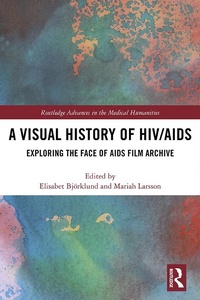
A Visual History of HIV/AIDS
Exploring The Face of AIDS film archive
1st Edition
Published on 4. July 2018
234 pages
978-1-351-38303-5 (ISBN)
Description

The Face of AIDS film archive at Karolinska Institutet, Sweden, consists of more than 700 hours of unedited and edited footage, shot over a period of more than thirty years and all over the world by filmmaker and journalist Staffan Hildebrand. The material documents the HIV/AIDS pandemic and includes scenes from conferences and rallies, and interviews with activists, physicians, people with the infection, and researchers. It represents a global historical development from the early years of the AIDS crisis to a situation in which it is possible to live a normal life with the HIV virus. This volume brings together a range of academic perspectives - from media and film studies, medical history, gender studies, history, and cultural studies - to bear on the archive, shedding light on memories, discourses, trauma, and activism.
Using a medical humanities framework, the editors explore the influence of historical representations of HIV/AIDS and stigma in a world where antiretroviral treatment has fundamentally altered the conditions under which many people diagnosed with HIV live. Organized into four sections, this book begins by introducing the archive and its role, setting it in a global context. The first part looks at methodological, legal and ethical issues around archiving memories of the present which are then used to construct histories of the past; something that can be particularly controversial when dealing with a socially stigmatized epidemic such as HIV/AIDS. The second section is devoted to analyses of particular films from the archive, looking at the portrayal of people living with HIV/AIDS, the narrative of HIV as a chronic illness and the contemporary context of particular films. The third section looks at how stigma and trauma are negotiated in the material in the Face of AIDS film archive, discussing ideas about suffering and culpability. The final section contributes perspectives on and by the filmmaker as activist and auteur.
This interdisciplinary collection is placed at the intersection of medical humanities, sexuality studies and film and media studies, continuing a tradition of studies on the cultural and social understandings of HIV/AIDS.
Using a medical humanities framework, the editors explore the influence of historical representations of HIV/AIDS and stigma in a world where antiretroviral treatment has fundamentally altered the conditions under which many people diagnosed with HIV live. Organized into four sections, this book begins by introducing the archive and its role, setting it in a global context. The first part looks at methodological, legal and ethical issues around archiving memories of the present which are then used to construct histories of the past; something that can be particularly controversial when dealing with a socially stigmatized epidemic such as HIV/AIDS. The second section is devoted to analyses of particular films from the archive, looking at the portrayal of people living with HIV/AIDS, the narrative of HIV as a chronic illness and the contemporary context of particular films. The third section looks at how stigma and trauma are negotiated in the material in the Face of AIDS film archive, discussing ideas about suffering and culpability. The final section contributes perspectives on and by the filmmaker as activist and auteur.
This interdisciplinary collection is placed at the intersection of medical humanities, sexuality studies and film and media studies, continuing a tradition of studies on the cultural and social understandings of HIV/AIDS.
More details
Series
Edition
1. Auflage
Language
English
Place of publication
London
United Kingdom
Publishing group
Taylor & Francis Ltd
Target group
College/higher education
Product notice
Reflowable
Illustrations
25 Halftones, black and white
ISBN-13
978-1-351-38303-5 (9781351383035)
Copyright in bibliographic data and cover images is held by Nielsen Book Services Limited or by the publishers or by their respective licensors: all rights reserved.
Schweitzer Classification
Other editions
Additional editions
Elisabet Bjoerklund | Mariah Larsson
A Visual History of HIV/AIDS
Exploring The Face of AIDS film archive
Book
12/2019
1st Edition
Routledge
€65.00
Shipment within 15-20 days
Elisabet Bjoerklund | Mariah Larsson
A Visual History of HIV/AIDS
Exploring The Face of AIDS film archive
Book
07/2018
1st Edition
Routledge
€206.30
Shipment within 10-20 days
Persons
Elisabet Bjoerklund is a postdoctoral researcher at the Department of History of Science and Ideas at Uppsala University and Senior Lecturer in Film Studies at Linnaeus University, Sweden.
Mariah Larsson is a Professor in Film Studies at Linnaeus University, Sweden.
Mariah Larsson is a Professor in Film Studies at Linnaeus University, Sweden.
Content
Preface Paula A. Treichler
Part I: Archives, Memories, Histories
1. Face of AIDS: The Making of an Online Archive
Martin Kristenson & Fredrik B. Persson
2. Witnessing AIDS in the Archive
Anna Sofia Rossholm & Beate Schirrmacher
3. Voices of AIDS: The HIV Virus and the Shaping of a Cultural Memory
Cecilia Trenter
4. "A Disease on Top of a Disease": People with Hemophilia through the Face of AIDS Film Archive
Daniel Normark
Part II: Aesthetics, Representations, Narratives
5. Performativity and Documentary Aesthetics in Staffan Hildebrand's Earliest Conference Films on AIDS in the 1980s
Tommy Gustafsson
6. Disease, Representation, and Activism: Crossover: The Global Impact of AIDS (1988) and its Reverberations
David Thorsen
7. A Positive Positive? Intersectional Analysis of Identification and Counter-identification in three Contemporary HIV Narratives
Desiree Ljungcrantz
Part III: Stigma and Trauma
8. Waiting for a Cure: Cultural Perspectives on AIDS in the 1980s
Adam Brenthel & Kristofer Hansson
9. Social Suffering as Symbolic Violence: LGBT Experiences in the Face of AIDS Film Archive
Marco Bacio & Cirus Rinaldi
10. Constructions of Safe Sex: Between Desire and Governmentality
Mariah Larsson
11. Sins of the Fathers? Syphilis, HIV/AIDS, and Innocent Women and Children
Elisabet Bjoerklund
Part IV: Activism and Auteurism
12. Archiving AIDS Activist Video: A Conversation with Jim Hubbard
Dagmar Brunow
13. Documenting the Journey from AIDS to HIV on Film
Staffan Hildebrand
Part I: Archives, Memories, Histories
1. Face of AIDS: The Making of an Online Archive
Martin Kristenson & Fredrik B. Persson
2. Witnessing AIDS in the Archive
Anna Sofia Rossholm & Beate Schirrmacher
3. Voices of AIDS: The HIV Virus and the Shaping of a Cultural Memory
Cecilia Trenter
4. "A Disease on Top of a Disease": People with Hemophilia through the Face of AIDS Film Archive
Daniel Normark
Part II: Aesthetics, Representations, Narratives
5. Performativity and Documentary Aesthetics in Staffan Hildebrand's Earliest Conference Films on AIDS in the 1980s
Tommy Gustafsson
6. Disease, Representation, and Activism: Crossover: The Global Impact of AIDS (1988) and its Reverberations
David Thorsen
7. A Positive Positive? Intersectional Analysis of Identification and Counter-identification in three Contemporary HIV Narratives
Desiree Ljungcrantz
Part III: Stigma and Trauma
8. Waiting for a Cure: Cultural Perspectives on AIDS in the 1980s
Adam Brenthel & Kristofer Hansson
9. Social Suffering as Symbolic Violence: LGBT Experiences in the Face of AIDS Film Archive
Marco Bacio & Cirus Rinaldi
10. Constructions of Safe Sex: Between Desire and Governmentality
Mariah Larsson
11. Sins of the Fathers? Syphilis, HIV/AIDS, and Innocent Women and Children
Elisabet Bjoerklund
Part IV: Activism and Auteurism
12. Archiving AIDS Activist Video: A Conversation with Jim Hubbard
Dagmar Brunow
13. Documenting the Journey from AIDS to HIV on Film
Staffan Hildebrand
