

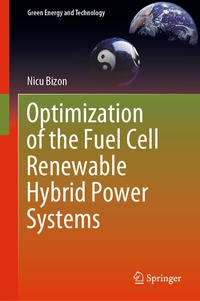
Optimization of the Fuel Cell Renewable Hybrid Power Systems
Description

This book offers a comprehensive review of renewable energy sources and optimization strategies in hybrid power systems (HPSs). It analyses the main issues and challenges in the renewable (REW) HPS field, particularly those using fuel cell (FC) systems as their main source of energy. It then offers innovative solutions to these issues, comparing them to solutions currently found in the literature.
The book discusses optimization algorithms and energy management strategies. The focus is chiefly on FC net power maximization and fuel economy strategies based on global optimization. The last two chapters discuss energy harvesting from photovoltaic systems and how to mitigate energy variability in REW FC HPS. The main content is supplemented by numerous examples and simulations. Academics, students and practitioners in relevant industrial branches interested in REW HPS finds it of considerable interest, as a reference book or for building their own HPSs based on the examples provided.
More details
Other editions
Additional editions
Person
Professor Nicu Bizon completed his degree in Electronic Engineering at the University Polytechnic of Bucharest, Romania, in 1986, and his Ph.D. in Automatic Systems and Control at the same university in 1996. He then worked in hardware design with Dacia Renault SA, Romania. Currently, he is a Professor at the University of Pitesti, Romania, and was Dean of the Faculty of Electronics, Communication and Computers (2012-2017). He was Head of University Research Department and Executive Director of the Research Centre 'Modeling and simulation processes and systems' for several years each, managing four research projects in the field of Green and Hydrogen Energy and serving as a team member in ten other projects in the same research field. He is the Editor of seven books and author of five more on green energy, hybrid power sources and power converters. He has authored or co-authored over 200 papers in journals and international conference proceedings. His current research interests include the broad area of nonlinear systems in both dynamics and control applied to the green energy field. He is Editor-in-Chief of the Journal of Electrical Engineering, Electronics, Control and Computer Science and a member of the Editorial/Technical Board for several international journals and conferences. He has been a senior member of the IEEE since 2016.
Content
Introduction.- Hybrid Power Systems.- Optimization Algorithms and Energy Management Strategies.- Global Extremum Seeking Algorithms.- Fuel Cell Net Power Maximization Strategies.- Fuel Economy Maximization Strategies.- Energy Harvesting From the Photovoltaic Systems Partially Shaded.- Mitigation of Energy Variability in Renewable Fuel Cell Hybrid Power Systems.
