Alles über E-Books | Antworten auf Fragen rund um E-Books, Kopierschutz und Dateiformate finden Sie in unserem Info- & Hilfebereich.
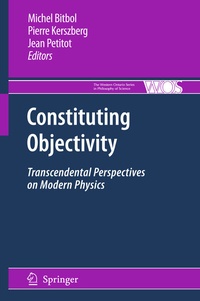
In recent years, many philosophers of modern physics came to the conclusion that the problem of how objectivity is constituted (rather than merely given) can no longer be avoided, and therefore that a transcendental approach in the spirit of Kant is now philosophically relevant. The usual excuse for skipping this task is that the historical form given by Kant to transcendental epistemology has been challenged by Relativity and Quantum Physics. However, the true challenge is not to force modern physics into a rigidly construed static version of Kant's philosophy, but to provide Kant's method with flexibility and generality.
In this book, the top specialists of the field pin down the methodological core of transcendental epistemology that must be used in order to throw light on the foundations of modern physics. First, the basic tools Kant used for his transcendental reading of Newtonian Mechanics are examined, and then early transcendental approaches of Relativistic and Quantum Physics are revisited. Transcendental procedures are also applied to contemporary physics, and this renewed transcendental interpretation is finally compared with structural realism and constructive empiricism. The book will be of interest to scientists, historians and philosophers who are involved in the foundational problems of modern physics.
Reviews / Votes
From the reviews:
"This collection not only meets its aims, it also uncovers an emerging and exciting field of study with multifaceted possibilities. . It would also function as a remarkably versatile and constructive resource for graduate students working in departments which fall roughly under the banner of history and/or philosophy of science. The more formal articles would also be of great interest to any physicists looking for an alternative to traditional metaphysics-one where the constitution of objectivity becomes paramount." (Jacob V. Pearce, International Studies in the Philosophy of Science, Vol. 24 (4), December, 2010)
Series
Edition
Language
Place of publication
Publishing group
Illustrations
File size
ISBN-13
978-1-4020-9510-8 (9781402095108)
DOI
10.1007/978-1-4020-9510-8
Schweitzer Classification
Historical Survey of Transcendental Readings of Physics.- Newton and Kant on Absolute Space: From Theology to Transcendental Philosophy.- On Kant's Transcendental Account of Newtonian Mechanics.- Ernst Cassirer: Open Constitution by Functional A Priori and Symbolical Structuring.- On the Transposition of the Substantial into the Functional: Bringing Cassirer's Philosophy of Quantum Mechanics into the Twenty-First Century.- Moritz Schlick: Between Synthetic A Priori Judgment and Conventionalism.- Carnap's Relativised A Priori and Ontology.- Transcendental Epistemologies and Modern Physics.- The Transcendental Domain of Physics.- Determinism, Determination, and Objectivity in Modern Physics.- The Constitution of Objects in Classical Physics and in Quantum Physics.- Laws of Nature: The Kantian Approach.- The Transcendental Role of the Principle of Anticipations of Perception in Quantum Mechanics.- Can the Principle of Least Action Be Considered a Relativized A Priori?.- A Critical Accountof Physical Reality.- Einstein, Kant, and the Relativized A Priori.- A Cognizable Universe: Transcendental Arguments in Physical Cosmology.- Hermann Weyl and "First Philosophy": Constituting Gauge Invariance.- Old Wine Enriched in New Bottles: Kantian Flavors in Bohr's Viewpoint of Complementarity.- A Transcendental Account of Correspondence and Complementarity.- The Convergence of Transcendental Philosophy and Quantum Physics: Grete Henry-Hermann's 1935 Pioneering Proposal.- Decoherence and the Constitution of Objectivity.- The Entangled Roots of Objective Knowledge.- Can Classical Description of Physical Reality Be Considered Complete?.- A View of the Symbolic Structure of Modern Physics.- Symbolic Constructions in Quantum Field Theory.- Noncommutative Geometry and Transcendental Physics.- Debate About the Relevance of Transcendental Epistemology for Modern Physics: Transcendentalism, Empiricism and Realism.- Can Empiricism Leave Its Realism Behind? Toward a Dialogue with Transcendentalists.- A Physicist's Approach to Kant.- Structural Realism and Abductive-Transcendental Arguments.- Provisional Knowledge.