

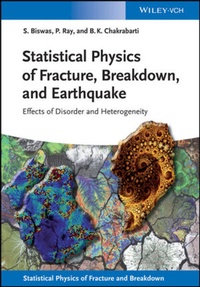
Statistical Physics of Fracture, Breakdown, and Earthquake
Description

They explain fracture-like phenomena, highlighting the role of disorder and heterogeneity from a statistical physical viewpoint. The role of defects is discussed in brittle and ductile fracture, ductile to brittle transition, fracture dynamics, failure processes with tension as well as compression: experiments, failure of electrical networks, self-organized critical models of earthquake and their extensions to capture the physics of earthquake dynamics. The text also includes a discussion of dynamical transitions in fracture propagation in theory and experiments, as well as an outline of analytical results in fiber bundle model dynamics
With its wide scope, in addition to the statistical physics community, the material here is equally accessible to engineers, earth scientists, mechanical engineers, and material scientists. It also serves as a textbook for graduate students and researchers in physics.
More details
Other editions
Additional editions
Persons
Bikas K. Chakrabarti is a senior professor of theoretical condensed matter physics at the Saha Institute of Nuclear Physics (SINP), Kolkata, and a visiting professor of economics at the Indian Statistical Institute, Kolkata, India. He received his doctorate in physics from Calcutta University in 1979 (for research at SINP). Following postdoctoral positions at Oxford University and Cologne University, he joined SINP in 1983. His main research interests include physics of fracture, quantum glasses, etc., and the interdisciplinary sciences of optimization, brain modeling, and econophysics. He has written several books and reviews on these topics.
Soumyajyoti Biswas finished his master degree in Physics from Calcutta University in 2008. Since then he is a research fellow at Saha Institute of Nuclear Physics.
Content
INTRODUCTION
MECHANICAL AND FRACTURE PROPERTIES OF SOLIDS
Mechanical Response in Materials
Ductile, Quasi-Brittle and Brittle Materials
Ductile and Brittle Fracture
CRYSTAL DEFECTS AND DISORDER IN LATTICE MODELS
Point Defects
Line Defects
Planar Defects
Lattice Defects: Percolation Theory
Summary
NUCLEATION AND EXTREME STATISTICS IN BRITTLE FRACTURE
Stress Concentration Around Defect
Strength of Brittle Solids: Extreme Statistics
Extreme Statistics in Fibre Bundle Models of Brittle Fracture
Extreme Statistitcs in Percolating Lattice Model of Brittle Fracture
Molecular Dynamics Simulation of Brittle Fracture
Summary
ROUGHNESS OF FRACTURE SURFACES
Roughness Properties in Fracture
Molecular Dynamics Simulation of Fractured Surface
Summary
AVALANCHE DYNAMICS IN FRACTURE
Probing Failure with Acoustic Emissions
Dynamics of Fiber Bundle Model
Interpolations of Global and Local Load Sharing Fiber Bundle Models
Random Threshold Spring Model
Summary
SUBCRITICAL FAILURE OF HETEROGENEOUS MATERIALS
Time of Failure Due to Creep
Dynamics of Strain Rate
Summary
DYNAMICS OF FRACTURE FRONT
Driven Fluctuating Line
Fracture Front Propagation in Fiber Bundle Models
Hydraulic Fracture
Summary
DISLOCATION DYNAMICS AND DUCTILE FRACTURE
Non-Linearity in Materials
Deformation by Slip
Slip by Dislocation Motion
Plastic Strain due to Dislocation Motion
When Does a Dislocation Move?
Ductile-Brittle Transition
Theoretical Work on Ductile-Brittle Transition
ELECTRICAL BREAKDOWN ANALOGY OF FRACTURE
Disordered Fuse Network
Numerical Simulations of Random Fuse Network
Dielectric Breakdown Problem
Summary
EARTHQUAKE AS FAILURE DYNAMICS
Earthquake Statistics: Empirical Laws
Spring-Block Models of Earthquakes
Cellular Automata Models of Earthquakes
Equivalence of Interface and Train Models
Summary
OVERVIEW AND OUTLOOK
APPENDIX
Percolation
Real Space RG for Rigidity Percolation
Fiber Bundle Model
Quantum Breakdown
Fractals
Two Fractal Overlap Model
Microscopic Theories of Friction
1
Introduction
Fracture is the result of driving a solid beyond its mechanical limit. It is immensely important to know the limit or how materials behave as they approach the limit and the factors that influence them. The failure properties of materials are very distinct from the other properties, such as elasticity, in the sense that their predictions are not always straightforward. For example, typically, fracture strength of a solid has a very wide distribution, and a larger object has lower failure strength than a smaller one of same composition. In brittle materials, fracture is catastrophic, that is, the solid fails without a precursor. It is this intriguing nature of failure phenomena that has led scientists to think about this problem over the centuries. It was Leonardo da Vinci (see Figure 1.1) who apparently first noticed that a longer wire has lower strength. Galileo also recognized the importance of this problem and commented about the limitation of sizes of an object for improvement in its strength (see Figure 1.2).
Figure 1.1 Leonardo di ser Piero da Vinci (1452-1519): da Vinci was a diversely talented person and a leader of the Italian Renaissance movement. He displayed his talent in many areas of arts and science. Best known as a painter (for his famous Mona Lisa, The Last Supper, Virgin of the rocks to name a few), he was also a great engineering designer. However, apart from his well-known inventions and sketches, comparatively less known is his contribution to fracture mechanics. In his experiment titled "Testing the strengths of iron wires of various lengths," he suspended a basket by an iron wire and slowly added sand to it from a pot hanging adjacent to the basket. The failure point of the wire was noted for its different lengths. In his own words (translated by Parsons, 1939): "The object of this test is to find the load an iron wire can carry. Attach an iron wire 2 braccia long to something which will firmly support it, then attach a basket or similar container to the wire and feed into the basket some fine sand through a small hole placed at the end of the hopper. A spring is fixed so that it will close the hole as soon as the wire breaks. The basket is not upset while falling, since it falls through a very short distance. The weight of sand and the location of the fracture of the wire are to be recorded. The test is repeated several times to check the results. Then a wire of 1/2 the previous length is tested and the additional weight it carries is recorded; then a wire of 1/4 length is tested and so forth, noting the ultimate strength and the location of the fracture." As we will see in Section 4.2, because of the extreme nature of the breaking statistics, the strength of solids decrease with their volume typically as .
Figure 1.2 Galileo Galilei (1564-1642): Galileo was an Italian physicist and astronomer who is called the "Father of Modern Science" to honor his many contributions to our present-day understanding of science. Particularly, he produced telescopic evidence of phases of Venus, the four largest satellite of Jupiter, sun spots, and also confirmed the earlier ideas of Copernicus and Kepler that the earth and other planets move around the sun. Because of his conflicting views with the church, he was put under house arrest for the last part of his life. There he wrote his famous book "Two new sciences," where he described his works on the two sciences "kinematics" and "strength of matter." There he had observed (see discussions in Section 4.2) the size effects of fracture and described how the natural sizes are limited by their own strengths. In his own words: "From what has already been demonstrated, you can plainly see the impossibility of increasing the size of structures to vast dimensions either in art or in nature; likewise the impossibility of building ships, palaces, or temples of enormous size in such a way that their oars, yards, beams, iron-bolts, and, in short, all their other parts will hold together; nor can nature produce trees of extraordinary size because the branches would break down under their own weight; so also it would be impossible to build up the bony structures of men, horses, or other animals so as to hold together and perform their normal functions if these animals were to be increased enormously in height; for this increase in height can be accomplished only by employing a material which is harder and stronger than usual, or by enlarging the size of the bones, thus changing their shape until the form and appearance of the animals suggest a monstrosity." [From: http://ebooks.adelaide.edu.au/g/galileo/dialogues/chapter2.html]
The understanding of fracture of materials has progressed enormously since those days. However, it is still far from being complete. Present-day understanding of fracture in homogeneous materials is based primarily on linear elastic fracture mechanics which deals with the stress concentration around notches and cracks in a model of linear elastic material. It starts with Griffith's theory (Griffith, 1921) of energy balance. The basic idea here is that when a solid gets strained, and if the elastic energy stored is sufficient to create new surfaces, then a crack becomes unstable and a fracture takes place. The theory was made more accurate by introducing a small plastic zone in front of the crack tip by Irwin and Dugdale (see e.g., Anderson, 1995). This picture, however, cannot handle fracture with plastic deformation and dissipation as it happens in ductile fracture, besides it cannot handle the effect of disorder. Disorder plays a vital role in the behavior of solids, especially before fracture. The strength of a material is determined by the weakest part of it, which leads to the extreme value statistics in failure properties.
After summarizing the basic characterizations of fracture, namely brittle and ductile fracture, the linearity of the stress-strain relationship in the elastic region and subsequent departure to nonlinearity in the plastic region, we go over to the properties of defects in solids in Chapter 3. The lattice defects are quantified in the form of the percolation theory, which gives the limit of high disorder in solids. These characterizations help us understand the nature of extreme statistics led by the stress nucleation around defects, which is the topic of discussion in Chapter 4. In addition to the continuum approach, we introduce a discrete element model, called the fiber bundle model, which is a simple one depicting many essential features of failure statistics, including the stress nucleation, and extreme statistics as discussed there.
While disorder in solids governs the failure strength, it also steers the path of the crack. A defect can deflect a propagating crack. Since it is the impression of this crack front that creates the roughness of the fracture surfaces, in a way presence of disorder is responsible for the roughness. It is our everyday observation that fractured surfaces are not smooth but are rough. However, it is not until the pioneering work of Mandelbrot et al. (1984) that a universal feature was found in the roughness in fracture surfaces. It was found that the fracture surfaces of various materials were self-affine, meaning they looked similar, no matter to what part of it-small or large-one focuses. Roughness can be quantified by a number called the "roughness exponent". A surprising observation was that the value was almost same for various materials. This idea of scale invariance and universality led to substantial activities in this field using the tools of statistical physics and critical phenomena. Many subsequent studies revealed facts both supporting and opposing this universality, also noting a crossover behavior in the exponent value, signifying that the fractured surfaces are not self-affine in all scales after all! Furthermore, an anisotropic feature has also been observed in the roughness properties, distinguishing the direction of crack propagation from the direction perpendicular to it. The experimental observations and theoretical modeling of roughness of fracture surfaces are discussed in Chapter 5.
Another familiar experience with fracture is the accompanying noise. One can experience that in day-to-day activities such as tearing a paper or eating potato chips to failure in geological scale, that is, earthquakes, where the precursor can be lifesaving. The so-called "crackling noise" or emission of acoustic noise is a common fact of fracture, where a portion of energy is released in the form of sound. The intriguing feature, however, once again is the scale-invariant response of the solids in terms of size distributions of acoustic emissions (bursts). When force is applied on a material, some portions (probably weaker) will fail but not the entire solid, since the solid is disordered. When further strained, some weak parts will break again and increase the stress on the remaining part initiating a chain reaction, called an "avalanche." Since a proportional fraction will be emitted as sound, it can be detected to measure the size of the avalanche. One avalanche may not be sufficient to break the entire solid as the remaining stronger parts may not break. But understandably that part will be highly stressed and a small increase of force may cause an avalanche of much larger size than one usually expects with a small perturbation. Those who are familiar with self-organized criticality, the...
