

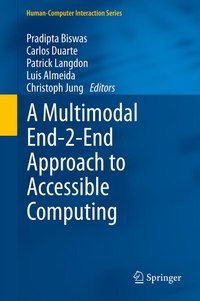
A Multimodal End-2-End Approach to Accessible Computing
Description

Research in intelligent interactive systems can offer valuable assistance to elderly and disabled populations by helping them to achieve greater levels of engagement with the world. Many users find it difficult to use existing interaction devices, either for physical or age-related impairments. However, research on intelligent voice recognition, adaptable pointing, browsing and navigation, and affect and gesture recognition can hugely benefit such users. Additionally, systems and services developed for elderly or disabled people often find useful applications for their able-bodied counterparts.
A Multimodal End-2-End Approach to Accessible Computing illustrates the state-of-the-art of technology and presents a vision for accessibility in the near future. It considers challenges faced by accessibility practitioners at research institutes, industries and legislative institutions throughout the world, and explores the different phases of delivering accessible products and services through design, development, deployment and maintenance. A collection of eminent researchers cover topics on developing and standardizing user models for inclusive design, adaptable multimodal system development for digital TV and ubiquitous devices.
With a foreword from the BBC's Head of Technology and organiser of the Switchover Help Scheme, and an End Note from the chairman of the ITU-T's Focus Group on Audiovisual Media Accessibility (presenting a vision for accessible computing), this book will be an invaluable resource for researchers and practitioners.
More details
Other editions
New editions
Additional editions
Content
Foreword by Nick Tanton.- Editorial.- Part I - Design .- What Technology Can and Cannot Offer an Ageing Population: Current Situation and Future Approach.- Developing an Interactive TV for the Elderly and Impaired: An Inclusive Design Strategy.- Designing TV Interaction for the Elderly - A Case Study of the Design for All Approach.- Inclusive User Modelling and Simulation.- Part II - Development .- Intelligent Interaction in Accessible Applications.- Interaction Techniques for Users with Severe Motor-Impairment.- Embodied Virtual Agents as a Means to Foster E-Inclusion of Older People.- Building an Adaptive Multimodal Framework for Resource Constrained Systems.- Part III - Maintenance .- Evaluating the Accessibility of Adaptive TV based Web Applications.- An Interoperable and Inclusive User Modelling concept for Simulation and Adaptation.- Standardization of Audiovisual Media Accessibility - From Vision to Reality.- Author Index.
