

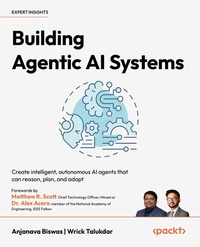
Building Agentic AI Systems
Description

Key Features
Understand the foundations and advanced techniques of building intelligent, autonomous AI agents
Learn advanced techniques for reflection, introspection, tool use, planning, and collaboration in agentic systems
Explore crucial aspects of trust, safety, and ethics in AI agent development and applications
Purchase of the print or Kindle book includes a free PDF eBook
Book DescriptionGain unparalleled insights into the future of AI autonomy with this comprehensive guide to designing and deploying autonomous AI agents that leverage generative AI (GenAI) to plan, reason, and act. Written by industry-leading AI architects and recognized experts shaping global AI standards and building real-world enterprise AI solutions, it explores the fundamentals of agentic systems, detailing how AI agents operate independently, make decisions, and leverage tools to accomplish complex tasks. Starting with the foundations of GenAI and agentic architectures, you'll explore decision-making frameworks, self-improvement mechanisms, and adaptability. The book covers advanced design techniques, such as multi-step planning, tool integration, and the coordinator, worker, and delegator approach for scalable AI agents. Beyond design, it addresses critical aspects of trust, safety, and ethics, ensuring AI systems align with human values and operate transparently. Real-world applications illustrate how agentic AI transforms industries such as automation, finance, and healthcare. With deep insights into AI frameworks, prompt engineering, and multi-agent collaboration, this book equips you to build next-generation adaptive, scalable AI agents that go beyond simple task execution and act with minimal human intervention.What you will learn
Master the core principles of GenAI and agentic systems
Understand how AI agents operate, reason, and adapt in dynamic environments
Enable AI agents to analyze their own actions and improvise
Implement systems where AI agents can leverage external tools and plan complex tasks
Apply methods to enhance transparency, accountability, and reliability in AI
Explore real-world implementations of AI agents across industries
Who this book is forThis book is ideal for AI developers, machine learning engineers, and software architects who want to advance their skills in building intelligent, autonomous agents. It's perfect for professionals with a strong foundation in machine learning and programming, particularly those familiar with Python and large language models. While prior experience with generative AI is beneficial, the book covers foundational concepts for those new to agentic systems.
All prices
More details
Other editions
Additional editions
Persons
Anjanava Biswas is an award-winning senior AI specialist solutions architect with over 17 years of industry experience. Specializing in machine learning, Generative AI, natural language processing, deep learning, data analytics, and cloud architecture, he partners with large enterprises to build and scale advanced AI systems in the cloud. Anjanava is widely recognized for his contributions to the field of applied AI. He has published research in multiple scientific journals and actively contributes to open-source AI/ML projects. His professional accolades include Fellowships with BCS (UK), the IET (UK), and IETE (India), and he is a senior IEEE member. A frequent public speaker, Anjanava has held key positions at industry giants like IBM and Oracle Corp. Originally from India, he now resides in San Diego, CA, with his wife and son, where he continues to innovate and inspire within the tech community.Talukdar Wrick :
Wrick Talukdar is a visionary technology leader in generative artificial intelligence (AI) at Amazon, with over two decades of global experience in AI, cloud computing, and product leadership. A pioneer in AI-driven transformation, he has led large-scale modernization initiatives that drive enterprise growth and impact millions worldwide. He has spearheaded the productization of award-winning AI/ML technologies, now deployed at scale for Fortune 500 companies, shaping real-world AI applications. A recognized figure in AI research, Wrick's work in generative AI, multimodality, natural language processing, and computer vision is widely cited and referenced in the field. As a senior IEEE member, Chair, and panelist in multiple industry forums, he advises global committees like CTSoc Industry Forums and NIC, setting industry standards and shaping AI's role for the future. He frequently presents his innovations at premier conferences such as World Technology Summit, IEEE HKN, ICCE, CERAWeek, and ADIPEC, bridging cutting-edge research with real-world AI applications to accelerate industry-wide innovation. Deeply rooted in his computer science background, he co-chairs IEEE NIC to empower young professionals. As an author and thought leader, he continues to push AI's boundaries, inspiring future innovators. Wrick lives in California with his family.
Content
Fundamentals of Generative AI
Principles of Agentic Systems
Essential Components of Intelligent Agents
Reflection and Introspection in Agents
Enabling Tool Use and Planning in Agents
Exploring the Coordinator, Worker, and Delegator Approach
Effective Agentic System Design Techniques
Building Trust in Generative AI Systems
Managing Safety and Ethical Considerations
Common Use Cases and Applications
Conclusion and Future Outlook
Preface
Building Agentic AI Systems is designed to provide both a theoretical foundation and practical guidance on generative AI and agent-based intelligence. Generative AI and agentic systems are at the forefront of the next wave of AI, driving automation, creativity, and decision-making in ways that were previously unimaginable. By enabling machines to generate text, images, and even strategic plans while reasoning and adapting autonomously, these technologies are transforming industries such as healthcare, finance, and robotics.
The book begins by introducing generative AI, covering key models such as Variational Autoencoders (VAEs), Generative Adversarial Networks (GANs), and autoregressive models. We explore their applications in content creation, design, and scientific research while addressing the limitations and challenges of these models.
Next, we dive into the world of agentic systems, defining concepts such as agency, autonomy, and multi-agent collaboration. We analyze different agent architectures-deliberative, reactive, and hybrid-and explore how multiple agents can interact, cooperate, and coordinate toward common goals.
Once the foundations are established, we move into practical implementation. We explore how agents can reflect on their own reasoning processes, plan, and use external tools effectively. This includes hands-on techniques for meta-reasoning, self-explanation, strategic planning, and multi-agent coordination. The book also introduces best practices for designing intelligent, trustworthy AI agents, balancing autonomy with control, and ensuring ethical and responsible AI development.
To conclude, we examine real-world use cases and applications across multiple domains, from NLP and robotics to decision support and optimization. We also explore trust, transparency, bias mitigation, and AI safety-key elements for ensuring the reliability of AI-driven systems.
Throughout this book, you will find code examples, practical exercises, and implementation strategies to help bridge the gap between theory and real-world application. Whether you are an AI practitioner, researcher, engineer, or technology leader, this book will equip you with the skills and knowledge to build autonomous, adaptive, and intelligent AI agents that can reason, collaborate, and evolve.
Let's embark on this journey together, shaping the future of intelligent systems-one agent at a time.
Who this book is for
This book is intended for AI practitioners, developers, researchers, engineers, and technology leaders who want to understand and build AI-driven agents that exhibit autonomy, adaptability, and intelligence. Whether you are a developer looking to integrate generative models into intelligent systems or an AI architect exploring advanced agentic capabilities, this book will equip you with both theoretical foundations and hands-on implementation strategies.
What this book covers
Chapter 1, Fundamentals of Generative AI, introduces generative AI, explaining its core concepts, various model types-including VAEs, GANs, and autoregressive models-real-world applications, and challenges such as bias, limitations, and ethical concerns.
Chapter 2, Principles of Agentic Systems, defines agentic systems, covering agency, autonomy, and the essential characteristics of intelligent agents, including reactivity, proactiveness, and social ability. It also explores different agent architectures and multi-agent collaboration.
Chapter 3, Essential Components of Intelligent Agents, details key elements of intelligent agents, including knowledge representation, reasoning, learning mechanisms, decision-making, and the role of Generative AI in enhancing agent capabilities.
Chapter 4, Reflection and Introspection in Agents, explores how intelligent agents analyze their reasoning, learn from experience, and improve decision-making using techniques such as meta-reasoning, self-explanation, and self-modeling.
Chapter 5, Enabling Tool Use and Planning in Agents, discusses how agents leverage external tools, implement planning algorithms, and integrate tool use with strategic decision-making to improve efficiency and goal achievement.
Chapter 6, Exploring the Coordinator, Worker, and Delegator Approach, introduces the CWD model for multi-agent collaboration, explaining how agents take on specialized roles-coordinator, worker, or delegator-to optimize task execution and resource allocation.
Chapter 7, Effective Agentic System Design Techniques, covers best practices for designing intelligent agents, including focused instructions, setting guardrails and constraints, balancing autonomy and control, and ensuring transparency and accountability.
Chapter 8, Building Trust in Generative AI Systems, examines techniques for fostering trust in AI, including transparency, explainability, handling uncertainty and bias, and designing AI systems that are reliable and interpretable.
Chapter 9, Managing Safety and Ethical Considerations, addresses the risks and challenges of generative AI, strategies for ensuring responsible AI development, ethical guidelines, and privacy and security considerations for AI deployments.
Chapter 10, Common Use Cases and Applications, showcases real-world applications of Generative AI, covering areas such as creative content generation, conversational AI, robotics, and decision-support systems.
Chapter 11, Conclusion and Future Outlook, summarizes key concepts covered in the book, explores emerging trends in generative AI and agentic intelligence, discusses artificial general intelligence (AGI), and highlights future challenges and opportunities in the field.
To get the most out of this book
Following along will be a bit easier if you have the following:
- Familiarity with AI and machine learning concepts: While the book covers foundational principles, prior knowledge of AI/ML, deep learning, and Python programming will help you understand the more advanced topics.
- Hands-on practice: Experiment with the provided code examples and frameworks for building Generative AI and agentic systems. Setting up a local or cloud-based development environment will enhance your learning experience.
- Think critically about AI ethics and safety: As you explore Generative AI and autonomous agents, consider the implications of trust, bias, and responsible AI design to build intelligent systems that align with ethical guidelines.
Software/hardware covered in the book
Operating system requirements
Python, Jupyter Notebooks, and CrewAI
Windows, macOS, Linux
Download the example code files
The code bundle for the book is hosted on GitHub at https://github.com/PacktPublishing/Building-Agentic-AI-Systems. We also have other code bundles from our rich catalog of books and videos available at https://github.com/PacktPublishing. Check them out!
Disclaimer on images
Some images in this title are presented for contextual purposes, and the readability of the graphic is not crucial to the discussion. Please refer to our free graphic bundle to download the images. You can download the images from https://packt.link/gbp/9781803238753
Conventions used
There are a number of text conventions used throughout this book.
Bold: Indicates a new term, an important word, or words that you see onscreen. For instance, words in menus or dialog boxes appear in bold. Here is an example: "Customized onboarding plan: Based on the goals and needs identified, create a bespoke onboarding plan that outlines the steps, milestones, and timelines toward achieving the set objectives."
Tips or important notes
Appear like this.
Get in touch
Newsletter: To keep up with the latest developments in the fields of Generative AI and LLMs, subscribe to our weekly newsletter, AI_Distilled, at https://packt.link/Q5UyU.
Feedback from our readers is always welcome.
General feedback: If you have questions about any aspect of this book, email us at customercare@packtpub.com and mention the book title in the subject of your...
