

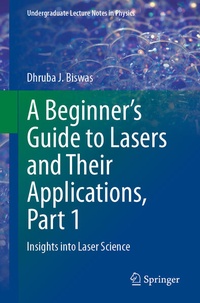
A Beginner's Guide to Lasers and Their Applications, Part 1
Insights into Laser Science
Published on 12. May 2023
XVI, 321 pages
978-3-031-24330-1 (ISBN)
Description

This two-volume book provides an enriching insight into the laser, covering different types of lasers, the basic science behind the technology, their role at the cutting-edge of current scientific research, and their wide-ranging applications. With just high school physics as a prerequisite and favoring qualitative yet scientifically sound explanations over high-level mathematics, this book is aimed at a broad spectrum of readers in physics, chemistry, engineering, medicine, and biology. Its engaging and lucid presentation is enhanced with plenty of illustrations, making the world of the laser accessible to undergraduate students in the sciences and any other inquisitive readers with high school physics under their belts. Furthermore, the text is often laced with anecdotes, picked from history, that are bound to pique the minds of the readers. It is ideal for self-study or as a complement to courses on optics and optoelectronics.
This volume, Part 1 of 2, explains the fundamentals of optics, what a laser is, how it works, and what is unique about the light it emits, from fundamental quantum theory through population inversion and cavity to common laser types.
It is followed by Part 2 which depicts the many advances in science enabled by the laser, including spectroscopy, nonlinear optics, optical cooling and trapping, and optical tweezers, among many others, and provides a glimpse into the ways that the laser affects our lives via its uses in medicine, manufacturing, the nuclear industry, energy, defence, communication, ranging, pollution monitoring, art conservation, fashion, beauty, and entertainment.
This volume, Part 1 of 2, explains the fundamentals of optics, what a laser is, how it works, and what is unique about the light it emits, from fundamental quantum theory through population inversion and cavity to common laser types.
It is followed by Part 2 which depicts the many advances in science enabled by the laser, including spectroscopy, nonlinear optics, optical cooling and trapping, and optical tweezers, among many others, and provides a glimpse into the ways that the laser affects our lives via its uses in medicine, manufacturing, the nuclear industry, energy, defence, communication, ranging, pollution monitoring, art conservation, fashion, beauty, and entertainment.
More details
Other editions
Additional editions
Dhruba J. Biswas
A Beginner's Guide to Lasers and Their Applications, Part 1
Insights into Laser Science
Book
05/2023
1st Edition
Springer
€64.19
Shipment within 15-20 days
Person
Dhruba Biswas
joined the laser program of Bhabha Atomic Research Centre (BARC), Mumbai, in 1979 after obtaining his M.Sc. (Physics) from the Indian Institute of Technology, Kharagpur. He later obtained his Ph.D. from Heriot Watt University, Edinburgh, UK, in 1986, under the supervision of his mentor Prof. Robert G. Harrison. His research work over the years has encompassed physics and technology of lasers, optical chaos, laser isotope separation, non-linear optics, laser assisted surface cleaning & modification. He has to date over a hundred peer reviewed research publications. While his work is commendable with respect to the new results that are of considerable academic value, it assumes greater significance as it involves technological innovations particularly appropriate from the point of view of a developing nation. He has been a recipient of a number of national and international awards, including the Indian National Science Academy Young Scientist Award in Physics, Indian National Science Academy A. K. Bose Memorial Award in Physical Sciences, N. S. Satyamurty Memorial Award of Indian Physics Association, Homi Bhabha Science & Technology Award of the Department of Atomic Energy, and Senior Associateship of the International Centre of Theoretical Physics, Trieste, Italy. He has presented numerous invited talks in national and international symposiums, and seminars, both technical and popular, in India, USA, and many countries across Europe. He has taught 'Laser Physics & Technology' course to both Physics trainees as well as all branches of engineering trainees of the BARC Training School for years nearly two decades.
Content
Chapter 1: Introduction.- Chapter 2: Behavior of light.- Chapter 3: Quantization of Energy.- Chapter 4: Lasers - At a Glance.- Chapter 5: Population Inversion and Consideration of Energy Levels of a lasing medium.- Chapter 6: Cavity and its Bearing on the Operation of Lasers.- Chapter 7: Continuous and Pulsed Lasers.- Chapter 8: Broadening of Gain and its Bearing on the Laser Subtleties.- Chapter 9: Boosting the Performance of a Pulsed Laser.- Chapter 10: Different Types of Lasers.- Chapter 11: Molecular gas lasers.- Chapter 12: Semiconductor lasers.
