

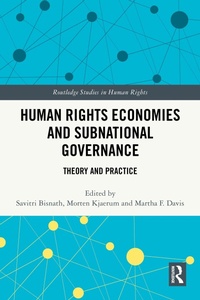
Human Rights Economies and Subnational Governance
Theory and Practice
Published on 22. December 2025
268 pages
978-1-040-63639-8 (ISBN)
Description

This book examines the understudied area of subnational human rights and the human rights economy.
Against the context of increasing economic and political power of local level governments - both cities and subnational regions - this interdisciplinary volume provides a crucial examination of economic policies that are grounded in human rights principles and obligations while being implemented in the places people live. Policies which promote economic justice and prosperity present many opportunities and challenges, and this book proposes ways in which local economic policies can respect, protect, and fulfil human rights, with positive multiplier effects at the national and global levels.
This book will be of keen interest to scholars, students, and practitioners in human rights, economics, law, development, and urban studies; as well as professionals and policymakers involved in local economic development planning and the implementation of human rights norms.
Against the context of increasing economic and political power of local level governments - both cities and subnational regions - this interdisciplinary volume provides a crucial examination of economic policies that are grounded in human rights principles and obligations while being implemented in the places people live. Policies which promote economic justice and prosperity present many opportunities and challenges, and this book proposes ways in which local economic policies can respect, protect, and fulfil human rights, with positive multiplier effects at the national and global levels.
This book will be of keen interest to scholars, students, and practitioners in human rights, economics, law, development, and urban studies; as well as professionals and policymakers involved in local economic development planning and the implementation of human rights norms.
Reviews / Votes
"This book is groundbreaking. Local governments, whether urban or rural, play a critical role in delivering public services, essential to the realization of economic, social, and cultural rights. By aligning their economic policies with human rights, local governments can significantly contribute to transforming economies for the benefit of people and the planet."Nada Youssef A. Al Nashif, UN Deputy High Commissioner for Human Rights
"A compelling and timely book that discusses whether the principle of "leave no one behind" can be realized by applying a human rights-based approach to the economic paradigms, particularly in cities? What roles do politics and administration as well as actors from business and civil society play? It is about community infrastructures for water, food and housing which should not be seen as commodities, but as resources available to all."
Shams Asadi, Human Rights Commissioner, Vienna, Austria
"This volume addresses a wide spectrum of economic issues related to human rights at the local level, exploring both familiar and less-examined topics. It is essential reading for anyone seeking to broaden their understanding of human rights while working to advance justice, equality, and sustainable development."
SHIN Gyonggu, Chair, World Human Rights Cities Forum Global Steering Committee; Executive Director, Gwangju International Center, South Korea
"An imaginative collection that will reinvigorate thinking on how economies can serve people and nature rather than the other way around and the role of human rights in that vital endeavour. The ideas, models, and case studies from around the world are locally conceived and operationalised, offering numerous ways of thinking and realising bottom-up change that could yet spur greater economic democracy. This is a novel and welcome work that will contribute to our collective efforts to begin anew."
Margot Salomon, Associate Professor of International Law and Human Rights, London School of Economics and Political Science, UK
"The sharply rising economic inequalities of income and wealth, as a result of neoliberal global economic policies, have undermined the social fabric and democratic coherence of our societies and led to the current polarization and radicalization. The editors and authors of this book counter this trend by arguing for human rights based economies to be implemented at the local level of human rights cities."
Manfred Nowak, Professor of International Law and Human Rights, University of Vienna, Austria, and Secretary General of the Global Campus of Human Rights, Venice, Italy
More details
Series
Language
English
Place of publication
London
United Kingdom
Publishing group
Taylor & Francis Ltd
Target group
College/higher education
Professional and scholarly
Product notice
Reflowable
Illustrations
1 Tables, black and white; 6 Line drawings, black and white; 6 Illustrations, black and white
File size
2,48 MB
ISBN-13
978-1-040-63639-8 (9781040636398)
Copyright in bibliographic data and cover images is held by Nielsen Book Services Limited or by the publishers or by their respective licensors: all rights reserved.
Schweitzer Classification
Other editions
Additional editions
Savitri Bisnath | Morten Kjaerum | Martha F. Davis
Human Rights Economies and Subnational Governance
Theory and Practice
Book
approx. 12/2025
1st Edition
Routledge
€206.60
Not yet published
Persons
Savitri Bisnath is Senior Director of Global Policy at the Institute of Race, Power and Political Economy at the New School, USA.
Morten Kjaerum is Adjunct Professor at the University of Aalborg, Denmark, and Affiliated Scholar at the Raoul Wallenberg Institute (RWI), Sweden.
Martha F. Davis is Distinguished Professor of Law and Co-director of the Center on Global Law & Justice at Northeastern University, USA. She is an affiliated scholar at the Raoul Wallenberg Institute, Sweden.
Morten Kjaerum is Adjunct Professor at the University of Aalborg, Denmark, and Affiliated Scholar at the Raoul Wallenberg Institute (RWI), Sweden.
Martha F. Davis is Distinguished Professor of Law and Co-director of the Center on Global Law & Justice at Northeastern University, USA. She is an affiliated scholar at the Raoul Wallenberg Institute, Sweden.
Content
Introduction: Towards local human rights economies Part 1: Human rights economy 1. Towards localised economic policies for people and the planet 2. Right to development and local economies 3. Scaling the human rights economy: Subnational engagements 4. Human rights economies and the role of local government public budgets Part 2: Local - National - International nexus 5. What human rights and the 5Rs can provide for the reform of the tax architecture at the global, national, and local levels 6. Biosphere defenders operationalising the prevention principle in climate adaptation through territorial planning 7. Water governance and human rights economies 8. Human rights as a key to unlock a just transition for the built environment 9. Human rights and spatial planning: Addressing the increasing tensions over access to land and resources Part 3: Subnational implementation of human rights economy 10. Towards the realisation of a human rights economy through human rights budgeting at local level 11. Devolution and the right to budgetary participation: Insights from subnational governments in Midlands Province, Zimbabwe 12. The role of local governments in upholding human rights and promoting economic justice: Addressing corruption and illicit financial flows 13. Municipal monies as policy tools to advance human rights economies 14. The racial wealth gap and localized solutions for promoting equality and justice
