

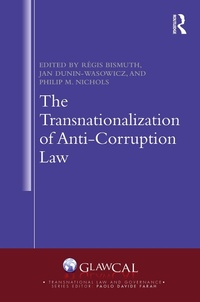
The Transnationalization of Anti-Corruption Law
1st Edition
Published on 27. May 2021
584 pages
978-1-000-38982-1 (ISBN)
Description

The last twenty years have witnessed an astonishing transformation: the fight against corruption has grown from a handful of local undertakings into a truly global effort. Law occupies a central role in that effort and this timely book assesses the challenges faced in using law as it too morphs from a handful of local rules into a global regime.
The book presents the perspectives of a global array of scholars, of policy makers, and of practitioners. Topics range from critical theoretical understandings of the global regime as a whole, to regional and local experiences in implementing and influencing the regime, including specific legal techniques such as deferred prosecution agreements, addressing corruption issues in dispute resolution, whistleblower protection, civil and administrative prosecutions, as well as blocking statutes. The book also includes discussions of the future shape of the global regime, the emergence of transnational compliance standards, and discussions by leaders of international organizations that take a leading role in the transnationalization of anti-corruption law.
The Transnationalization of Anti-Corruption Law deals with the most salient aspects of the global anti-corruption regime. It is written by people who contribute to the structure of the regime, who practice within the regime, and who study the regime. It is written for anyone interested in corruption or corruption control in general, anyone with a general interest in jurisprudence or in international law, and especially anyone who is interested in critical thinking and analysis of how law can control corruption in a global context.
The book presents the perspectives of a global array of scholars, of policy makers, and of practitioners. Topics range from critical theoretical understandings of the global regime as a whole, to regional and local experiences in implementing and influencing the regime, including specific legal techniques such as deferred prosecution agreements, addressing corruption issues in dispute resolution, whistleblower protection, civil and administrative prosecutions, as well as blocking statutes. The book also includes discussions of the future shape of the global regime, the emergence of transnational compliance standards, and discussions by leaders of international organizations that take a leading role in the transnationalization of anti-corruption law.
The Transnationalization of Anti-Corruption Law deals with the most salient aspects of the global anti-corruption regime. It is written by people who contribute to the structure of the regime, who practice within the regime, and who study the regime. It is written for anyone interested in corruption or corruption control in general, anyone with a general interest in jurisprudence or in international law, and especially anyone who is interested in critical thinking and analysis of how law can control corruption in a global context.
Reviews / Votes
Global anti-corruption laws have come (an impressively) long way since the enactment of the U.S. Foreign Corrupt Practices Act. To wit: in less than five decades, a single national law fighting foreign bribery spawned a true transnational application of anti-corruption laws. For practitioners and academics interested in the fascinating field of global anti-corruption laws, this timely, comprehensive and well researched book reviews different jurisdictions, and encourages new thinking and approaches. It is an outstanding read.Pascale Helene Dubois - Independent International Anti-Corruption Advisor. Adjunct Professor, Georgetown University Law Center. Former VP, Integrity, World Bank Group.
This publication sheds light on some of the cutting-edge issues raised by the globalisation of the fight again bribery, including: the parameters for multilateral enforcement actions, the way to account for cultural differences in shaping new standards and practices, and the effect of the transnationalization of anticorruption on trade dynamics. Bringing together authors from academia, international organizations, the private sector, as well as civil society organizations, this publication canvasses a wide range of perspectives, providing an invaluable contribution to the discussion.
Patrick Moulette, Head of the OECD Anti-Corruption Division
Elisabeth Danon, Legal Analyst at the OECD Anti-Corruption Division
The book co-edited by Regis Bismuth, Jan Dunin-Wasowicz and Philip Nichols is not only a recognition of how the anti-corruption landscape has evolved in the last twenty years but also charts some of the current and future challenges. Covering a wide range of different issues and combining the point of view of academics and practitioners, this collective book is a must read for anybody interested in understanding how corruption has become contrary to transnational public policy and what does this entails. But, further than that, it also indicates a path for the public international law of the XXIst century. An international law based on a combination of treaty law, jurisprudence and new forms of so called "soft" law through the adoption of instruments which, while non legally binding, represent politically stringent commitments difficult to ignore.
Nicola Bonucci, Paul Hastings LLP, Former OECD General Counsel
More details
Series
Edition
1. Auflage
Language
English
Place of publication
London
United Kingdom
Publishing group
Taylor & Francis Ltd
Target group
College/higher education
Illustrations
12 Tables, black and white; 6 Line drawings, black and white; 6 Illustrations, black and white
ISBN-13
978-1-000-38982-1 (9781000389821)
Copyright in bibliographic data and cover images is held by Nielsen Book Services Limited or by the publishers or by their respective licensors: all rights reserved.
Schweitzer Classification
Other editions
Additional editions
Regis Bismuth | Jan Dunin-Wasowicz | Philip M. Nichols
The Transnationalization of Anti-Corruption Law
Book
01/2023
1st Edition
Routledge
€65.70
Shipment within 10-20 days
Regis Bismuth | Jan Dunin-Wasowicz | Philip M. Nichols
The Transnationalization of Anti-Corruption Law
Book
05/2021
1st Edition
Routledge
€208.80
Shipment within 15-20 days
Persons
Regis Bismuth is Professor of Law at Sciences Po Law School, France.
Jan Dunin-Wasowicz is an anti-corruption and arbitration associate, Hughes Hubbard & Reed LLP, Paris, France.
Philip M. Nichols is the Joseph Kolodny Professor of Social Responsibility in Business and Professor of Legal Studies and Business Ethics at the Wharton School, University of Pennsylvania, USA.
Jan Dunin-Wasowicz is an anti-corruption and arbitration associate, Hughes Hubbard & Reed LLP, Paris, France.
Philip M. Nichols is the Joseph Kolodny Professor of Social Responsibility in Business and Professor of Legal Studies and Business Ethics at the Wharton School, University of Pennsylvania, USA.
Content
Foreword Preface 1. The transnationalization of anti-corruption law: an introduction and overview Part I: International, regional, and domestic sources of anti-corruption law: eclecticism or convergence? 2. The Americanization of international anti-corruption: the influence of the FCPA on the OAS and OECD conventions 3. Toward an interest group theory of foreign anti-corruption laws 4. Never waste a crisis: anti-corruption reforms in South America 5. The relevance of moral arguments against foreign bribery: Israel as a case study 6. France's new approach towards extraterritoriality in anti-corruption law: paving the way for a protective principle in economic matters? 7. Chinese multinational corporations' obligations in the global anti-corruption arena: levelling the playing field in Africa Part II: Traditional methods reconsidered 8. The failure of transnational anti-corruption law: civil law strategies reconsidered 9. The proliferation of international anti-corruption initiatives, standards, and guidelines: classification, benefits and shortcomings, future prospects 10. In the ocean of anti-corruption compliance standards and guidelines: time for codification? 11. State capture through corruption: how can human rights help? 12. Impact of corruption on the implementation of international law: an international criminal law perspective Part III: The new frontiers of compliance 13. Whistleblower protection: the next frontier in the transnationalization of anti-corruption law 14. The contract as anti-corruption platform for the global corporate sector 15. Linear and non-linear modeling techniques in transnational corruption risk assessment 16. Transnationalization of anti-corruption trainings Part IV: Anti-corruption considerations in international dispute resolution 17. Methodologies for proving corruption in arbitration: uses and limitations of red flags 18. The World Bank Group in international dispute resolution of fraud and corruption: examining the practice and jurisprudence of the Sanctions Board and ICSID Arbitral Tribunals 19. References to international anti-corruption conventions in international investment arbitration and international investment agreements Part V: Challenges in the transnational enforcement of anti-corruption laws 20. The global diffusion of DPAs: the not so functional remaking of the rules against business corruption 21. The impact of blocking statutes on the enforcement of anti-corruption laws 22. The search for synergies: the utopian ideal of cooperation between international anti-corruption mechanisms 23. In search of a tailored approach to anti-corruption sanctions in the international development context: financial remedies by the multilateral development banks
