

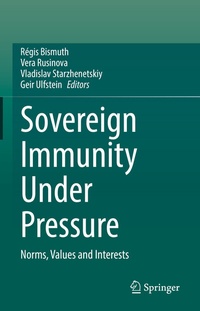
Sovereign Immunity Under Pressure
Description

This book offers a critical analysis of current challenges and developments of the State immunity regime through three dimensions: it looks at State immunity from a comparative perspective; it discusses the major trends relating to the interplay between State immunity and the protection of human rights as well as counter-terrorism; and it examines the relationship between State immunity and the financial obligations of States.
Part I, Sovereign Immunity from a Comparative Perspective: Weak v. Strong Immunity Regimes, deals with the diversity of existing regimes of State immunity at the national level. This part aims to explore different approaches of particular states to sovereign immunity and their general attitude to international law, and attempts to understand why some States favour a weaker State immunity regime by multiplying exceptions or interpreting them broadly, while others continuously support a stronger one and sometimes rely on the doctrine of absolute immunity.
Part II, International Customary Law of Sovereign Immunity, Human Rights and Counter-Terrorism, highlights how human rights and counter-terrorism have shaped the law and practice of sovereign immunity. This part specifically discusses the role of national legislators and judges in the development of international law, emerging conflicts between national constitutional norms and the rules of international law concerning State immunity and human rights, and possible ways of their reconciliation.
Part III, Sovereign Immunity of States and their Financial Obligations, contributes to on-going debates related to the mixed and complex nature of States' financial obligations. In this part, authors elaborate on perceptions of the underlying public-private law divide, cross influences in public and private international law and their consequences for State immunity, as well as recent trends relating to immunity from execution.
More details
Other editions
Additional editions
Persons
Vladislav Starzhenetskiy is an associate professor at the Chair of International Law, Faculty of Law, National Research University Higher School of Economics. He also serves as an academic director of the master's program 'Law of International Trade, Finance and Economic Integration' and researcher at the HSE Laboratory on Sanctions in International Law. From 1998 to 2014, he was working at the Russian Federation's Supreme Commercial Court and was heading the Department of International Law and Cooperation from 2011 to 2014. The main fields of his research interests include jurisdictional immunities of states, economic sanctions, international protection of intellectual property and international human rights law. He is a member of the editorial group of the journal International Justice .
Geir Ulfstein is a professor of international law in the Department of Public and International Law and co-director of PluriCourts - Centre for the Study of the Legitimate Roles of the Judiciary in the Global Order. Geir was co-chair of the International Law Association's study group on the content and evolution of the rules of interpretation, and is chair of the Scientific Advisory Board, Max Planck Institute for Procedural Law, Luxembourg. Geir has been a member of the Executive Board of the European Society of International Law (2010-2016). He is president of the Norwegian Branch of the International Law Association (ILA) and member of the Norwegian Academy of Science and Letters.