

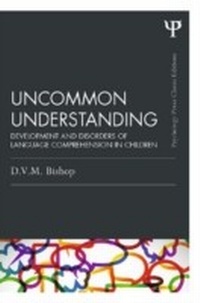
Uncommon Understanding (Classic Edition)
Development and disorders of language comprehension in children
1st Edition
Published on 14. March 2014
368 pages
978-1-134-60718-1 (ISBN)
Description

This is a Classic Edition of Dorothy Bishop's award-winning textbook on the development of language comprehension, which has been in print since 1997, and now includes a new introduction from the author. The book won the British Psychological Society book award in 1999, and is now widely seen as a classic in the field of developmental language disorders.
Uncommon Understanding provides a comprehensive account of the process of comprehension, from the reception of an acoustic signal, to the interpretation of communicative intentions, and integrates a vast field of research on language acquisition, psycholinguistics and neuropsychology. In the new introduction Dorothy Bishop reflects on the organization of the book, and developments in the field since the book was first published.
A major theme in the book is that comprehension should not be viewed as a unitary skill - to understand spoken language one needs the ability to classify incoming speech sounds, to relate them to a "mental lexicon," to interpret the propositions encoded by word order and grammatical inflections, and to use information from the environmental and social context to grasp an intended meaning. Another important theme is that although neuropsychological and experimental research on adult comprehension provides useful concepts and methods for assessing comprehension, it should be applied with caution, because a sequential, bottom-up information processing model of comprehension is ill-suited to the developmental context.
Although the main focus of the book is on research and theory, rather than practical matters of assessment and intervention, the theoretical framework presented in the book will continue to help clinicians develop a clearer understanding of what comprehension involves, and how different types of difficulty may be pin-pointed.
Uncommon Understanding provides a comprehensive account of the process of comprehension, from the reception of an acoustic signal, to the interpretation of communicative intentions, and integrates a vast field of research on language acquisition, psycholinguistics and neuropsychology. In the new introduction Dorothy Bishop reflects on the organization of the book, and developments in the field since the book was first published.
A major theme in the book is that comprehension should not be viewed as a unitary skill - to understand spoken language one needs the ability to classify incoming speech sounds, to relate them to a "mental lexicon," to interpret the propositions encoded by word order and grammatical inflections, and to use information from the environmental and social context to grasp an intended meaning. Another important theme is that although neuropsychological and experimental research on adult comprehension provides useful concepts and methods for assessing comprehension, it should be applied with caution, because a sequential, bottom-up information processing model of comprehension is ill-suited to the developmental context.
Although the main focus of the book is on research and theory, rather than practical matters of assessment and intervention, the theoretical framework presented in the book will continue to help clinicians develop a clearer understanding of what comprehension involves, and how different types of difficulty may be pin-pointed.
Reviews / Votes
Praise for the 1st Edition:Uncommon Understanding is a comprehensive and authoritative analysis of research and theory within the important field of children's language comprehension and disorders. Dr Bishop has admirably met the challenge of bringing together and critically but even-handedly evaluating what is undoubtedly a vast body of complex, and at times disparate and even conflicting, knowledge and research. - Valerie Muter, Great Ormond Street Hospital in Journal of Child Psychology and Psychiatry
This is an excellent book. Everyone who has an interest in understanding language development should read this book and many readers will want to keep a copy of the book on their shelf for reference. Students of language disorders will find here a brilliant summary of the issues and analyses that are shaping their field. Students of normal development can use this book as a way of gaining a better understanding of the ways in which the intricate structure of language learning can become unbraided. - Brian MacWhinney, Carnegie Mellon University in Developmental Review
This is an absolutely excellent book! In a well-argued review, Bishop provides an admirably clear and incisive account of specific language impairment, displaying a remarkable blend of scholarship and clinical insight. In my view, the book cannot be faulted and will become a classic in the field of developmental language disorders." - Margaret J. Snowling, University of York, UK
This book is excellently written. Dorothy Bishop manages to combine discussing pertinent and controversial theoretical accounts of SLI with giving a clear presentation of empirical results and an introduction to basic terms of linguistic theory and psychological testing. The book is suited to researchers, students, teachers, and practitioners alike. - Gisela Szagun, University Oldenburg, in International Journal of Behavioral Development
More details
Series
Language
English
Place of publication
London
United Kingdom
Publishing group
Taylor & Francis Ltd
Target group
College/higher education
Illustrations
90 s/w Abbildungen, 30 s/w Tabellen, 90 s/w Zeichnungen
30 Tables, black and white; 90 Line drawings, black and white; 90 Illustrations, black and white
File size
11,53 MB
ISBN-13
978-1-134-60718-1 (9781134607181)
Copyright in bibliographic data and cover images is held by Nielsen Book Services Limited or by the publishers or by their respective licensors: all rights reserved.
Schweitzer Classification
Other editions
Additional editions
Dorothy V. M. Bishop
Uncommon Understanding (Classic Edition)
Development and disorders of language comprehension in children
Book
07/2013
1st Edition
Psychology Press Ltd
€207.30
Shipment within 3-4 weeks
Dorothy V. M. Bishop
Uncommon Understanding (Classic Edition)
Development and disorders of language comprehension in children
Book
07/2013
1st Edition
Psychology Press Ltd
€79.30
Shipment within 3-4 weeks
Person
Dorothy Bishop is Professor of Developmental Neuropsychology and a Wellcome Trust Principal Research Fellow at the Department of Experimental Psychology at the University of Oxford.
Content
Preface to the Classic Edition. Foreword. 1. From Sound to Meaning: A Framework for Analysing Comprehension. 2. Specific Language Impairment. 3. Speech Perception. 4. Understanding Word Meaning. 5. Grammatical Knowledge in Sentence Comprehension. 6. Understanding Sentences in Real Time. 7. Understanding Discourse: Integrating Language and Context. 8. Understanding Intended Meaning: Social Aspects of Comprehension. 9. Modularity and Interaction in Language Development and Disorders.
