

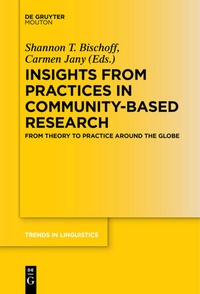
Insights from Practices in Community-Based Research
Description

Free Access in January 2019
There has been an increasing interest in the emerging subfield within linguistics and anthropology often referred to as community-based research (Himmelmann 1998, Rice 2010, Crippen and Robinson 2013, among others). This volume brings together perspectives from academics, community members, and those that find themselves in both academia and the community. The volume begins with a working definition of the notions of community-based research as a practice and illustrates how such notions shifted, without abandoning the outlined tenets within the working definition, as the chapters developed to include notions of community-based research as a tool and ideology as well as an orientation. Each of the 17 chapters represents a case-study with the first five including discussions of broader issues and theoretical perspectives while exploring community-based research as an emerging subfield within linguistics. The case-studies comprise work from the Americas, Australia, India, Europe, and Africa. The goal of the volume is to build on the emerging literature and practices in the field to arrive at a better understanding of how community-based research is theorized and practiced in a variety of environments, communities, and cultures.
More details
Other editions
Additional editions
Persons
Shannon Bischoff , Purdue University Fort Wayne, IN, USA; Carmen Jany , California State University, San Bernardino, CA, USA.
Content
- Intro
- Contents
- Introduction
- Collaborative research: Visions and realities
- When Participatory Action Research (PAR) and (Western) Academic Institutional Policies do not align
- Consultation, relationship and results in community-based language research
- Creating sustainable models of language documentation and revitalization
- Slowly, slowly said the jaguar: Collaborations as a goal of linguistic field research over time
- The Koasati Language Project: A collaborative, community-based language documentation and revitalization model
- Full collaboration of native speaker and linguist, working together for language revitalization
- Participatory action research for Indigenous linguistics in the digital age
- Implementing collaborative research in Blackfoot language instruction
- 100 years of analyzing Coeur d'Alene with the community
- Creating learning materials and teaching materials for language revitalization: The case of Mutsun
- Collaborative research and assessment in Kaqchikel
- The collaborative process in a Wounaan meu language documentation project
- Babanki literacy classes and community-based language research
- Exploring new research perspectives on African cultures through language documentation
- The field is not the lab, and the lab is not the field: Experimental linguistics and endangered language communities
- Transforming the landscape of language revitalization work in Australia: The Documenting and Revitalising Indigenous Languages training model
- Index
