

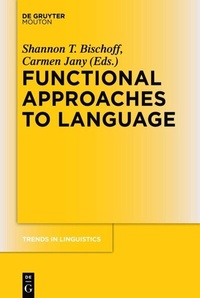
Functional Approaches to Language
Description

Functionalism, as characterized by Allen, (2007:254) "holds that linguistic structures can only be understood and explained with reference to the semantic and communicative functions of language, whose primary function is to be a vehicle for social interaction among human beings." Since the 1970s, inspired by the work of Jespersen, Bolinger, Dik, Halliday, and Chafe, functionalism has been attached to a variety of movements and models making major contributions to linguistic theory and to various subfields within linguistics, such as syntax, discourse, language acquisition, cognitive linguistics, typology, and documentary linguistics. Further, functional approaches have had a major impact outside linguistics in fields such as psychology and education, both in terms of theory and application. The main goal of functionalist approaches is to clarify the dynamic relationship between form and function (Thompson 2003:53). Functionalist perspectives have gained more ground over the past decades with more linguists resorting to functional explanations to account for linguistic structure. The authors in this volume present the current state of functional approaches to linguistic inquiry expanding our knowledge of language and linguistics.
More details
Other editions
Additional editions
Persons
Content
1.1 - 1 Introduction [Seite 9]
1.2 - 2 The Volume Papers [Seite 11]
1.3 - Acknowledgments [Seite 16]
1.4 - References [Seite 16]
2 - On the Intellectual Roots of Functionalism in Linguistics [Seite 17]
2.1 - 1 Antiquity [Seite 17]
2.2 - 2 Middle Ages to the 19th Century [Seite 19]
2.3 - 3 The 19th Century [Seite 20]
2.4 - 4 Structuralism [Seite 20]
2.5 - 5 Chomsky [Seite 23]
2.6 - 6 The 1970's pragmatic synthesis [Seite 25]
2.7 - References [Seite 31]
3 - Functional Explanation and its Uses [Seite 39]
3.1 - 1 Preliminary Remarks [Seite 39]
3.2 - 2 Explaining the Zero in Verb Morphology [Seite 39]
3.3 - 3 Explaining Grammatical Asymmetries and Hierarchies [Seite 47]
3.4 - 4 Explaining Grammaticalization [Seite 54]
3.5 - 5 Additional Examples of Typological Explanation [Seite 58]
3.6 - 6 Explanations: From Typological via Teleological to Rational [Seite 62]
3.7 - 7 Sense-Perception and Its Complementary Notions: Introspection < Empathy < Intuition [Seite 66]
3.8 - 8 In Which Sense Do Typological Explanations Qualify as Functional? [Seite 68]
3.9 - 9 What Other Types of Explanation May Be Needed? [Seite 73]
3.10 - 10 Conclusion [Seite 74]
3.11 - References [Seite 74]
4 - Structure and Function: A Niche-Constructional Approach [Seite 79]
4.1 - 1 Introduction [Seite 79]
4.2 - 2 Linguistics and evolutionary theory [Seite 81]
4.3 - 3 The structuralist-functionalist dichotomies - in the light of nicheconstructional evolution [Seite 93]
4.4 - 4 Conclusion [Seite 110]
4.5 - References [Seite 111]
5 - Toward a Thought-Based Linguistics [Seite 115]
5.1 - 1 Language function [Seite 115]
5.2 - 2 Looking through the wrong end of the telescope [Seite 116]
5.3 - 3 What are thoughts anyway? [Seite 117]
5.4 - 4 Two views of language design [Seite 120]
5.5 - 5 Thought structure [Seite 121]
5.6 - 6 From thoughts to a semantic structure [Seite 123]
5.7 - 7 From semantics to syntax [Seite 127]
5.8 - 8 From syntax to phonology and sounds [Seite 129]
5.9 - 9 Thought and language as a continuous flow [Seite 130]
5.10 - 10 Does language shape thoughts? [Seite 130]
5.11 - 11 Interdisciplinary convergence [Seite 132]
5.12 - 12 Summary [Seite 135]
5.13 - References [Seite 136]
6 - Changing Language [Seite 139]
6.1 - 1 Introduction [Seite 139]
6.2 - 2 Syntactic Adaptations [Seite 141]
6.3 - 3 Phonological Adaptations [Seite 147]
6.4 - 4 What Kind of Learning System? [Seite 153]
6.5 - 5 Concluding Remarks [Seite 156]
6.6 - References [Seite 157]
7 - An Outline of Discourse Grammar [Seite 163]
7.1 - 1 Introduction [Seite 163]
7.2 - 2 Discourse Grammar [Seite 164]
7.3 - 3 The two main domains of DG [Seite 166]
7.4 - 4 The categories of TG [Seite 171]
7.5 - 5 Non-restrictive meaning and the situation of discourse [Seite 190]
7.6 - 6 Cooptation [Seite 193]
7.7 - 7 Types of theticals [Seite 195]
7.8 - 8 Earlier accounts [Seite 198]
7.9 - 9 Conclusions [Seite 202]
7.10 - Abbreviations [Seite 205]
7.11 - Acknowledgements [Seite 205]
7.12 - References [Seite 206]
8 - Towards an Experimental Functional Linguistics: Production [Seite 215]
8.1 - 1 Introduction [Seite 215]
8.2 - 2 Why do experiments? [Seite 215]
8.3 - 3 Why study production? [Seite 219]
8.4 - 4 The observer's paradox and the 'design space' of functional language production experiments [Seite 220]
8.5 - 5 Beyond recipient design: Strategies, choices, and brain-traps [Seite 222]
8.6 - 6 Two things that functional linguists need to know about how the brain works: Lexical and structural priming [Seite 225]
8.7 - 7 Experiments and their design [Seite 230]
8.8 - 8 Conclusion [Seite 247]
8.9 - Acknowledgements [Seite 248]
8.10 - References [Seite 248]
9 - Index [Seite 255]
